


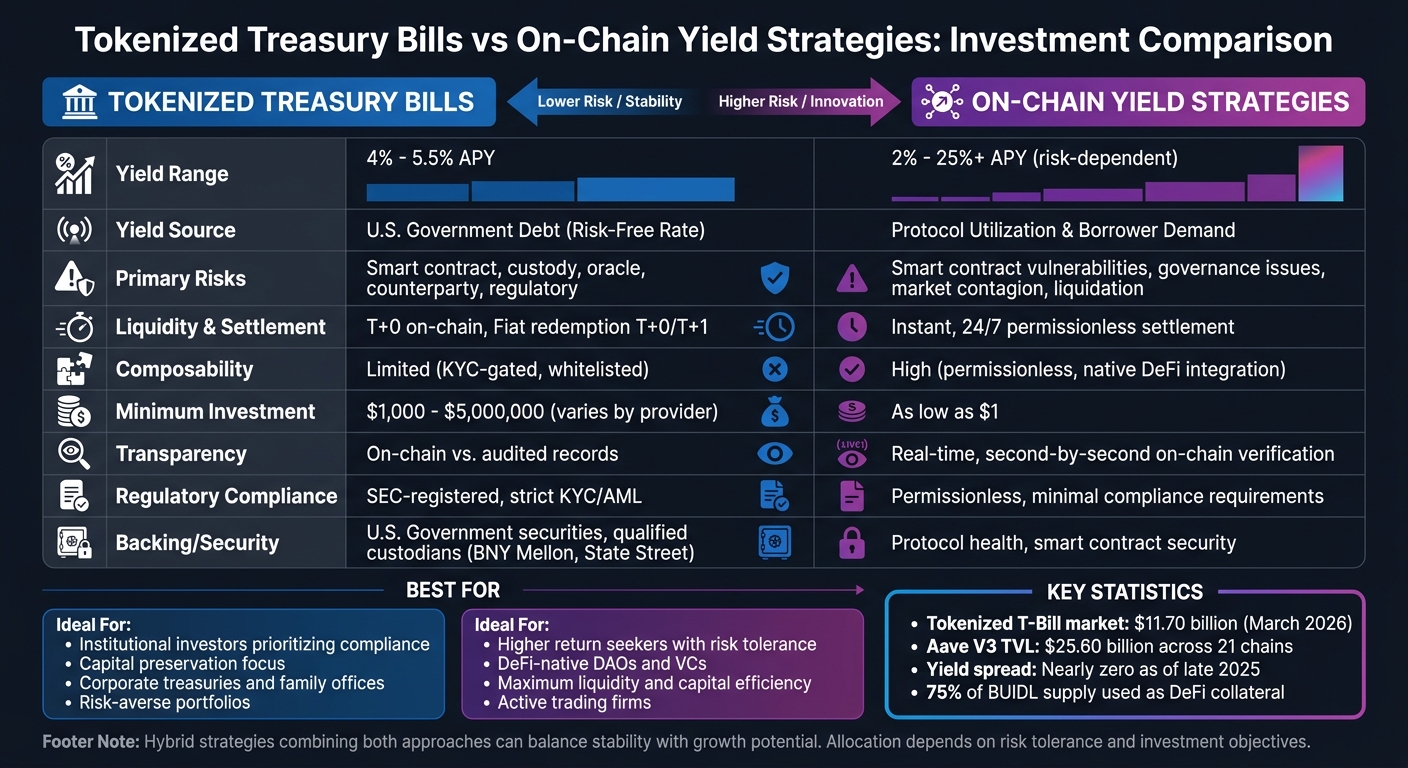
Tokenized Treasury Bills (T-bills) and on-chain yield strategies are two key investment options in the blockchain space, each offering distinct benefits and risks. Tokenized T-bills are digital representations of U.S. government debt, providing stable yields (4%-5.5% APY) and near-instant settlement (T+0), backed by government securities. On-chain yield strategies, on the other hand, leverage decentralized finance (DeFi) mechanisms like lending, liquidity pools, and staking, offering higher potential returns (up to 15%-25%) but with greater risks, including smart contract vulnerabilities and market volatility.
Key Highlights:
- Tokenized T-bills: Low risk, government-backed, high liquidity, but limited composability and higher entry thresholds.
- On-chain yield: Higher returns, 24/7 settlement, and composability, but subject to protocol health and smart contract risks.
Quick Comparison
| Feature | Tokenized T-Bills | On-Chain Yield Strategies |
|---|---|---|
| Yield | 4%-5.5% APY | 2%-25%+ depending on risk |
| Primary Risk | Smart contract, custody, oracle | Smart contract, governance, market |
| Liquidity | T+0, fiat redemption T+0/T+1 | Instant, permissionless |
| Composability | Limited (KYC/whitelisted) | High (DeFi integration) |
| Institutional Appeal | Regulatory compliance, stability | Higher yield, flexible use cases |
For investors, combining these options can balance stability and growth. Tokenized T-bills suit those prioritizing safety and compliance, while on-chain strategies fit those seeking higher returns with manageable risks.
Tokenized Treasury Bills vs On-Chain Yield Strategies Comparison
The Next Generation of Tokenized RWA Yields in DeFi
sbb-itb-c5fef17
1. Tokenized Treasury Bills
As institutional investors look for ways to maximize returns within the blockchain ecosystem, tokenized Treasury bills (T-bills) present an option that combines familiarity with a modern twist.
Yield Potential
Tokenized T-bills replicate the returns of traditional Treasury instruments, offering annual yields of 4%-5.5% as of early 2026 [1][2]. Unlike traditional T-bills, which pay semi-annual coupons, these digital assets provide daily or weekly accruals. This distribution happens through two main mechanisms: rebasing, where token balances increase daily, or accumulation, where the net asset value (NAV) grows over time [1].
For instance, Franklin Templeton‘s OnChain U.S. Government Money Fund (FOBXX) amassed $557 million in assets by February 2026, delivering a 5.1% yield [2]. Similarly, BlackRock‘s BUIDL fund reached $2.9 billion in assets under management (AUM) by mid-2025. The BUIDL fund maintains a stable $1.00 NAV and pays daily dividends in the form of new tokens [3]. These yields are competitive with decentralized finance (DeFi) lending platforms like Aave, where USDC lending rates hover around 4.57% – but with the added security of being backed by U.S. government securities [6].
Let’s dive into the technical risks associated with these instruments.
Risk Profile
While traditional T-bills are considered risk-free, their tokenized counterparts introduce some unique risks. These include vulnerabilities in smart contracts, inaccuracies in price oracles, and counterparty risks. To mitigate these, tokenized T-bills are typically structured with legal safeguards such as Special Purpose Vehicles (SPVs) or funds. Additionally, qualified custodians like BNY Mellon or State Street secure the physical assets, while smart contracts automate yield distribution [4].
For example, OpenEden appointed BNY Mellon as the investment manager and custodian for its TBILL fund in August 2025, ensuring institutional-grade segregated custody [5]. Despite the technical risks, the underlying assets remain U.S. government securities, making them an attractive option for institutions bound by fiduciary responsibilities.
Liquidity Characteristics
Tokenized T-bills bring a significant advantage in liquidity. Unlike traditional T-bills, which settle in T+1 or T+2 (one or two business days), tokenized versions offer T+0 settlement [4]. This means transactions are settled instantly. Additionally, these instruments facilitate 24/7 trading and settlement, a stark contrast to traditional financial markets that operate only during business hours [4].
Platforms like Ondo Finance (OUSG) provide instant redemptions at any time, leveraging integrations with BlackRock’s BUIDL fund. Meanwhile, Franklin Templeton’s BENJI fund supports T+0 redemptions during business days [2].
"The tokenization thesis is that distributed ledger technology, by enabling atomic settlement and continuous yield accrual, makes this liquidity tax optional for the first time."
- AltStreet Research [3]
Secondary market liquidity is also enhanced through integration with DeFi platforms. For example, in mid-2025, OpenEden and Ceffu launched cUSDO, the first yield-bearing collateral accepted on Binance‘s MirrorRSV platform. This allowed institutional traders to earn Treasury yields while using these tokens as collateral [5]. Such flexibility makes tokenized T-bills a valuable tool for DeFi protocols and exchange collateral systems [3].
Suitability for Institutional Investors
Tokenized T-bills are particularly appealing to institutions due to their compliance with strict regulatory frameworks and operational efficiency. Providers of these instruments operate as SEC-registered funds and enforce Know Your Customer (KYC) and Anti-Money Laundering (AML) requirements, aligning with institutional needs [2]. Entry thresholds vary: BlackRock’s BUIDL fund requires a minimum investment of $5 million, while Franklin Templeton’s BENJI fund has a more accessible entry point of $1,000 [7].
The market for tokenized Treasury bills has grown rapidly, reaching $11.70 billion by March 2026. Circle’s USYC captured 20.87% of the market, followed by Securitize’s BUIDL at 18.08% and Ondo at 17.06% [5]. Notably, the adoption of Hashnote’s USYC by the Usual protocol in late 2024 drove the token’s market value from $240 million to over $1.2 billion in just three months [5]. This growth highlights the appeal of earning the "risk-free rate" while staying within the blockchain ecosystem – a key strategy for corporate treasurers and DAOs seeking to optimize idle stablecoin reserves [4].
2. On-Chain Yield Strategies
Tokenized T-bills bring traditional government debt into the digital realm, while on-chain yield strategies generate returns directly within decentralized finance (DeFi) ecosystems. These strategies operate independently of traditional financial instruments, offering distinct mechanisms for yield generation. Below, we’ll dive into their yield potential, associated risks, liquidity features, and their appeal to institutional investors.
Yield Potential
On-chain yield strategies draw returns from several sources. For instance, lending interest spreads occur when users borrow assets for leverage or hedging purposes. Aave V3, a prominent platform, reported $25.60 billion in total value locked (TVL) across 21 chains as of early 2026 [8]. Decentralized exchanges (DEXs) and concentrated liquidity market maker (CLMM) pools also create opportunities for liquidity providers to earn trading fees from genuine trading activity [10,12]. Additionally, network validation rewards, obtained through liquid staking and restaking protocols, contribute to yield while supporting blockchain security [8].
"The institutional stablecoin market has crossed $300 billion in total market capitalization as of early 2026. Yet the question most treasurers and allocators struggle to answer is deceptively simple: where does the yield actually come from?" – Conner Romanov, Founder, ArkenYield [10]
The level of yield depends on the associated risk. Low-risk strategies, such as ETH staking and lending with top-tier assets, typically yield between 2%–5% annually. Medium-risk approaches, including cross-chain lending and concentrated liquidity provision, often generate returns in the 5%–12% range. Higher-risk strategies, involving new protocol token emissions and leverage, can exceed 12% [8]. Basis trading, which captures funding rate payments from leveraged positions, averages around 10.95% annually but can spike to 50%–100% during bullish markets [10].
Recent examples highlight the evolving landscape. In January 2026, Maple Finance launched syrupUSDC on the Base network, integrating it into Aave V3 with a 90% loan-to-value (LTV) ratio. The initial $50 million cap was swiftly filled, enabling institutions to borrow against credit-yielding collateral [10]. Similarly, the Janus Henderson Anemoy AAA CLO fund, which targets floating-rate yields above 5% by securitizing senior-secured loans, surpassed $1 billion in assets under management (AUM) by February 2026, tripling its on-chain assets since mid-2025 [9]. While these yield sources are diverse, they come with distinct risks.
Risk Profile
Despite the appeal of high returns, on-chain strategies are not without challenges. Smart contract vulnerabilities are a major concern, as coding errors or exploits can result in significant financial loss. Governance issues also pose risks; for instance, when BGD Labs ceased contributing to Aave, questions arose about the platform’s future interest rate models and collateral policies [8]. Additionally, many early DeFi projects relied on inflationary token emissions, which can undermine long-term sustainability compared to models based on actual revenue from fees and interest [8]. The industry is now shifting toward "real yield", where returns are tied to genuine protocol revenue streams.
Another key challenge is the "oracle problem", where discrepancies between off-chain asset values and on-chain prices can lead to inaccuracies. Solutions like Chainlink’s Proof of Reserve aim to enhance transparency and reliability [2]. Unlike tokenized T-bills, which are backed by U.S. government securities, on-chain strategies depend on the health of the protocol, liquidity conditions, and the robustness of smart contracts.
Liquidity Characteristics
On-chain yield strategies offer the advantage of 24/7 T+0 settlement, enabling faster and more flexible operations in decentralized markets. The ERC-4626 vault standard further enhances utility by allowing yield-bearing tokens to serve as collateral across multiple protocols without requiring custom integrations [3]. In early 2025, Standard Chartered and OKX introduced a collateral mirroring program, enabling institutional traders to retain tokenized money market fund assets in regulated custody while simultaneously using them as collateral for trading. This setup reduced custodial risk while ensuring yield accumulation [3]. However, during periods of market stress, DeFi liquidity can face challenges such as widened spreads and withdrawal restrictions [12]. These liquidity dynamics are crucial when assessing institutional suitability.
Suitability for Institutional Investors
For institutions, combining on-chain strategies with tokenized T-bills can enhance portfolio performance within the blockchain space. Institutional investors are increasingly drawn to on-chain yield strategies but often prefer non-rebasing models. These models align with traditional fund accounting, as token prices increase with net asset value (NAV), simplifying tax considerations [3]. As institutional capital flows into DeFi, yields are gradually aligning with traditional finance rates, albeit with an added risk premium [8]. This trend makes on-chain strategies more comparable to conventional investments while retaining benefits like continuous access, real-time transparency, and high composability.
"Institutional capital flows are reshaping DeFi yield structures, with traditional finance giants like BlackRock entering the space." – Fensory Insights [8]
Pros and Cons
When it comes to optimizing Web3 allocation models, tokenized T-bills and on-chain yield strategies each bring distinct benefits and challenges for institutional investors.
Tokenized T-bills provide stable yields of approximately 4.7%, backed by U.S. government securities, and are structured with stringent KYC/AML compliance [6]. Their standout advantage is the low counterparty risk and alignment with regulatory requirements [14]. However, these benefits come with some drawbacks, including limited composability due to whitelisting, high minimum investment thresholds (ranging from $1,000 to $5,000,000) [15], and delays in converting to fiat currency [13].
On-chain yield strategies, on the other hand, offer instant, 24/7 settlement and high composability without KYC barriers, making them accessible with investments as low as $1 [15]. Yields averaged 4.8% in late 2025 but can surge to 15–25% during periods of high protocol activity [6]. However, these strategies carry risks such as potential smart contract vulnerabilities, governance challenges, and exposure to market contagion [3]. Unlike the predictable returns of tokenized T-bills, DeFi yields depend entirely on the health and security of the underlying protocols.
Here’s a breakdown of their key features:
| Feature | Tokenized Treasury Bills | On-Chain Yield (DeFi) |
|---|---|---|
| Yield Source | U.S. Government Debt (Risk-Free Rate) [11] | Protocol Utilization & Borrower Demand [6] |
| Primary Risk | Counterparty, Custodial, Regulatory [13] | Smart Contract, Liquidation, Governance [6] |
| Liquidity | High (On-chain), but Fiat Redemption is T+0/T+1 [13] | Instant, 24/7 Permissionless Settlement [6] |
| Composability | Limited (KYC-gated, Whitelisted) [14] | High (Permissionless, Native DeFi integration) [6] |
| Transparency | On-chain vs. audited records [11] | Real-time, Second-by-second On-chain Verification [6] |
As of late 2025, with yield spreads narrowing to nearly zero, investors are increasingly focused on balancing risk tolerance with operational requirements [6]. Institutions that prioritize regulatory safeguards often lean toward tokenized T-bills, while those aiming for maximum liquidity and capital efficiency gravitate toward DeFi strategies.
These considerations set the stage for refining allocation strategies, which will be discussed in the next section.
Portfolio Allocation Models
Portfolio allocation models serve as a roadmap for blending assets into a well-balanced investment strategy. One widely used method is the Equal Weighted Ladder, where investors evenly distribute capital across 1-, 3-, 6-, and 12-month Treasury tenors, rolling over positions monthly. This strategy ensures consistent liquidity and captures average yields across the curve. However, it does come with moderate risk. For instance, during the 2022 rate-hike cycle, investors focusing exclusively on 12-month Treasury bills saw drawdowns as steep as 190 basis points [16].
For those seeking a more adaptive approach, the Dynamic Treasuries Strategy offers flexibility by adjusting allocations based on shifts in the yield curve and Federal Reserve policy. This strategy outperforms static "Buy and Hold" models by reallocating to shorter-duration bills, such as 1-month Treasuries, in rising-rate environments. This adjustment minimizes price erosion while delivering steady returns. Institutions aiming to minimize volatility often favor the 1-month roll strategy, which has shown near-zero drawdowns compared to longer-term tenors [16].
Hybrid looping strategies add another layer of return potential but come with added complexity. In this model, investors use tokenized Treasury bills – such as BlackRock’s BUIDL or Ondo’s OUSG – as collateral in DeFi platforms like Aave. They borrow stablecoins against these assets and reinvest the borrowed capital into yield-farming opportunities. This approach can boost returns to an impressive 20–50% APY, though it introduces risks like smart contract vulnerabilities and liquidation threats. By late 2025, approximately 75% of the total BUIDL supply was actively utilized as collateral in DeFi protocols [9], highlighting growing institutional interest in these capital-efficient models.
Bestla VC advocates for hybrid strategies to balance risk management with yield potential in institutional portfolios. Their framework often uses tokenized Treasury bills as a risk-free benchmark (yielding 4–5.5% APY) [1][2], allocating 20–50% of treasury holdings to these assets. The remaining portfolio typically targets higher-yield instruments, such as Collateralized Loan Obligations (CLOs), which offer floating rates exceeding 5% – a particularly attractive option as the Federal Reserve begins to lower rates [9].
Operational efficiency is just as critical as yield generation. Investors are encouraged to use accumulating token structures, like Circle’s USYC, where interest automatically accrues within the token balance. This simplifies margin and derivatives management. Additionally, selecting providers that use Chainlink Proof of Reserve ensures consistency between on-chain and off-chain assets [2], reducing both operational overhead and counterparty risks. These models provide a practical foundation for institutions aiming to maximize returns while navigating the complexities of Web3 portfolios.
Conclusion
Balancing tokenized Treasury bills with on-chain yield strategies involves tailoring your allocation to fit both your risk tolerance and investment objectives. Tokenized Treasuries provide a steady yield of around 4–5.5% APY with low volatility, acting as the on-chain equivalent of a risk-free benchmark. On the other hand, alternative strategies, such as collateralized loan obligations (CLOs), can offer returns exceeding 20%, though these come with added risks that require careful management. Together, these tools can create a robust Web3 portfolio.
Your strategy should align with your primary goals. For instance, corporate treasuries and family offices prioritizing capital preservation may focus on SEC-registered money market funds like BlackRock BUIDL or Franklin Templeton’s FOBXX. These funds offer regulatory clarity and familiar accounting structures [3]. Meanwhile, active trading firms might benefit from collateral mirroring to maintain margin efficiency without moving assets into exchange wallets. In 2025, Standard Chartered and OKX introduced a program allowing institutions to keep tokenized money market fund assets in regulated custody while using their value as trading collateral on-exchange [3]. Similarly, DeFi-native DAOs and venture capital firms can leverage ERC-4626 permissioned vaults, like Ondo OUSG, for 24/7 programmable liquidity and seamless cross-protocol integration [3]. These tools enable tailored approaches for varying institutional needs.
Hybrid strategies take this a step further, blending tokenized Treasuries’ stability with higher-yield alternatives. These approaches dynamically reallocate assets based on market conditions. For example, the Janus Henderson Anemoy AAA CLO fund saw its assets under management triple to over $1 billion in six months during late 2025 as interest rates fell, demonstrating how investors shift toward yield-enhancing opportunities to outperform the risk-free rate [9]. This dynamic reallocation, combined with features like atomic settlement and continuous yield accrual, ensures idle capital becomes productive.
For corporate treasuries managing significant funds – say, $500 million – keeping settlement buffers idle could mean losing up to $4.4 million annually [3]. Tokenization infrastructure eliminates this inefficiency while maintaining the security and compliance standards required by institutional investors. Ultimately, choosing the right instruments depends on whether your focus is capital preservation, operational efficiency, or yield optimization.
FAQs
How do tokenized T-bills earn yield on-chain?
Tokenized T-bills provide a way to earn yield on the blockchain by representing ownership in short-term U.S. Treasury securities. Here’s how it works: investors buy blockchain-based tokens, and the funds are used to invest in Treasury bills with maturities of less than a year. The yield is distributed in two ways – either by increasing the token balance (known as rebasing) or by boosting the redemption value (called accumulating). These tokens come with some notable perks, like blockchain transparency, round-the-clock access, and returns that closely align with Treasury rates, generally ranging from 4% to 5.5%.
What’s the biggest risk in DeFi yield strategies?
The biggest concern with DeFi yield strategies is smart contract risk. This happens when vulnerabilities in the protocol’s code create opportunities for losses. On top of that, investors face the challenge of impermanent loss, which can occur during periods of market volatility, making it another key risk to watch out for in this space.
How much should I allocate to tokenized T-bills vs DeFi yield?
The best way to allocate your investments depends on your personal risk tolerance, financial goals, and the current market environment. Tokenized T-bills provide a stable, low-volatility option with "risk-free" yields between 4% and 4.9%, backed by U.S. government debt – making them ideal for those seeking reliability. On the other hand, DeFi yields can range from 4.8% to over 35%, but they come with higher risks, such as smart contract vulnerabilities.
For a balanced strategy, you might consider allocating 70–80% to tokenized T-bills for steady returns and 20–30% to DeFi to capture the potential for higher gains. This mix offers a way to balance stability with growth opportunities.