


Cross-chain yield aggregation is transforming how family offices manage decentralized finance (DeFi) investments. By spreading capital across multiple blockchain networks, this strategy aims to balance higher returns with risk management. However, it comes with challenges like smart contract vulnerabilities, bridge exploits, and regulatory hurdles.
Here’s what you need to know:
- Why It Matters: Family offices increasingly allocate 2-5% of their portfolios to digital assets, seeking diversification and tailored risk strategies.
- Key Risks: Smart contract bugs, bridge vulnerabilities, liquidity fragmentation, and regulatory compliance pose significant threats.
- Risk Mitigation: Use audited protocols, multisig wallets, and real-time monitoring tools. Maintain collateral ratios above minimums and diversify across chains.
- Regulatory Concerns: Compliance with evolving U.S. laws, like the FIT21 Act, is critical to avoid penalties and legal issues.
- Practical Steps: Establish a structured evaluation process, secure wallet infrastructure, and detailed tax reporting to safeguard investments.
Family offices must adopt a disciplined approach to manage these risks effectively while navigating the complex DeFi landscape.
DeFi Investing Infrastructure: Risk, Security, and Scale
sbb-itb-c5fef17
Primary Risks in Cross-Chain Yield Strategies
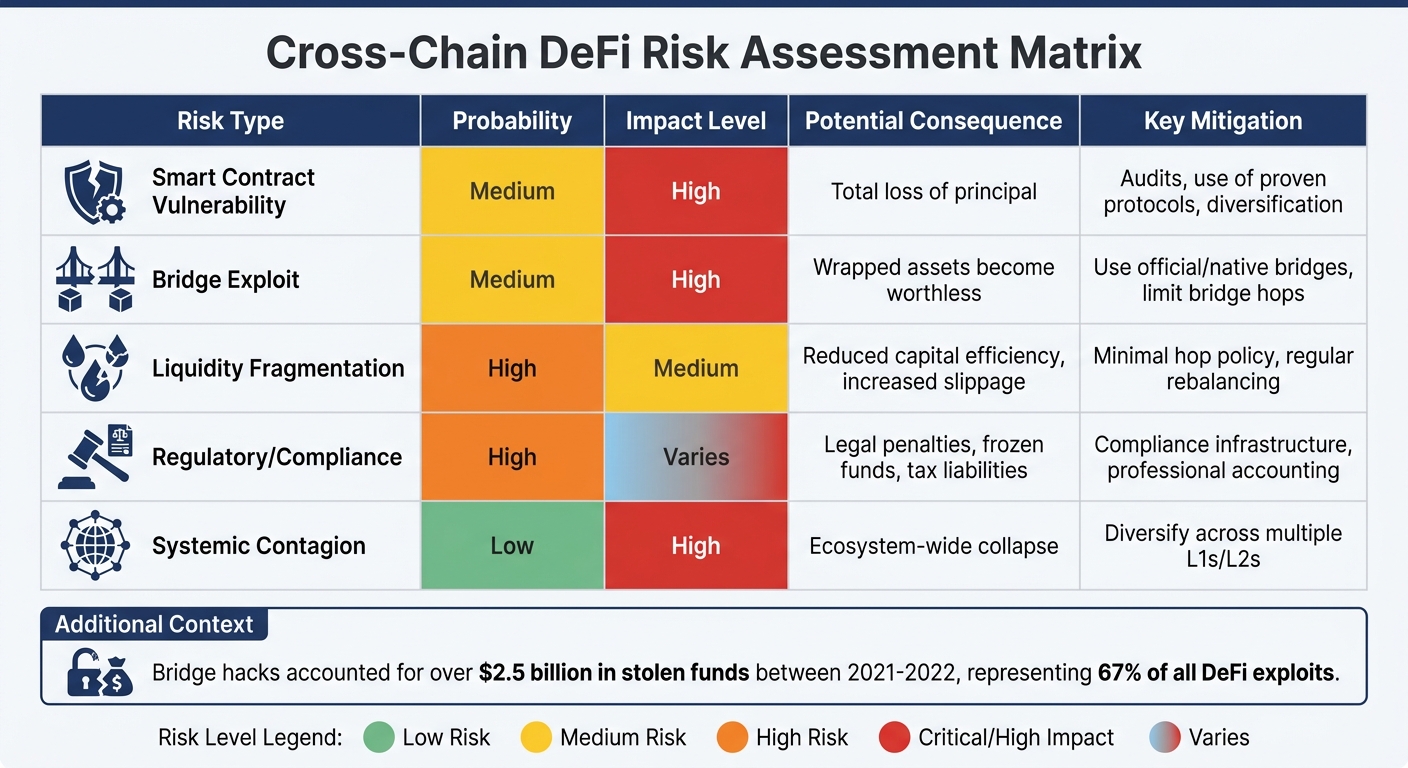
Cross-Chain DeFi Risk Assessment Matrix for Family Offices
Cross-chain yield aggregation introduces several risks that can heavily influence portfolio outcomes. Recognizing these risks and understanding their potential impact is essential for crafting resilient investment plans. This section delves into specific risk categories, providing examples to guide effective risk management.
Smart Contract Vulnerabilities
Smart contracts, while integral to DeFi, are prone to bugs caused by issues like logic errors, reentrancy, or flawed upgrades. These vulnerabilities can result in attackers draining funds in moments.
For instance, in March 2023, Euler Finance on Ethereum faced a $197 million loss when a logic error in the donateToReserves function was exploited using a flash loan. The attacker manipulated the mechanism to create unbacked debt, depleting the protocol within minutes. Similarly, in April 2022, Beanstalk Farms lost $182 million when an attacker used a flash loan to gain 67% voting power. This allowed them to pass a proposal transferring all protocol funds to their own wallet.
These incidents highlight a critical lesson: an audit doesn’t guarantee safety. Investors must thoroughly review audit reports, ensuring critical modules are formally verified and that identified issues have been resolved.
"If you cannot identify exactly which risks you are taking on for a given yield, you are probably the exit liquidity." – Jorge Rodriguez, Risk Management, Lince Yields [5]
Liquidity Fragmentation and Bridge Exploits
Spreading capital across multiple chains creates challenges like liquidity dilution, higher gas fees, and the risk of wrong-network transactions. Managing native tokens for transaction fees on each chain adds complexity, while monitoring positions across several networks increases operational strain.
Bridge exploits are an even bigger concern. Between 2021 and 2022, bridge hacks accounted for over $2.5 billion in stolen funds, representing more than two-thirds of all DeFi exploits during that period [6]. In one case, the Wormhole bridge suffered a $320 million loss in February 2022 when an attacker forged a signature to mint 120,000 unbacked wrapped ETH on Solana without depositing the corresponding ETH on Ethereum.
Operational risks also come into play. For example, in July 2023, the Multichain bridge shut down after its CEO was detained and centralized multi-party computation (MPC) servers became inaccessible. This left hundreds of millions in user funds stranded [5]. Every bridge introduces an additional counterparty risk. For instance, holding wrapped Bitcoin depends on BitGo‘s custody services [8]. Beyond technical vulnerabilities, regulatory challenges further complicate cross-chain strategies.
Regulatory and Compliance Risks
Regulatory uncertainty presents a significant challenge for family offices using cross-chain DeFi. Automated yield protocols risk being classified as "managed money" or "investment companies", which can result in heavy penalties. For example, in December 2023, the BarnBridge DAO settlement led to a $1.7 million fine, while Kraken faced a $30 million penalty and was forced to halt its U.S. staking program [4].
Taxation adds another layer of complexity. Cross-chain transactions – such as swaps, bridging, staking rewards, and yield harvesting – each create taxable events that require precise reporting. With jurisdiction-specific requirements varying widely, family offices must maintain rigorous compliance systems and detailed on-chain records to navigate the intricate tax and regulatory landscape [3].
| Risk Type | Probability | Impact Level | Potential Consequence | Key Mitigation |
|---|---|---|---|---|
| Smart Contract Vulnerability | Medium | High | Total loss of principal | Audits, use of proven protocols, diversification [5] |
| Bridge Exploit | Medium | High | Wrapped assets become worthless | Use official/native bridges, limit bridge hops [3][1] |
| Liquidity Fragmentation | High | Medium | Reduced capital efficiency, increased slippage | Minimal hop policy, regular rebalancing [1] |
| Regulatory/Compliance | High | Varies | Legal penalties, frozen funds, tax liabilities | Compliance infrastructure, professional accounting [3] |
| Systemic Contagion | Low | High | Ecosystem-wide collapse | Diversify across multiple L1s/L2s [5] |
Interconnected Risks
DeFi protocols are deeply interconnected, meaning risks often cascade. For example, a bridge exploit can lead to liquidity fragmentation, which may then trigger broader systemic stress. The collapse of UST/LUNA in May 2022 wiped out over $40 billion in value, demonstrating how the failure of an algorithmic stablecoin can ripple across the ecosystem [5]. Family offices must consider these correlations when sizing positions and distributing capital across chains. The next section will outline tools and practices to help mitigate these risks effectively.
Risk Assessment Framework for Family Offices
Creating a thorough evaluation process is crucial for safeguarding capital before diving into cross-chain yield strategies. This structured approach helps align these strategies with the long-term goals of family offices, providing a clear way to identify reliable protocols and steer clear of riskier options. With yields ranging from 8% to 35% APY depending on the associated risks, having a solid framework is non-negotiable [5].
Protocol Evaluation Criteria
This framework builds on existing insights by laying out clear and actionable benchmarks. Start with audit integrity. Look for reports from trusted firms like Trail of Bits or OpenZeppelin, ensuring that any critical issues flagged have been resolved and that core modules have undergone formal verification [5][7]. However, don’t rely solely on audits; history has shown that even audited protocols can fail if unresolved vulnerabilities remain [5].
Next, assess governance transparency. Protocols should have time-locks – ideally 48 to 72 hours – between proposal approval and execution. This delay gives users time to react and exit if needed [5][10]. Also, check the robustness of multisig thresholds. For protocols managing significant Total Value Locked (TVL), a minimum of 5-of-9 signers is recommended, with 7-of-11 being even better. The Beanstalk attack serves as a cautionary tale, where the absence of execution delays allowed an attacker to drain funds immediately after gaining control [5].
Evaluate economic security by comparing the cost of attacking validators against the protocol’s TVL. Combine this with an assessment of operational resilience, especially during market stress. Protocols should enforce slashing conditions to penalize malicious actions, making attacks financially impractical. Features like "circuit breakers" or pause functions are essential to halt ongoing exploits – something that could have mitigated losses in several high-profile incidents [5][9]. For example, during MakerDAO’s March 2020 network congestion, vaults were liquidated at $0, leading to $8.3 million in bad debt. Protocols that navigate such stress events successfully demonstrate stronger risk management practices. With these criteria in place, the next focus should be on blockchain-specific risks.
Chain-Specific Metrics
Beyond protocol fundamentals, each blockchain comes with its own risk factors. Consensus and finality times vary significantly. Ethereum typically takes about 15 minutes for economic finality, while Solana achieves it in seconds [5][9]. This difference matters when evaluating bridges. For instance, minting wrapped assets before source-chain finality is confirmed can create vulnerabilities, as seen in several exploit cases [5][9].
Carefully examine the bridge trust model. Custodial and federated bridges often rely on multisig validators, while trust-minimized systems use light clients or zero-knowledge proofs [3][7]. A stark example is the Ronin Bridge hack in March 2022, where compromised validator keys led to a $625 million loss, highlighting the risks of centralized bridge designs [9].
"Bridges represent less than 10% of DeFi’s total value locked, yet account for over 50% of all funds stolen in DeFi exploits." – Zealynx Security [9]
Assess network decentralization by looking at the geographical distribution of validators, their organizational independence, and any history of network outages [3][9]. For example, Solana’s outages can temporarily freeze on-chain activity, making it impossible to manage positions or add collateral. Similarly, Ethereum’s high gas fees during congestion can delay critical actions. Monitor supply conservation for wrapped assets as well – wrapped token supplies should always match the locked collateral on the source chain. Any mismatch could indicate potential exploits or bridge failures [9]. These metrics provide a detailed understanding of blockchain-specific risks, helping you tailor your allocation strategy.
Measuring Risk Tolerance
Once protocol and chain risks are identified, the next step is aligning these with your risk tolerance. Use Value at Risk (VaR) to measure market exposure and set maximum acceptable drawdown limits before deploying capital [3][10]. Instead of chasing high APYs, establish allocation caps for each protocol and chain [3].
Divide your strategy into risk tiers. For instance:
- Allocate 50% to 70% of your portfolio to established chains like Ethereum and Arbitrum.
- Reserve 20% to 35% for mature Layer 2 solutions like Optimism or Base.
- Limit exposure to newer chains or emerging zkEVMs to just 10% to 20% [1].
Maintain collateral ratios well above protocol minimums (e.g., 250% instead of 150%) to reduce liquidation risks [3][10]. Keep a stablecoin reserve sufficient to cover expected unstaking times and fees, ensuring you can meet margin calls without forced liquidations [3].
| Risk Parameter | Aave V3 (Ethereum) | Compound V3 (Ethereum) | MakerDAO (ETH-A) |
|---|---|---|---|
| Max Loan-to-Value (LTV) | 80% | N/A (Borrow Caps) | 170% (Collateral Ratio) |
| Liquidation Threshold | 82.5% | N/A (Keepers) | 150% |
| Liquidation Penalty | 5% | 8% | 13% |
| Oracle Price Deviation | 2% | 1% | 1.5% |
Finally, set clear exit triggers using drawdown thresholds and on-chain alerts to avoid emotional decision-making during market turbulence [3]. Tools like Forta Network or Tenderly can provide real-time alerts on governance proposals, unusual fund movements, or deviations in oracle prices [10]. By following this structured approach, you turn risk assessment into a repeatable and scalable process for managing your portfolio effectively.
Risk Mitigation Tools and Best Practices
Once risks are clearly identified, the next step is deploying tools that help keep cross-chain investments aligned with long-term wealth preservation goals. By combining custody solutions, legal structures, and monitoring systems, family offices can significantly reduce exposure to technical and regulatory risks.
Secure Wallet Infrastructure and Custody Solutions
A strong wallet setup is the backbone of secure asset management. The curation wallet acts as the custody layer, guiding asset deployment [11]. For institutional portfolios exceeding $1 million, multisig wallets with at least seven signers are recommended [12]. Safe (formerly Gnosis Safe), which manages over $50 billion in assets, is widely regarded as the go-to solution for on-chain custody [11].
"By requiring multiple approvals to execute a transaction, multisig wallets introduce redundancy and checks and balances into asset management." – Chainlink [13]
A common setup is a 3-of-5 multisig threshold, where signers use hardware wallets from different manufacturers and are geographically spread out to avoid risks tied to supply chains or physical threats [12]. For family offices managing high-frequency strategies across multiple blockchains, MPC (Multi-Party Computation) wallets like Fireblocks (securing over $10 trillion in cumulative assets) or Fordefi (handling around $120 billion in monthly transactions) enable quicker execution by distributing private key shards among multiple parties [11].
Hybrid models are another option, blending a multisig base (e.g., Safe) with a permissions module like Zodiac Roles Modifier. This setup allows specific DeFi actions – such as "supply" and "withdraw" on platforms like Aave – without granting unrestricted treasury access [11]. For cross-chain governance, tools like Chainlink CCIP enable a master multisig on Ethereum to control transactions on other chains like Arbitrum and Polygon from one secure point [13]. Additionally, implementing timelocks ensures a delay between transaction approval and execution, while critical changes (like adding a signer) should always be verified through independent channels, such as video calls [12].
Legal Structures and Tax Optimization
Operating without a formal legal entity can leave family office principals exposed to unlimited personal liability. A January 14, 2025 federal court ruling in the Lido DAO case highlighted this risk, as token holders in unincorporated DAOs were classified as general partners, bearing personal liability for protocol obligations [14]. Establishing a legal entity – like a Cayman Islands Foundation or a Wyoming DAO LLC – can help mitigate this risk while optimizing tax strategies.
Cayman Islands Foundations, known for tax neutrality and a well-developed service ecosystem, typically cost $25,000–$50,000 to set up and $20,000–$40,000 annually to maintain [14]. For U.S.-based family offices, Wyoming DAO LLCs or Decentralized Unincorporated Nonprofit Associations (DUNAs) offer a more cost-effective alternative, with formation costs ranging from $5,000 to $15,000 and similar annual upkeep [14]. In fact, the Uniswap Foundation proposed a Wyoming DUNA in 2025 to protect token holders from liability while enabling protocol fee mechanisms [14].
Sophisticated setups like MakerDAO’s use a multi-entity structure – combining a Cayman RWA Foundation and Delaware SPVs – to link on-chain governance with off-chain assets like T-bills and real estate [14]. To avoid single points of failure, adopt multisig quorums (e.g., 2-of-3 or 3-of-5) and create a "financial airlock" by separating transaction preparation from approval. Regular tabletop exercises can prepare teams for scenarios like seed phrase loss or signer incapacitation [18]. These legal frameworks should be complemented by continuous oversight of on-chain activities.
Continuous Monitoring and Compliance
Effective risk management requires constant vigilance. Secure custody setups help mitigate smart contract and liquidity risks by providing real-time insights into protocol health, security events, and compliance requirements. Platforms like Nansen, Dune, and Glassnode enable monitoring of key metrics such as Total Value Locked (TVL), token distribution, active addresses, and transaction flows [19][3]. Automated alerts can flag critical events, such as protocol upgrades, large outflows (e.g., over 10% of TVL within 24 hours), oracle feed issues, or changes in vault strategies [3].
Reconcile cross-chain balances weekly to catch imbalances early. Given past bridge exploits, real-time monitoring is essential. Instead of fixed schedules, use variance-based rebalancing when asset allocations deviate beyond set thresholds (typically 5% to 10%) to avoid unnecessary fees [15].
"Active risk management doesn’t just react to an oncoming storm – it mitigates the fallout from disturbances that aren’t even in the forecast yet." – Bobby Stover, EY Americas Family Enterprise and Family Office Leader [15]
Integrate wallet-level tax tools and KYC-enabled liquidity systems to streamline reporting and track staking rewards and swaps [19][17]. With 74% of investment professionals either investing in or exploring cryptocurrencies as of 2025, regulatory scrutiny is increasing [17]. On-chain compliance modules can help ensure continuous sanctions screening and AML/KYC compliance for cross-chain transactions [19][4]. Lastly, schedule regular operational drills to practice withdrawals, rebalancing, and recovery plans, ensuring preparedness for market volatility [19].
Regulatory and Operational Considerations
Family offices diving into cross-chain yield aggregation must navigate a shifting regulatory environment in the US. Since the FIT21 Act came into effect in July 2025, the SEC and CFTC have adopted a dual oversight model. By Q2 2026, many protocols will likely need to comply with "DeFi Hybrid Registration" (Form DCR-1) for products that blur the line between securities and commodities. Under this setup, governance tokens with profit-sharing mechanisms fall under SEC oversight, while liquidity provider tokens in perpetual pools are regulated by the CFTC [22]. This regulatory framework adds a layer of complexity to risk management strategies for family offices.
US Regulatory Requirements
The Howey Test remains the key benchmark for determining what qualifies as a security. Yield-generating products can be classified as "investment contracts" if they involve a common enterprise, pooled assets, and reliance on others’ efforts [4]. For example, protocols pooling investor funds for DeFi lending positions may trigger the Investment Company Act of 1940. This was highlighted in December 2023 when BarnBridge DAO settled with the SEC for $1.7 million after its SMART Yield pools – attracting $509 million in deposits – were deemed an unregistered investment company [4]. Similarly, in February 2023, Kraken paid $30 million and ended its US staking-as-a-service program after the SEC determined it exercised discretion over validator selection while pooling assets [4].
"Whether it’s through staking-as-a-service, lending, or other means, crypto intermediaries, when offering investment contracts in exchange for investors’ tokens, need to provide the proper disclosures and safeguards required by our securities laws."
- Gary Gensler, Former SEC Chair [4]
To manage these risks, family offices might turn to private fund structures under Regulation D. This ensures all participants qualify as accredited investors and leverages exemptions for qualified purchasers. Additionally, adopting non-custodial infrastructure – where users maintain control of their private keys – can minimize exposure to "common enterprise" risks. Compliance budgets for protocols seeking dual registration typically range from $750,000 to $2 million, covering legal, accounting, and technical requirements [22].
Tax considerations add yet another layer of complexity to cross-chain yield strategies.
Tax Treatment and Accounting Standards
The repeal of the IRS DeFi broker reporting rule (TD 10021) in April 2025 via H.J. Res. 25 shifted the tax reporting burden entirely onto family offices [21][23]. Without Form 1099-DA from decentralized platforms, family offices must independently track and report on-chain activities. Liquidity pool deposits are often treated as taxable exchanges of tokens for LP tokens, while yield farming may generate both ordinary income on rewards and capital gains on the underlying assets [23].
Using the Specific Identification cost basis method can help optimize tax outcomes. Detailed record-keeping is essential – track transaction hashes, UTC timestamps, fair market values in USD, and gas fees. Regular reconciliations, such as weekly balance checks, monthly position reviews, and quarterly audits across all chains and protocols, can simplify compliance. Segregating DeFi investments into dedicated wallets also streamlines the process [23].
Family offices should also prepare for broker reporting requirements under Notice 2025-03. Starting January 1, 2027, trading front-end services must collect user information and report transactions on IRS Form 1099-DA. A "good-faith" penalty relief period allows brokers to demonstrate compliance efforts [20]. Family offices acting as intermediaries should begin developing systems to track gross proceeds in anticipation of these changes.
Stress Testing for Operational Resilience
Operational resilience is essential when managing cross-chain yield strategies. Family offices should regularly perform stress tests and operational drills to simulate potential disruptions, such as cross-chain connectivity issues, liquidity shortages, oracle failures, or unexpected protocol updates. These exercises help identify weaknesses and ensure that emergency withdrawal and cross-chain rebalancing plans are functional.
Implementation Checklist for Family Offices
This checklist provides actionable steps to turn risk frameworks into practical strategies. Family offices must establish clear criteria for selecting protocols, analyzing yield components, and maintaining oversight as markets evolve.
Setting Protocol Selection Criteria
Start by defining strict thresholds for selecting protocols. Ensure smart contracts are audited by well-known firms, and confirm that audits cover both core vaults and deployed strategies [10][24]. Admin keys should be managed using multisig setups with timelocks, avoiding single-party control [10][7]. For bridge transactions over $10,000, rely on official or native bridges (e.g., Arbitrum Bridge or Base Bridge) to align with the trust levels of the underlying Layer 2 network [1].
As of April 24, 2026, Lido holds a TVL of $21.67 billion, accounting for roughly 25% of the $84.07 billion DeFi market, making it a benchmark for Tier 1 stability [2]. Assess whether a protocol operates as non-custodial infrastructure, which typically implies fewer compliance challenges, or if it manages pooled assets, potentially triggering additional regulatory scrutiny [4]. These steps directly address cross-chain risks highlighted earlier.
After selecting protocols, shift focus to understanding the components driving yields.
Analyzing Yield Components
Dissect yields into their main components:
- Base rate: For example, Ethereum staking offers 3.2% annually.
- Credit risk premium: Accounts for liquidation or counterparty exposure.
- Liquidity premium: Reflects lock-up periods or bridge transitions.
- Technology premium: Covers risks from smart contracts and oracles [2][5].
Institutional lending yields for USDC generally range from 2.8% to 4.2% APY depending on utilization. Restaking protocols offering Actively Validated Services (AVS) add another 1.8% to 4.3% [2]. Yields on Layer 2 solutions like Arbitrum and Base can climb as high as 8–15% for stablecoins, compared to Ethereum Mainnet’s 3%, due to increased bridge and technology risks [1].
To calculate risk-adjusted yields, subtract a systemic risk premium – 25 to 50 basis points for Tier 1 protocols and 200+ for experimental ones [2]. Use token approval managers regularly to revoke outdated ERC-20 allowances and reduce "infinite approval" vulnerabilities [7].
Regular Reviews and Adjustments
Leverage real-time monitoring tools like Forta Network and Tenderly to track TVL outflows, oracle discrepancies, and governance proposals [10]. Conduct weekly balance checks, monthly position reviews, and quarterly audits to reconcile on-chain balances and update your risk register [3]. Maintain a detailed risk register, listing each risk, its severity, mitigation strategies, and the responsible party [10].
Set clear stop-loss and rebalancing triggers based on drawdown thresholds and on-chain signals. Rebalancing is generally advisable when yield differences between chains exceed 3% to 5% [1]. Regularly schedule tabletop exercises and withdrawal simulations to ensure the team is prepared for emergencies [10][19]. Treat audits as snapshots – update your risk framework quarterly to reflect lessons from post-mortem analyses and new exploit trends [10][24].
Conclusion and Key Takeaways
Summary of Risks and Mitigation Strategies
Cross-chain yield aggregation carries several risks for family offices, including vulnerabilities in smart contracts, bridge exploits, liquidity fragmentation, and regulatory challenges. The history of significant losses from bridge hacks highlights the importance of strong risk management measures. Regulatory scrutiny, as seen in cases like the BarnBridge DAO settlement, further emphasizes the need for ongoing diligence [4].
To address these risks, consider a tiered allocation strategy. Allocate 50–70% to core assets like regulated stablecoins and audited liquid staking tokens, 20–40% to satellite investments in established AMMs, and limit exposure to high-risk protocols to 0–10% [19]. Maintain collateral ratios well above the minimum – such as 250% instead of the required 150% – to cushion against market volatility [5]. Use multisig wallets with 48–72 hour timelocks for treasury management and employ real-time monitoring tools to identify anomalies, such as oracle failures or unusual outflows, before they escalate [3][5]. These strategies are essential for aligning risk management with the specific objectives of family offices.
Matching Cross-Chain Strategies with Family Office Goals
While high yields can be tempting, they come with added risks. Family offices must carefully align yield strategies with their risk tolerance and liquidity needs. For instance, a 25% APY from an experimental protocol may seem appealing but reflects higher risk compared to the steadier returns of established staking protocols.
Diversification is key – not just across protocols, but also validators, chains, and instruments – to minimize the impact of correlated failures. Opt for canonical bridges with cryptographic proofs over third-party alternatives, and maintain a stablecoin reserve to cover unstaking delays and fees. Instead of rebalancing portfolios on a fixed schedule, adjust based on meaningful yield differences [15]. Striking the right balance between risk and reward is critical for building a resilient investment strategy.
Next Steps for Family Offices
With risk-mitigation strategies in place, family offices should focus on refining their operational and governance frameworks. Create an Investment Policy Statement that clearly defines allocation limits, risk management practices, and governance protocols [16][17]. Adopt institutional-grade custody solutions, such as combining cold storage with multisig setups, and separate IT functions from cybersecurity oversight for added security [15][17].
Document operational workflows, establish succession plans for key personnel, and conduct quarterly risk audits using a detailed risk register that tracks identified risks, severity levels, and mitigation measures [10]. Regular tabletop exercises and withdrawal simulations can help teams prepare for market stress [10]. Partnering with experienced firms like Bestla VC can provide valuable guidance. The key takeaway is that cross-chain yield aggregation requires active management, continuous oversight, and a disciplined approach to risk, rather than treating it as a passive income source.
FAQs
How do I choose safer chains and bridges for cross-chain yield?
When transferring assets across blockchain networks, it’s essential to focus on protocols with strong security track records and trust-minimized designs. These features help reduce risks and ensure your assets remain safe.
Native bridges are often considered the safest option because they are deeply integrated into the blockchain’s infrastructure. However, they can come with a tradeoff – withdrawals may take longer to process.
For faster and secure transfers, intent-based bridges like Across and Connext are excellent alternatives. They balance speed and security, making them a popular choice for many users.
To minimize risks, follow these steps:
- Double-check contract addresses: Always verify the contract address before initiating a transaction.
- Start small: Test the bridge with a small transaction before moving larger amounts.
- Diversify transfers: Spread large transfers across multiple bridges to reduce exposure.
Finally, prioritize protocols that maintain transparent security models and have demonstrated resilience under real-world conditions. This approach can significantly lower the chances of encountering issues during your transactions.
What’s the simplest way to set risk-adjusted yield targets?
Defining your risk tolerance is a straightforward starting point. Use systematic tools to weigh potential returns against risks, such as smart contract vulnerabilities or liquidity issues. The key is to align your yield targets with your financial goals while keeping these risks in mind to make well-informed choices.
What records are needed for U.S. taxes on cross-chain DeFi?
To meet U.S. tax obligations, keep detailed records of all your on-chain activities. This includes token trades, swaps, staking, providing liquidity, earning rewards, and any protocol interactions. Accurate documentation is crucial for reporting taxable events tied to cross-chain DeFi transactions.