


Web3 market making is reshaping how digital assets are traded by ensuring liquidity and reducing price gaps on decentralized platforms. Here’s what you need to know:
- What it is: Market making involves placing simultaneous buy and sell orders to provide liquidity and minimize price slippage.
- Why it matters: It stabilizes pricing across decentralized exchanges (DEXs) and centralized exchanges (CEXs), supporting fair valuations and smoother trades.
- Key challenges: High gas fees, fragmented liquidity, and smart contract risks can complicate operations.
- Core methods: Automated Market Makers (AMMs) use algorithms for pricing, while order books offer precision for professional traders.
- Strategies: Arbitrage, algorithmic trading, and risk management help market makers optimize profits while managing inventory and volatility.
- Tools: Platforms like Hummingbot and Uniswap v3 provide essential infrastructure for efficient trading.
Web3 market makers are critical to the decentralized finance ecosystem, but success requires the right mix of technology, strategies, and compliance with evolving regulations.
Core Concepts and Mechanisms
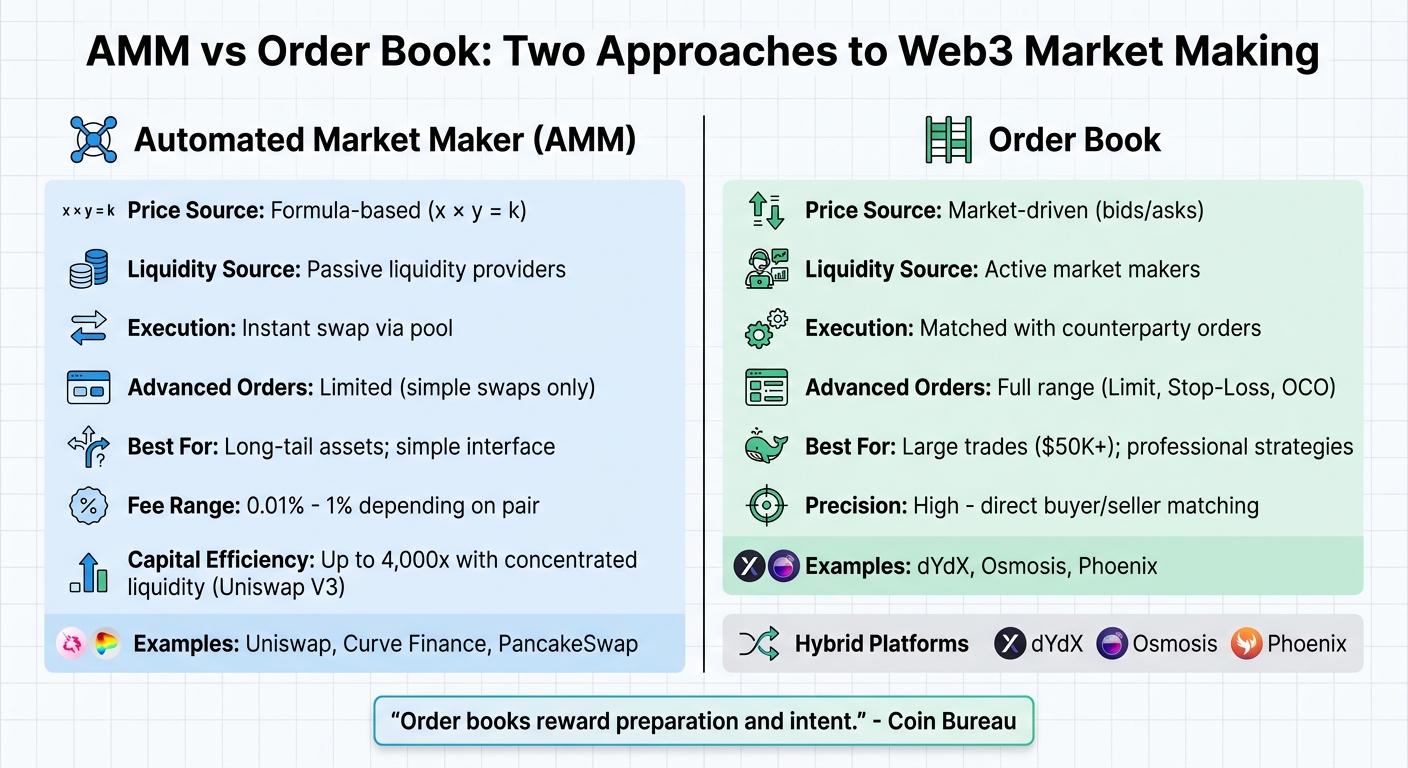
AMM vs Order Book Trading Systems Comparison
Let’s dive deeper into the mechanisms that drive Web3 market making. At its core, Web3 market making revolves around two main models: Automated Market Makers (AMMs) and order book-based systems. These models use distinct approaches to provide liquidity and facilitate trades.
Automated Market Makers (AMMs)
AMMs rely on mathematical formulas, most commonly the constant product formula ($x \times y = k$), to determine asset prices. Unlike traditional systems, AMMs don’t require direct matching between buyers and sellers. Instead, traders interact with a smart contract that holds token reserves. Here, $x$ and $y$ represent the quantities of two tokens in the pool, while $k$ remains constant [4].
"The smart contract is the counterparty – and its behavior is transparent, auditable, and automated."
– ECOS Team [4]
By mid-2025, top protocols such as Uniswap, Curve Finance, and PancakeSwap had locked billions of dollars in assets across multiple blockchains [6].
One standout feature of AMMs is concentrated liquidity, which allows liquidity providers to allocate their capital within specific price ranges. For instance, Uniswap V3 achieves up to 4,000x greater capital efficiency using this approach [9]. Additionally, arbitrageurs play a critical role in maintaining price alignment between AMM pools and external markets [4]. Trading fees in AMM systems typically range between 0.01% and 1%, depending on the asset pair and the specific protocol [9].
On the other hand, order book systems offer a different approach, particularly for traders seeking precision and control.
Order Book-Based Market Making
Order book systems operate through a ranked list of buy and sell orders, where prices are determined by market demand and supply [5]. Unlike AMMs, these systems match buyers and sellers directly, creating a more traditional trading experience [4]. This mechanism is especially effective for large trades, often exceeding $50,000, as it provides better execution [3].
Order books also support advanced order types, such as Limit, Stop-Loss, and One-Cancels-the-Other (OCO), offering traders more precision and flexibility [3].
| Feature | Automated Market Maker (AMM) | Order Book |
|---|---|---|
| Price Source | Formula-based ($x \times y = k$) | Market-driven (bids/asks) |
| Liquidity Source | Passive liquidity providers | Active market makers |
| Execution | Instant swap via pool | Matched with counterparty orders |
| Advanced Orders | Limited (simple swaps only) | Full range (Limit, Stop, OCO) |
| Best For | Long-tail assets; simple interface | Large trades; professional strategies |
"Order books reward preparation and intent."
– Coin Bureau [3]
Some platforms now combine features of both systems. For example, dYdX, Osmosis, and Phoenix integrate AMM pools with order book engines, offering both continuous liquidity and precise trade execution [5].
With these mechanisms in mind, let’s explore how liquidity providers are incentivized to support these systems.
Liquidity Provision and Incentives
Liquidity providers (LPs) deposit equal values of two tokens into a pool and receive LP tokens in return. These LP tokens represent their share of the pool and entitle them to a portion of the trading fees generated. Many protocols also offer additional rewards through yield farming, distributing governance tokens to LPs as an incentive to provide liquidity and maintain long-term engagement [8]. In decentralized exchanges (DEXs), fee yields for LPs can range from 20% to over 100% [8].
However, LPs face a key risk: impermanent loss (IL). This occurs when the price ratio of the deposited tokens shifts, potentially making the LP’s position less valuable than simply holding the tokens. For example, significant price divergence between two assets can amplify impermanent loss [3]. To mitigate this, LPs often focus on stablecoin pairs (e.g., USDC/USDT) or pegged assets (e.g., ETH/stETH). AMM fee structures vary, with common rates including 0.05% for stablecoin pairs, 0.3% for standard pairs, and 1% for more volatile or exotic pairs [7].
Additionally, high gas fees on Ethereum’s mainnet have pushed many LPs to Layer 2 networks like Base and Arbitrum. These networks offer lower transaction costs, making frequent rebalancing more feasible [7].
sbb-itb-c5fef17
Market Making Strategies for Web3
Success in Web3 market making revolves around three core components: leveraging arbitrage opportunities, employing algorithmic trading for efficiency, and implementing robust risk management practices.
Arbitrage Opportunities
Arbitrage takes advantage of price differences for the same asset across various platforms. This could mean buying an asset at a lower price on one exchange and selling it at a higher price on another. For centralized exchanges, these spreads typically range from 0.1%–0.3%, while decentralized exchange (DEX) trades can see spreads between 0.3%–2.0%. However, retail traders often lose 40–70% of their gross profits to gas fees, slippage, and MEV (Miner Extractable Value) front-running. By 2026, arbitrage windows close in mere milliseconds, making manual execution nearly impossible [11][13].
"The real edge in arbitrage trading crypto isn’t spotting the opportunity – bots do that in milliseconds. It’s execution."
– BitMEX [10]
Flash loans offer another avenue for arbitrage, allowing traders to borrow funds, execute trades, and repay the loan – all within a single blockchain transaction. Flash loan providers usually charge fees between 0.1%–0.3% [12].
One trader used machine learning to identify mispriced contracts on Polymarket from 2024 to 2025, earning approximately $150,000 in profit with $500,000 in deployed capital [11]. But not all attempts succeed. For example, a researcher testing a CEX-to-CEX arbitrage bot with Hummingbot ended up with a $40 net loss after factoring in API rate limits, exchange fees, and a sudden flash crash [11].
To improve success rates, it’s crucial to:
- Pre-fund accounts on multiple exchanges to reduce delays.
- Use limit orders to minimize slippage.
- Calculate the full fee stack, including maker/taker fees, withdrawal costs, and gas fees, before executing trades [10][13].
These strategies naturally lead into the importance of algorithmic systems for managing market-making operations.
Algorithmic Market Making
Algorithmic trading is all about speed and precision. Automated systems analyze live market data and adjust orders in milliseconds, making them essential for optimizing trade execution and maintaining inventory balance. Professional operations often aim for annual yields of 15–30%, while retail grid bots typically achieve 10–20% APY under favorable conditions [16].
A key challenge in algorithmic market making is inventory management. Maintaining a delta-neutral position – where gains or losses are balanced regardless of market direction – is vital. Many traders use models like Avellaneda-Stoikov to calculate optimal spreads based on market volatility and inventory levels [15][18].
"Take care of your tech and it will take care of your PnL."
– HFT Adage [15]
Major players like Jump Trading and Citadel have entered the crypto space, tightening spreads on leading assets [15][18]. For instance, market makers on Polymarket earned over $20 million in 2024 [18]. Maker fee rebates also play a crucial role. Gate.io, for example, offers rebates up to -0.015%, while WhiteBIT provides up to -0.012% [14].
To ensure smooth operations, algorithmic systems should include:
- Kill-switches to pause trading during API outages.
- Automatic quote withdrawals if prices exceed predefined thresholds.
- Monitoring tools like VPIN (Volume-Synchronized Probability of Informed Trading) to detect toxic order flow [15].
Hosting trading servers close to an exchange’s servers minimizes latency. Avoid trading pairs with low liquidity – specifically, pairs with less than $1 million in 24-hour trading volume or bid-ask spreads exceeding 1% – as they often lead to liquidity traps [15][16].
Risk Management Techniques
Effective risk management ensures liquidity even during volatile market conditions. Market makers face several risks, including inventory imbalances, sudden market swings, and directional price movements.
To manage inventory risk, adjust bid and ask quotes dynamically. For example, if holding a net short position, narrow bid quotes to attract buyers and return to a neutral stance. Under normal conditions, spreads should remain around 0.1%, but during periods of high volatility, they can widen to 0.5% [1][21].
Automated circuit breakers and stop-loss orders can protect against flash crashes, such as Bitcoin’s dramatic drop from $64,000 to $30,000 in 2021 [19]. Hedging strategies also help mitigate risks. For instance, market makers might:
- Short futures contracts to offset price drops.
- Purchase put options for downside protection.
- Use inverse tokens to hedge against directional exposure [19][20].
To limit exposure, traders should risk only 1–3% of their total capital on any single trade. Maintaining at least 99.95% uptime is critical for uninterrupted liquidity provision [21]. Additionally, position limits should not exceed 15% of an asset’s daily trading volume. Keeping capital reserves equal to 5–10% of maximum inventory positions provides a safety net during extreme market volatility [21].
Firms like Bestla VC offer expertise in digital finance and algorithmic trading, helping market makers navigate the challenges of Web3 liquidity while maintaining strong risk controls.
Tools and Platforms for Market Makers
Building a reliable infrastructure is key for market makers. In the Web3 space, they depend on specialized software, decentralized protocols, and analytics dashboards to execute trades, manage inventory, and monitor performance in real time.
Market-Making Software Solutions
Hummingbot is a standout open-source Python framework that automates trading across centralized and decentralized exchanges. Its modular design features tools like "Gateway" for blockchain transactions and "Condor" for remote management through Telegram. Supporting over 20 exchanges, it offers pre-built strategies such as "Liquidation Sniper" and "Cross-Exchange Market Making" (XEMM) [22][26].
For those who prioritize speed, QuantMesh is built in Go and operates 10–50 times faster than Python-based systems. It’s tailored for perpetual contract infinite grid strategies and has handled over $100 million in trading volume. Using a WebSocket-driven model, it eliminates polling delays and manages multiple order states with its "Super Slots" system [23].
Enflux Terminal brings AI into the mix, offering an intelligent control panel for market making, OTC, and treasury management. Its "AI Co-Pilot" identifies market signals – such as whale activity or social surges – and can recommend or execute strategies like buybacks or spread adjustments [24].
Arbital focuses on perpetual DEXs, emphasizing systematic inventory risk management. Its "stealth execution" approach uses randomized timing and adaptive quoting to reduce market signaling, helping traders avoid revealing their positions [27].
These tools are designed to streamline operations and ensure efficient trading on decentralized exchanges.
Decentralized Exchanges and Protocols
Decentralized protocols are another cornerstone of effective market-making strategies. Uniswap v3 is a prime example, allowing precise capital allocation for market makers. As of December 2025, Uniswap had $5.2 billion in total value locked (TVL) and $1.8 billion in daily trading volume [29]. It offers four fee tiers: 0.01% for stablecoins, 0.05% for correlated assets, 0.30% for standard pairs, and 1.00% for exotic pairs [25][28].
"Uniswap v3 introduces: Concentrated liquidity, giving individual LPs granular control over what price ranges their capital is allocated to." – Uniswap [25]
Curve Finance is tailored for stablecoin and liquid staking token (LST) swaps, offering minimal slippage with a base trading fee of 0.04% [29]. dYdX provides a central limit order book (CLOB) for perpetuals, featuring maker rebates of -0.011% and taker fees ranging from 0.025% to 0.05%, depending on volume. By October 2025, the platform reported a cumulative trading volume exceeding $1.5 trillion [28].
Balancer stands out by allowing customizable pool ratios, supporting up to eight assets per pool. For instance, an 80/20 pool helps projects manage token liquidity while reducing impermanent loss [29]. Meanwhile, CoW Protocol uses batch auctions to protect market makers from MEV attacks, offering uniform clearing prices and eliminating sandwich risks [28].
As of November 20, 2025, decentralized exchanges saw a 24-hour trading volume of about $13.55 billion [28]. High-frequency market-making is increasingly shifting to Layer 2 solutions like Arbitrum and Base, as well as appchains like dYdX Chain, to cut gas costs and reduce latency [28]. To combat MEV – which accounted for approximately 526,207 ETH (around $1.1 billion) from September 2022 to June 2024 – market makers can use private relays such as Flashbots Protect or MEV Blocker [28]. Additionally, analyzing "tick density" helps ensure capital is deployed where the highest trading volume occurs [28].
Analytics and Monitoring Tools
Analytics platforms are crucial for optimizing strategies. RangeScout allows market makers to backtest concentrated liquidity strategies on platforms like Uniswap v3, Meteora, and Orca using Monte Carlo simulations. It evaluates risk metrics like Sharpe and Sortino ratios and claims that optimized strategies can outperform standard 50/50 LP positions by an average of 47% [31].
"Every concentrated liquidity position is economically a short straddle – a short put at your lower bound plus a short call at your upper bound." – RangeScout [31]
Market Monkey Terminal (MMT) consolidates data from over 20 exchanges – including Binance, Bybit, OKX, and Hyperliquid – into one interface. This helps market makers identify liquidity clusters and anticipate price squeezes [32].
Raytrade Studio provides real-time logs, live order book interactions, and trade lists, offering insights into how quotes interact with the market [33].
For DEX-specific data, DEX Analytics standardizes schemas for tracking order flow, Just-in-Time (JIT) liquidity, and Uniswap v4 events across multiple EVM chains [30].
Before deploying capital, market makers should test strategies using 180-day historical data and walk-forward validation to gauge performance against real price movements and rebalancing costs [31]. Monitoring Greeks – Delta, Gamma, Theta, and Vega – can reveal how price changes and volatility affect performance [31]. Automated optimization tools can also help avoid preventable losses, saving an average of $2,300 from high-risk pools or wash trading [31].
These tools and platforms equip market makers with the resources needed to navigate the complexities of Web3 trading. Firms like Bestla VC specialize in digital finance and algorithmic trading, offering guidance to market makers in selecting the right tools and maintaining strong risk controls in this evolving ecosystem.
Regulatory and Legal Considerations
Web3 market makers operate in a patchwork of regulatory environments that vary by jurisdiction. In the United States, the SEC introduced its "Dealer" Rule in early 2024, requiring entities with at least $50 million in total assets to register as dealers. This applies to those regularly providing liquidity on both sides of the market or primarily earning revenue from bid-ask spreads, with compliance set to begin around April 2025 [35]. Additionally, the GENIUS Act, enacted on July 18, 2025, established federal oversight for payment stablecoin issuers, including reserve requirements and approval processes [34].
In the European Union, the Markets in Crypto-Assets (MiCA) regulation oversees Crypto-Asset Service Providers (CASPs) and introduces "passporting", enabling licensed entities to operate across all EU member states. The Digital Operational Resilience Act (DORA), effective January 2025, mandates robust ICT risk management, incident reporting, and resilience testing [34]. Meanwhile, the UAE’s Virtual Assets Regulatory Authority (VARA) offers a distinct framework for VASP licensing in Dubai [34]. These evolving standards require market makers to implement comprehensive compliance strategies.
Compliance in Decentralized Markets
Decentralization does not exempt market makers from regulatory scrutiny. SEC Chair Gary Gensler has emphasized:
"These platforms are not truly decentralized… there’s some group of people who are there and they’re getting some compensation" – Gary Gensler [36]
This viewpoint has driven aggressive enforcement actions. For instance, in the CFTC v. Ooki DAO case, token holders who voted on governance decisions were held personally liable, leading to $643,542 in penalties [36]. Similarly, in SEC v. EtherDelta, the founder was penalized $375,000 for operating an unregistered securities exchange, despite using decentralized smart contracts [36].
To mitigate regulatory risks, market makers should adopt measures like multi-layer geoblocking with IP detection, VPN blocking, and attestation checkboxes. Additionally, wallets should be screened against the OFAC SDN list for all front-end interactions [36]. The FATF Travel Rule requires Virtual Asset Service Providers to collect and share originator and beneficiary information for qualifying transfers, with KYC records retained for five years and made available to regulators within 24 hours [34]. These compliance measures complement operational strategies and help reduce regulatory exposure.
Regulators are increasingly targeting front-end interfaces and RPC providers, which are easier to regulate than immutable smart contracts [36]. To prepare for audits, market makers should maintain an "evidence pack" that includes smart contract audits, remediation records, admin key management policies, and incident response plans [34].
Taxation and Reporting for Market Makers
Tax obligations for market makers vary based on their jurisdiction and legal structure. In the United States, entities structured as C-Corps face specific tax reporting requirements, while offshore foundations may offer more efficient treasury management options [34]. The OECD’s Crypto-Asset Reporting Framework (CARF) facilitates the automatic exchange of taxpayer information between jurisdictions [38].
Market makers must meticulously track every trade for tax purposes, including cost basis, holding periods, and realized gains or losses. Frequent trading often results in short-term capital gains, taxed at ordinary income rates of up to 37% for high earners. To avoid allegations of fund mismanagement, operational and client funds should be strictly segregated. Detailed documentation of trading strategies and transaction records is also critical for regulatory scrutiny [39].
| Jurisdiction | Primary Framework | Key Requirement for Market Makers |
|---|---|---|
| USA | SEC Dealer Rule / GENIUS Act | Dealer registration for $50M+ entities; stablecoin licensing [34][35] |
| EU | MiCA / DORA | CASP authorization; ICT resilience testing; whitepaper disclosures [34] |
| UK | FCA AML/CTF Regime | Mandatory AML registration and Travel Rule compliance [34] |
| UAE | VARA Rulebook | Activity-based VASP licensing in Dubai [34] |
| Canada | PCMLTFA | MSB registration with FINTRAC and provincial securities compliance [34] |
Adhering to tax laws and establishing a robust legal framework can help market makers avoid penalties and regulatory challenges.
Best Practices for Legal Setup
Choosing the right legal structure can significantly reduce liability and regulatory risks. For market makers operating as DAOs, legal wrappers such as Wyoming DAO LLCs, Marshall Islands DAO entities, or Swiss Foundations can provide legal personhood and protect contributors from personal liability [34][36].
When launching tokens, creating a Token Special Purpose Vehicle (TokenCo) can isolate liability, facilitate SAFT agreements, and manage token minting processes [37]. A common strategy involves using an offshore foundation for protocol governance combined with a US-based entity for software development to limit regulatory exposure [36].
To secure admin keys, market makers should rely on Hardware Security Modules (HSM) or multi-signature custody solutions, with all emergency procedures and timelocks fully documented [34]. Conducting independent smart contract audits and maintaining records of remediation efforts and re-audits is essential as part of a "duty-of-care" approach [34].
In October 2024, the US Department of Justice and SEC charged Gotbit Consulting LLC and its CEO with wire fraud and market manipulation. By using proprietary algorithms to execute wash trades, they inflated trading volume from $330,000 to $1 million within hours, resulting in coordinated arrests and potential 20-year prison sentences [39].
For expert guidance, firms like Bestla VC provide specialized legal consultancy for Web3 market makers. Their expertise in regulatory frameworks and digital finance ensures that market makers can navigate compliance challenges effectively while maintaining operational confidence.
Conclusion and Key Takeaways
Web3 market making has become a cornerstone of exchange performance [21]. Exchanges that adopt professional market-making programs often see trading volumes rise by 30–50% within six months. Algorithmic strategies, in particular, have shown the ability to tighten spreads by 40–60% compared to manual methods [21].
This guide has explored key strategies – spread-based, algorithmic, inventory-based, and hybrid approaches – that cater to different market scenarios. Real-world applications have consistently demonstrated improvements in bid-ask spreads and order book depth [21].
"Market making strategies have evolved from specialized trading techniques into essential infrastructure components that determine exchange competitiveness." – Anand, Nadcab [21]
Another critical factor is regulatory compliance. Market makers operating in key regions like the USA, UK, UAE, and Canada must meet stringent AML/KYC requirements to maintain trust and operational integrity. These performance and compliance benchmarks set the stage for further advancements in technology and strategy.
The Role of Innovation in Web3 Market Making
The shift from manual to algorithmic market making has been transformative. High-frequency systems now execute thousands of orders per second with latency under 100 milliseconds. These systems act as stabilizers during flash crashes and volatile periods, but they require considerable investment. Building institutional-grade infrastructure can cost between $5 million and $15 million [21].
Market makers are also navigating a complex ecosystem, balancing Central Limit Order Books (CLOB), Automated Market Makers (AMM), and Request for Quote (RFQ) systems [17]. For instance, the on-chain lending sector grew from $19.7 billion in early 2024 to $67.4 billion by January 2026, fueled by advancements in managed vaults and decentralized protocols [17].
"If you are not able to place, cancel, or modify your orders quickly enough to adjust with the ever-changing market, you will very quickly lose a lot of money. Crypto market-making is very much a technology business." – Julia Zhou, Co-founder, Caladan [17]
Machine learning is also playing a growing role, enabling systems to predict optimal order placements and adjust dynamically to market conditions [21]. These technologies allow firms to maintain a competitive edge, achieving end-to-end latency under 2 milliseconds across multiple venues [17].
The Future of Web3 Market Making
Looking ahead, the next phase of market making will incorporate emerging asset classes and prioritize transparency. The institutionalization of crypto markets is accelerating, with tighter spreads and increasing participation from traditional finance [21]. As these markets evolve, tokenized real-world assets will demand new risk and compliance frameworks [17].
Transparency will be essential. A recent survey found that 37% of the crypto community perceives market makers as price manipulators. To address this, the industry must adopt performance dashboards and provide real-time trading visibility [2]. Firms that share metrics like uptime guarantees of 99.97% and order fill rates of 97.3% will build trust with both users and regulators [21].
For market makers navigating this intricate landscape, collaborating with experts who understand both the technical and regulatory challenges is crucial. Firms like Bestla VC bring specialized knowledge in digital finance, OTC market solutions, and Web3 legal frameworks. By partnering with such specialists, market makers can access the tools and expertise needed to build the next generation of liquidity infrastructure.
Ultimately, success in Web3 market making hinges on combining advanced technology, strict compliance, and adaptable strategies that work across centralized and decentralized markets. The resources and frameworks are available – success depends on how effectively they are implemented.
FAQs
How do I choose between an AMM and an order book?
Choosing between an Automated Market Maker (AMM) and an order book comes down to your trading preferences and how much risk you’re willing to take.
Order books give you precise control over pricing and access to deeper liquidity, but they demand more active involvement. In less liquid markets, you might also encounter higher slippage.
On the other hand, AMMs use algorithms to provide round-the-clock liquidity. They allow users to trade anytime and even participate as liquidity providers. However, they come with their own challenges, such as the risk of impermanent loss and potential slippage during high market volatility.
How can I reduce impermanent loss as an LP?
To minimize impermanent loss as a liquidity provider (LP), consider these strategies:
- Choose token pairs with minimal price divergence: Opt for pairs that tend to move in sync, as this reduces the likelihood of significant price gaps.
- Monitor market conditions actively: Stay informed about market trends and adjust your positions accordingly to reduce risk.
- Focus on stablecoin pairs: Stablecoins generally experience less price volatility, making them a safer option for liquidity provision.
For more advanced approaches, you can:
- Adjust liquidity ranges: Align your liquidity positions with current market volatility to better manage risks.
- Offset losses with trading fees: Earnings from trading fees can help counterbalance potential impermanent loss.
By combining smart pair selection, consistent oversight, and tailored strategies, you can effectively reduce the impact of impermanent loss.
What compliance steps do Web3 market makers need in the U.S.?
In the U.S., Web3 market makers need to meet specific compliance requirements to operate within the law. These include registering with regulatory bodies if their activities involve securities, following anti-money laundering (AML) regulations, and ensuring adherence to the FATF Travel Rule. Additionally, they must carefully assess token classifications under the Howey Test as regulations continue to evolve. For those working internationally, staying informed about global standards is equally important. Meeting these requirements helps ensure operations remain both lawful and ethical.