

Blockchain is transforming supply chain management by addressing inefficiencies, reducing costs, and improving visibility. It creates a shared, tamper-proof ledger that enhances traceability, speeds up dispute resolution, and cuts reconciliation costs. For instance, Walmart reduced produce trace times from 7 days to 2.2 seconds using blockchain. However, challenges like integration with legacy systems, scalability, and compliance can hinder adoption. Despite these hurdles, global spending on blockchain for supply chains is projected to reach $3.6 billion by 2026, driven by applications in traceability, fraud prevention, and cost savings.
Key Takeaways:
- Traceability: Blockchain provides instant tracking, reducing fraud and ensuring product authenticity.
- Collaboration: Shared ledgers improve data access and streamline processes with smart contracts.
- Cost Savings: Automating workflows and reducing manual reconciliation lowers operational expenses.
- Challenges: Integration, scalability, and regulatory compliance require careful planning.
- Adoption: Focused pilot projects and selecting the right platform (e.g., Hyperledger Fabric) are critical for success.
Blockchain is no longer experimental – it’s becoming a standard tool for modernizing supply chains.
Will Enterprise Blockchain Transform Your Supply Chain
sbb-itb-c5fef17
Benefits of Blockchain in Supply Chain Management
Blockchain offers three major advantages that tackle common challenges in supply chain operations: better visibility into product journeys, smoother collaboration among stakeholders, and measurable reductions in both costs and delays.
Better Traceability and Transparency
Blockchain creates an unchangeable record of every transaction, from sourcing raw materials to delivering finished products. Once data is added, it can’t be modified without agreement from the network, making it a powerful tool against counterfeiting – a problem that costs global supply chains over $323 billion annually[8]. Traditional systems, on the other hand, can take days or even weeks to trace the origin of a product[8].
A great example is De Beers’ "Tracr" platform, which tracks diamonds from the mine to the store. This ensures ethical sourcing and prevents conflict diamonds from entering the market[8][9]. Similarly, the MediLedger network, used by companies like Pfizer, Genentech, and AmerisourceBergen, leverages blockchain to comply with the US Drug Supply Chain Security Act (DSCSA). This system has cut dispute resolution times from weeks to mere hours[1].
"Blockchain gives companies real-time visibility into every step of their supply chain… making it easier to verify the authenticity of products, resolve disputes faster, and stay in compliance." – Innovariatech[9]
By enhancing traceability, blockchain not only improves product verification but also simplifies collaboration between different stakeholders.
Better Collaboration Across Stakeholders
Blockchain’s shared, distributed ledger allows all authorized participants to access the same data, eliminating the need for separate databases and manual reconciliation. This creates a more direct and efficient way for supply chain participants to work together.
Smart contracts further streamline the process by automatically triggering actions – like payments or document releases – once specific conditions are met. These automated rules have been shown to reduce disputes between parties by 30% to 40%[1].
For instance, in August 2024, the German startup Tracifier integrated Oracle Blockchain into its food traceability system. Using smart contracts, the platform authenticated food safety inspections and origin data, cutting food processing costs by up to 40% and improving operational efficiency for its clients[3]. This shift has redefined how suppliers, processors, and retailers communicate and ensure compliance.
Cost and Time Savings
Traditional supply chains are burdened by high administrative costs and fees from intermediaries, which can make up as much as 30% of logistics expenses. On top of that, poor data quality costs companies an average of $12.9 million every year[10].
Blockchain addresses these inefficiencies. Smart contracts alone can reduce administrative costs by 20%, and in some compliance-related areas, savings can reach as high as 60%[10]. Shared ledgers also cut data reconciliation expenses by up to 70%[11]. Additionally, companies using blockchain report a 70% faster transaction completion rate compared to manual processes, while real-time tracking reduces logistics delays by up to 25%[10].
One example is the fintech platform Mesha, which implemented a blockchain module in July 2025 to automate supplier financing. Within just 60 days, it achieved a 2.2x faster supplier payment process and a 48% reduction in reconciliation time[11].
| Feature | Traditional Systems | Blockchain-Enabled Supply Chains |
|---|---|---|
| Data Storage | Siloed, centralized databases[8] | Shared, distributed ledger[8] |
| Traceability Speed | Days to weeks[8] | Seconds to minutes[8] |
| Data Reconciliation | High effort (40% of finance time) | Up to 70% reduction[11] |
| Transaction Speed | Days/weeks due to paperwork | Minutes/seconds via automated triggers |
| Fraud Prevention | Reactive (detected after loss)[8] | Proactive (prevented by immutability)[8] |
Challenges in Implementing Blockchain Solutions
While blockchain holds promise for transforming supply chains, putting it into practice comes with its own set of hurdles. A striking 97% of executives predict blockchain will become mainstream by 2026, yet only 34% feel prepared to adopt it [14]. The gap between optimism and readiness boils down to three key challenges that businesses must navigate.
Integration with Legacy Systems
One of the biggest roadblocks is connecting blockchain technology to existing ERP and supply chain management systems. In fact, 70% of organizations cite integration challenges as a major barrier to digital transformation [14]. The problem? Most legacy systems lack the modular architecture or APIs needed to interact seamlessly with decentralized ledgers. This often leads to compatibility issues that require extensive system re-engineering.
To complicate things further, data formats often differ across vendors, making integration even trickier. Companies can address this by auditing their systems and adopting universal standards like GS1 or OpenAPI [12]. However, achieving compatibility often involves coordinating efforts across departments and external partners, which can be a time-consuming process.
Even after overcoming integration challenges, scalability remains another significant hurdle.
Scalability and Resource Requirements
Scalability is another critical issue that organizations face when adopting blockchain. Public blockchains, for instance, can only process 15–100 transactions per second (TPS), which falls far short of the demands of high-volume supply chains. On the other hand, permissioned blockchains like Hyperledger Fabric can handle around 3,000 TPS, while Layer 2 solutions such as Polygon can process over 7,000 TPS at a fraction of the cost [13].
The financial aspect is also worth noting. Blockchain storage costs range from $0.10 to $10 per kilobyte, compared to just $0.000001 per kilobyte for traditional cloud storage [13]. Storing all supply chain data on-chain is not only inefficient but also extremely expensive.
According to Gartner, 77% of enterprise blockchain projects fail to go live, often because companies choose platforms that don’t align with their throughput or integration needs [2]. A more practical approach is to use off-chain storage for high-frequency data like IoT sensor readings or transaction histories, while recording only cryptographic hashes or Merkle tree roots on-chain. For example, in cold chain monitoring, batching sensor data off-chain and periodically updating the blockchain can prevent network congestion [13].
| Platform | Typical TPS | Cost per Transaction | Best Use Case |
|---|---|---|---|
| Ethereum L1 | 15–30 | $1–$50 | High-value, infrequent transactions [13] |
| Hyperledger Fabric | ~3,000–3,500 | $0 (Operational cost) | Private enterprise consortiums [13] |
| Polygon (L2) | 7,000+ | ~$0.01 | General high-volume enterprise apps [13] |
Regulatory and Compliance Considerations
Blockchain’s immutability can clash with data privacy laws and compliance requirements, creating legal challenges. For example, violations of privacy regulations can lead to fines as high as 10% of a company’s revenue. To mitigate these risks, early collaboration with legal teams, incorporating "privacy by design" principles, and conducting regular risk assessments are critical steps [14][15].
In supply chains that involve trade finance or tokenized payments, strict Know Your Customer (KYC) protocols are essential. Additionally, industries like food production face extra obligations under regulations such as the Food Safety Modernization Act (FSMA), which imposes specific transparency requirements on blockchain implementations [15].
"79% of executives believe that regulatory changes are one of the most significant risks their organizations face." – World Economic Forum [14]
These challenges highlight the complexity of blockchain adoption, but understanding and addressing them is key to unlocking its potential in supply chain operations.
Comparison: Traditional vs. Blockchain-Enabled Supply Chains
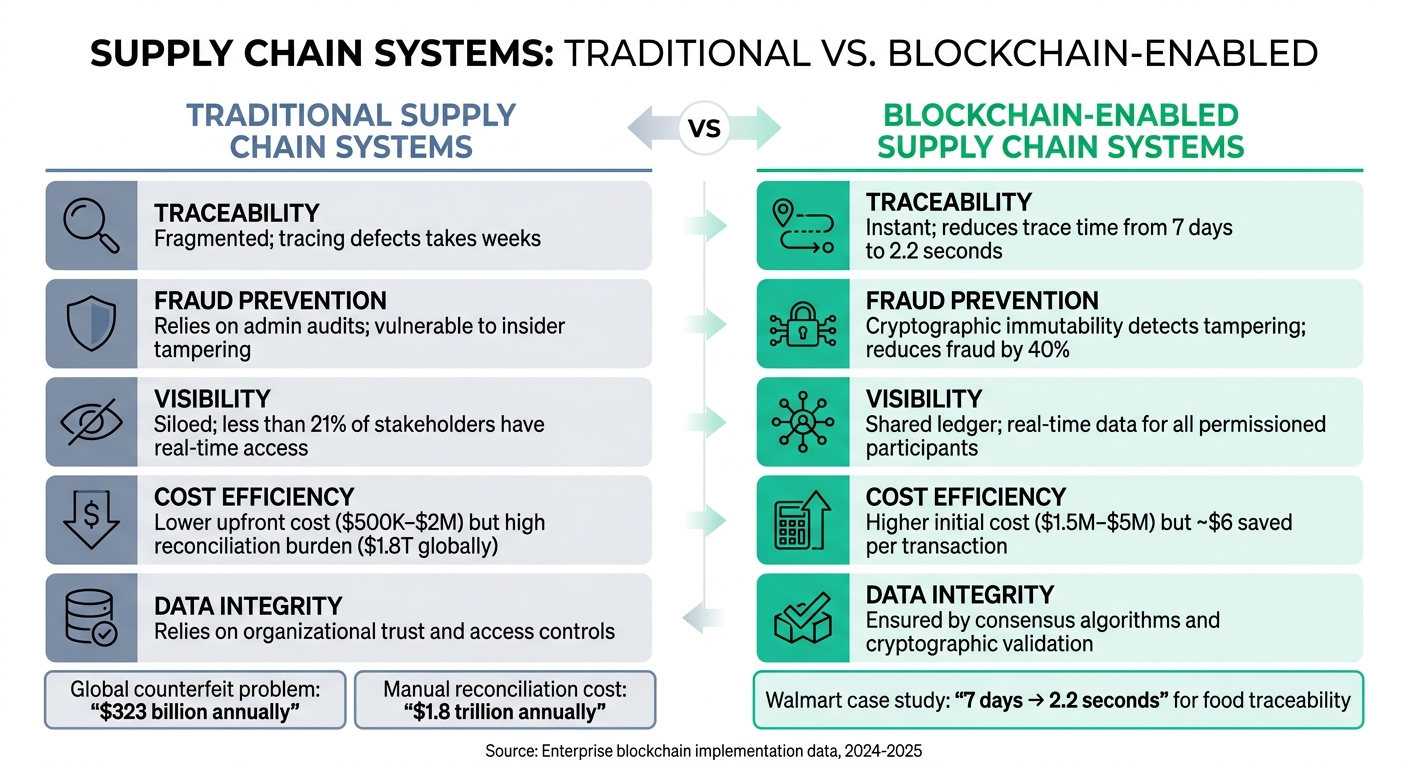
Traditional vs Blockchain Supply Chains: Key Differences in Speed, Cost, and Security
The divide between traditional and blockchain-enabled supply chains becomes evident when you look at how they handle core processes. Traditional supply chains rely on centralized databases, where records can be modified, while blockchain operates on an immutable ledger – a system where all participants maintain synchronized copies of the same data [17]. This distinction impacts everything from record management to cost efficiency and fraud prevention.
In traditional systems, authorized users can edit or delete records, leaving room for errors or intentional manipulation. Blockchain, on the other hand, uses an append-only model. Any corrections are logged as new transactions, preserving the full history [17].
When it comes to costs and fraud prevention, the differences are just as stark. Traditional systems often have lower upfront costs – typically ranging from $500,000 to $2 million for cloud-based ERP modules. However, manual reconciliation costs the global supply chain industry an estimated $1.8 trillion annually [17][2]. Blockchain implementations, while more expensive upfront ($1.5 million to $5 million for mid-sized pilots), eliminate many paper-based processes, saving about $6 per transaction [17][7]. For example, Maersk’s deployment of TradeLens in 2024 slashed paperwork costs by 40% across 15 million container journeys [7].
Fraud prevention also highlights blockchain’s edge. Traditional systems rely on access controls and trust within organizations, making them susceptible to insider tampering. Blockchain’s cryptographic immutability provides a tamper-proof audit trail. De Beers Group’s "Tracr" platform is a prime example – by 2024, it had tracked over 3 million diamonds from mine to retail, ensuring authenticity and preventing conflict-diamond contamination [17][2]. Similarly, the MediLedger consortium, involving companies like Pfizer and Gilead, enabled real-time drug verification, addressing the $3.3 trillion global counterfeit problem by covering over 80% of U.S. pharmaceuticals [2][7].
| Dimension | Traditional Supply Chain Systems | Blockchain-Enabled Supply Chain Systems |
|---|---|---|
| Traceability | Fragmented; tracing defects takes weeks [7] | Instant; reduces trace time from days to seconds (e.g., 7 days to 2.2 seconds) [17][7] |
| Fraud Prevention | Relies on admin audits; vulnerable to insider tampering [17] | Cryptographic immutability detects tampering; reduces fraud by 40% [17][7] |
| Visibility | Siloed; less than 21% of stakeholders have real-time access [7] | Shared ledger; real-time data for all permissioned participants [17][5] |
| Cost Efficiency | Lower upfront cost ($500K–$2M) but high reconciliation burden ($1.8T globally) [17][2] | Higher initial cost ($1.5M–$5M) but ~$6 saved per transaction [17][7] |
| Data Integrity | Relies on organizational trust and access controls [17] | Ensured by consensus algorithms and cryptographic validation [7] |
These contrasts lay the groundwork for examining how blockchain is transforming supply chains in practical enterprise settings.
Enterprise Blockchain Use Cases in Supply Chains
These examples showcase how enterprise blockchain applications improve traceability, transparency, and efficiency in supply chain operations.
IBM Food Trust for Cold Chain Logistics
Walmart’s pilot with IBM Food Trust transformed food safety from a reactive process into a proactive system. In 2018, Walmart used the platform – built on Hyperledger Fabric – to track mangoes in the U.S. and pork in China. The time required to trace these products dropped from nearly seven days to just 2.2 seconds [18][19].
Frank Yiannas, Walmart’s former Vice President of Food Safety, spearheaded the initiative and mandated its use for over 200 leafy greens suppliers by 2020. Today, the platform covers more than 25,000 products across hundreds of suppliers. By enabling precise, batch-specific recalls instead of broad category-wide removals, Walmart reduced food waste by 50% and improved consumer trust scores by 15–20% [18].
"Blockchain technology represents the most significant advancement in food safety since the introduction of Hazard Analysis and Critical Control Points (HACCP) systems."
- Frank Yiannas, former Vice President of Food Safety, Walmart [18]
The system also integrates IoT sensors to monitor temperature, humidity, and location during transport. If conditions deviate from safety parameters, smart contracts automatically flag violations [2][19]. For medium-sized companies, setup costs range from $50,000 to $200,000, with ROI typically achieved in 12–18 months through 30–40% administrative savings [18]. Golden State Foods, a major food processor operating 1,000 trucks and completing 25,000 weekly deliveries, uses this combination of blockchain and IoT to ensure temperature-sensitive shipments remain safe [19].
While IBM Food Trust focuses on food safety, other platforms are expanding blockchain’s role in broader supply chain verification.
Tracifier with Oracle Blockchain
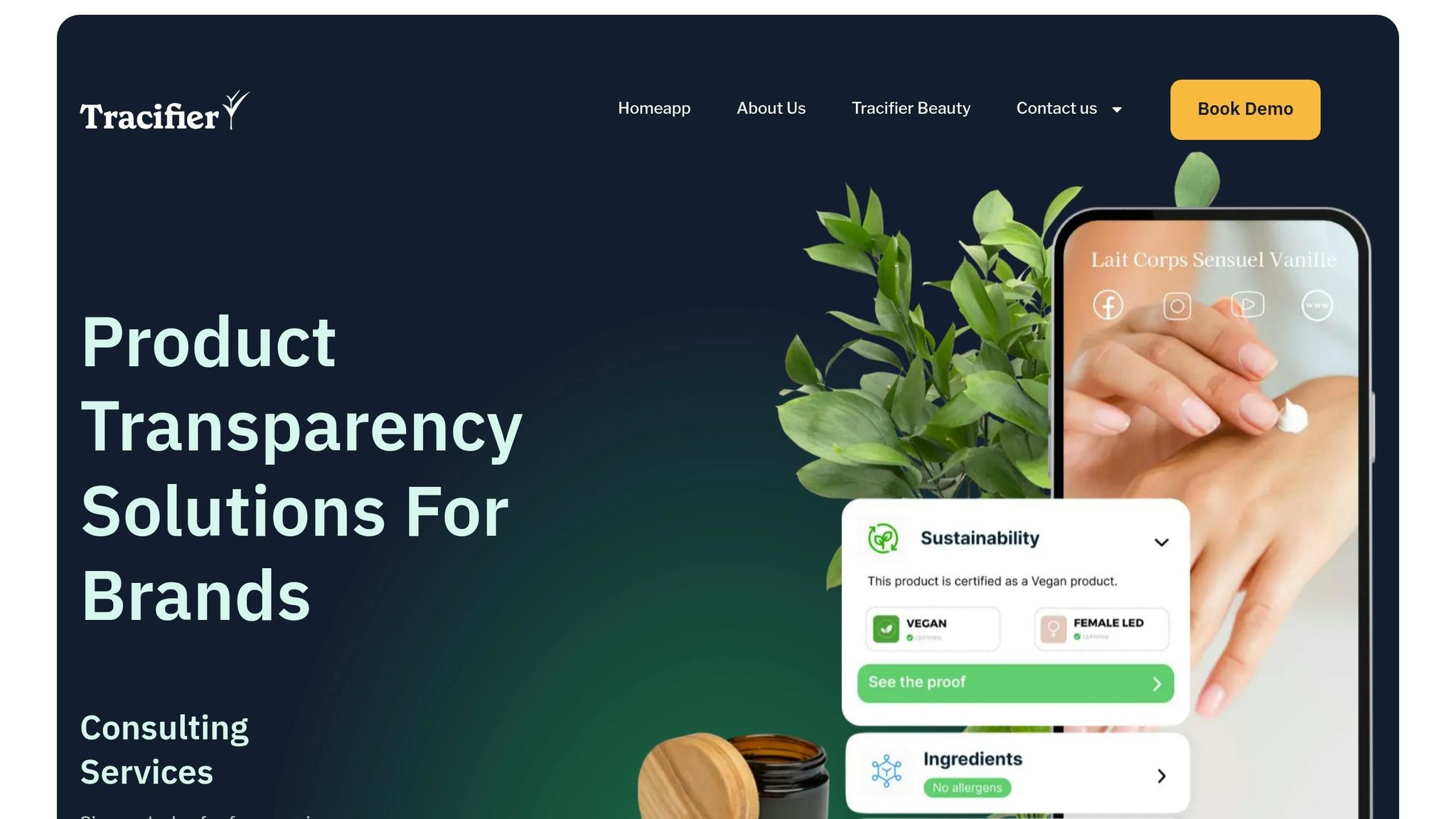
Tracifier, powered by Oracle Blockchain, tackles supply chain verification by creating a digital passport for products. Every step – from raw materials to finished goods – is recorded as a cryptographically sealed block [18]. This replaces fragmented paper records and disconnected spreadsheets with a unified, shared ledger accessible to authorized participants. The result is enhanced transparency and traceability throughout the supply chain.
While Oracle Blockchain simplifies product tracking, BanQu addresses challenges in tracing upstream suppliers.
BanQu for Supplier Traceability
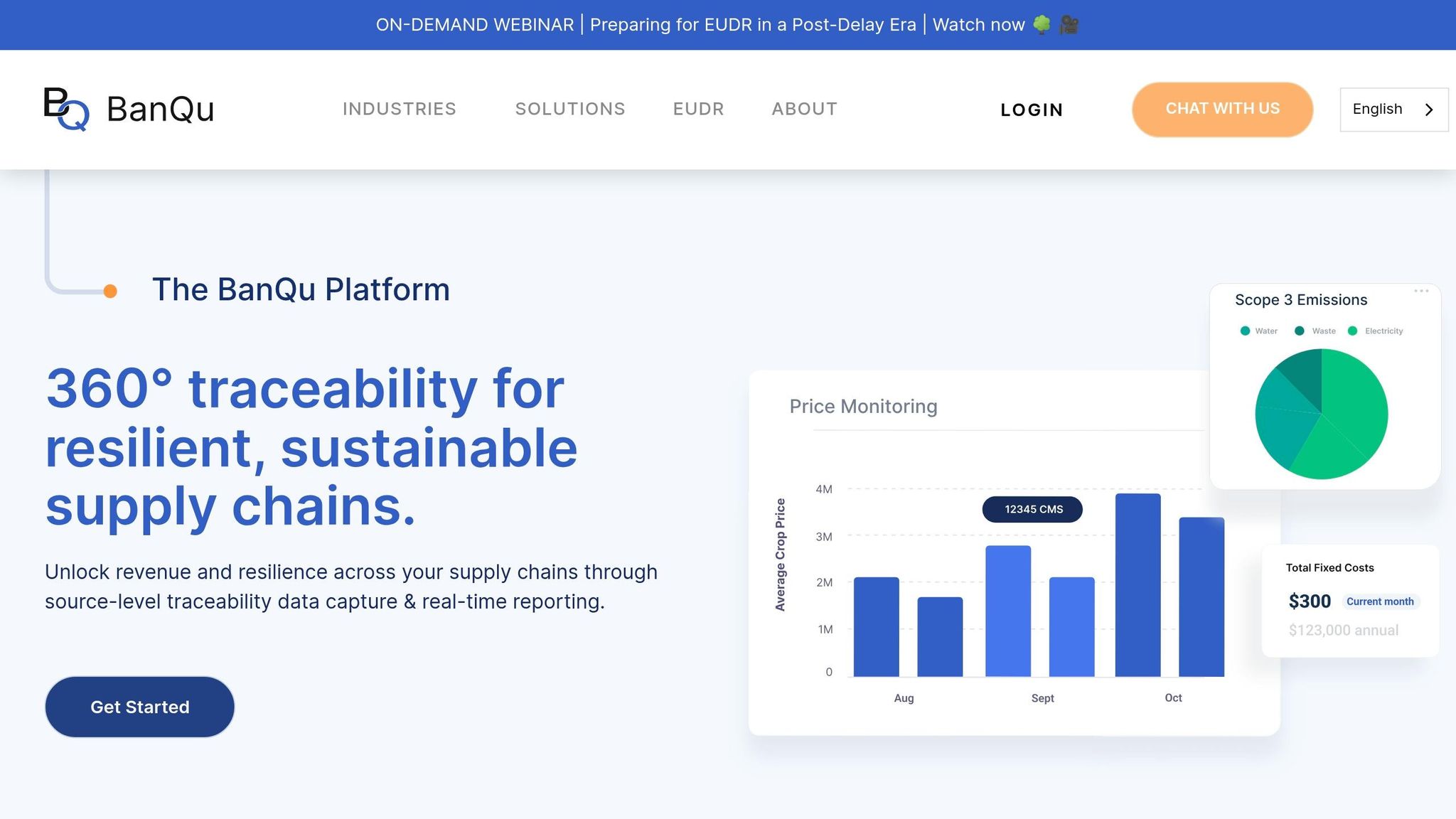
BanQu secures early-stage supplier data using decentralized storage. It resolves the "Paper Trail Problem", where crucial data often gets stuck in silos. By leveraging permissioned blockchain with role-based access controls, BanQu ensures transparency while maintaining commercial confidentiality. The platform integrates seamlessly with existing ERP systems, eliminating the need for a complete IT overhaul.
Implementation usually begins with a pilot focused on a single high-risk or high-value product line – such as cocoa, beef, or fresh vegetables – before scaling across the organization. As more participants join, the system’s overall value grows, making early supplier engagement a key factor for success.
Steps for Enterprises to Implement Blockchain in Supply Chains
A structured approach is essential to address inefficiencies in supply chains. Following a clear roadmap can help enterprises avoid common pitfalls that often derail blockchain projects before they reach full implementation.
Identify Key Pain Points
Start by pinpointing the processes where fragmented, multi-party data leads to high reconciliation costs and delays [20]. Blockchain works best in scenarios involving multiple parties where trust is lacking, making it less suitable for internal processes where centralized databases might perform better [1][20].
Focus on areas with high-value goods or strict regulatory requirements. For example, industries like pharmaceuticals, governed by the FDA’s Drug Supply Chain Security Act (DSCSA), or food suppliers dealing with safety recalls, can achieve faster returns through enhanced traceability and fraud prevention [2]. Establish success metrics early, balancing business goals like reducing cycle times with technical benchmarks such as network reliability [20]. This step is critical for selecting the right platform and designing a pilot that addresses key inefficiencies.
Select the Right Blockchain Platform
Choosing the right platform is a pivotal decision. For general traceability needs, Hyperledger Fabric often stands out due to its channel-based privacy model, which allows competitors to share a network without compromising sensitive data [2]. On the other hand, Hyperledger Besu is better suited for tokenization or supply chain finance, while R3 Corda excels in trade finance scenarios requiring point-to-point privacy [2].
"Hyperledger Fabric is the best default choice for most supply chain blockchain projects. Its channel-based privacy model solves the biggest supply chain problem – sharing a network with competitors without exposing confidential data."
- David Viejo, Writer, ChainLaunch [2]
When selecting a platform, ensure it integrates seamlessly with existing ERP systems, warehouse tools, and IoT devices using robust APIs and SDKs. Before any coding begins, establish governance rules – decide who operates nodes, how smart contracts are updated, and the process for onboarding new partners [2][20][21].
By 2025, supply chain traceability is expected to account for 31% of enterprise blockchain deployments, with spending projected to hit $3.6 billion by 2026 [2].
| Implementation Phase | Estimated Cost | Estimated Timeline |
|---|---|---|
| Pilot / MVP | $150,000 – $250,000 | 8–12 weeks |
| Production Rollout | $250,000 – $450,000 | 12–20 weeks |
| Consortium-Scale | $450,000 – $800,000+ | 20–36 weeks |
Annual maintenance costs typically range from $20,000 to $150,000+ depending on the scale [20].
Addressing the "Oracle Problem" – ensuring digital blockchain data matches physical goods – requires tools like IoT sensors, RFID tags, or multi-party verification methods [1]. Once the platform is selected and integrated, enterprises can move on to testing their solution through pilot projects.
Pilot Projects and Collaboration
Begin with a focused pilot project. Limit the scope to a single product line, one geographic region, and 2–3 participating organizations to validate the concept within 4–8 weeks [2]. For companies without the leverage to mandate participation, joining established networks like IBM Food Trust or MediLedger can be quicker and more cost-effective [1].
"The technology is rarely the bottleneck – partner onboarding and governance decisions take the most time."
- David Viejo, Writer, ChainLaunch [2]
Measure success using metrics like cycle time reduction, fewer disputes, and improved working capital efficiency rather than speculative value [20]. Conduct thorough technical audits and real-world scenario testing of smart contracts to avoid scaling errors [20]. Enterprises that have implemented blockchain report benefits like a 30% reduction in counterfeit products, a 25% boost in customer trust, and a 60% cut in compliance reporting costs [6].
Role of Web3 Investors in Driving Blockchain Adoption
Web3-focused investors are playing a key role in turning blockchain pilots into fully operational solutions. The main challenge here isn’t the technology itself but the steep costs tied to integration and governance alignment. For example, combining blockchain with ERP and IoT systems requires significant investment [2]. Many enterprises are hesitant to commit to these costs without clear proof of return on investment (ROI). This is where specialized investors step in, not only by providing funding but also by offering the strategic expertise needed to speed up implementation.
Take investors like Bestla VC, for instance. They go beyond just financial backing, offering deep knowledge in areas like decentralized infrastructure, advanced cryptography, and the intersection of AI and Web3. These skills are critical for solving integration and governance hurdles. Additionally, they help enterprises navigate complex regulatory frameworks, such as the FDA’s DSCSA and the EU’s MiCA, by funding tools like automated KYC/AML systems, hardware security modules, and zero-knowledge proofs [24][16]. This kind of support is vital, especially considering that 80% of executives believe blockchain will become central to commerce and supply chain operations [23], even though many companies lack the internal expertise to deploy these systems securely.
Another major hurdle is consortium governance, which investors help streamline [2]. Before any blockchain code is written, enterprises must decide on essential governance issues – like who will operate nodes, how smart contracts will be updated, and how new partners will join the network. Drawing on experience from previous deployments, Web3 investors connect companies with established networks like IBM Food Trust and MediLedger. This approach cuts down the time and costs of building solutions from scratch. Investors also provide access to specialized talent, which is crucial given that senior blockchain developers can earn salaries ranging from $150,000 to $200,000 [2][22].
The growing focus on real-world asset (RWA) tokenization and institutional DeFi by 2026 highlights how investors are pushing practical applications over speculative ventures [25][13]. By supporting startups that tackle critical issues like automated reconciliation and regulatory compliance, these investors help enterprises achieve measurable results. Examples include counterfeit detection rates exceeding 95%, recalls that are 80% faster, and a 70–90% reduction in verification workflows [13]. With blockchain spending in supply chain management projected to hit $3.6 billion by 2026 [2], these strategic investment partnerships are becoming indispensable for businesses looking to harness these efficiency gains.
"2026 is the first year blockchain becomes a standard part of enterprise digital transformation."
- Jason Ansell [4]
This kind of investor-backed support not only addresses operational challenges but also lays the groundwork for broader blockchain integration in supply chains.
Conclusion
Blockchain has evolved into a foundational component of enterprise supply chains, replacing outdated, fragmented systems with a shared, unchangeable ledger. This technology brings real-time traceability and enables automated workflows through smart contracts. With the global blockchain supply chain market expected to hit $5.23 billion by 2026 [5], industries ranging from pharmaceuticals to food safety and diamonds are moving beyond pilot programs to fully operational deployments.
Practical applications and strategic investments are now driving blockchain’s widespread adoption in supply chains. However, integrating blockchain with existing ERP and IoT systems requires careful planning. Decisions about governance – such as who operates nodes, how smart contracts are updated, and how partners join the network – must be addressed early. Additionally, solving the "oracle problem" is essential, as blockchain’s reliability depends on accurate physical data from IoT sensors and tamper-proof tokens [1][2]. Specialized Web3 investment strategies play a crucial role, offering technical expertise and guidance to navigate regulatory frameworks like the FDA’s DSCSA and the EU’s MiCA. With around 77% of projects stalling before reaching production [2], these investors help bridge the gap, enabling systems that deliver real results: over 95% accuracy in detecting counterfeits, 80% faster recall processes, and reductions in verification workflows by 70–90% [13].
For businesses looking to adopt blockchain, the best approach is to start with a focused pilot targeting high-impact areas like food safety or pharmaceutical serialization. Choosing the right platform is key – Hyperledger Fabric works well for multi-competitor networks, while Hyperledger Besu is ideal for tokenization. Equally important is prioritizing data quality and establishing strong consortium governance from the beginning. Blockchain now offers measurable improvements in efficiency and cost savings across global supply chains.
"Blockchain is no longer the experiment – it’s the infrastructure."
- Jason Ansell [4]
FAQs
When does blockchain make more sense than a normal database?
Blockchain stands out as the better choice over traditional databases when trustless verification, transparency, and immutability are priorities. Instead of relying on a central authority, blockchain operates through a decentralized ledger. This setup makes it incredibly difficult to alter data retroactively without the agreement of the network, ensuring both security and data integrity.
This approach is particularly valuable in scenarios like supply chains, where tracking product authenticity is crucial. It’s also ideal for multi-party collaborations that need secure, tamper-resistant records without depending on intermediaries to maintain trust.
How do you keep supply chain data private on a shared blockchain network?
Enterprises safeguard supply chain data on a shared blockchain by using permissioned blockchains, which restrict access to sensitive information. These blockchains incorporate privacy tools such as private data collections, channels, and privacy groups, ensuring that only authorized participants can access specific details. Additionally, secure key management technologies add another layer of protection, allowing businesses to balance privacy with the transparency and immutability that blockchain technology provides.
What’s the fastest way to run a low-risk blockchain pilot with partners?
The fastest way to launch a low-risk blockchain pilot is by leveraging rapid deployment platforms. These platforms allow you to set up enterprise-grade networks, such as Hyperledger Fabric or Besu, in just minutes. Choosing a permissioned blockchain model is key to maintaining data privacy and controlling access. On top of that, using AI-driven tools for smart contract testing and automated configurations can simplify the setup process, minimize risks, and speed up collaboration during the pilot phase.