


Decentralized exchanges (DEXs) are growing rapidly, handling $15 billion in monthly trading volume. However, they face five major challenges when it comes to interoperability across blockchains:
- Security Risks: Cross-chain bridges account for over 50% of DeFi hack losses, with vulnerabilities like validator key compromises and signature bugs leading to billions in stolen funds. Zero-knowledge proofs and stronger audits are helping mitigate risks.
- Lack of Standardization: Different blockchains use unique transaction models, making communication difficult. Protocols like ERC-7683 and IBC aim to unify blockchain interactions.
- Fragmented Liquidity: Liquidity is split across chains, leading to inefficiencies and higher slippage. Aggregators and unified liquidity solutions are tackling this issue.
- Poor User Experience: Cross-chain transactions are complex, with 70% of users abandoning bridge processes. Simplified interfaces and gas abstraction are improving usability.
- High Costs and Delays: Fees and latency in cross-chain trading remain high, but Layer-2 solutions and optimized standards are reducing these barriers.
These challenges highlight the fragmented state of blockchain ecosystems, but emerging technologies and collaborative efforts are addressing the gaps to create a more interconnected future.
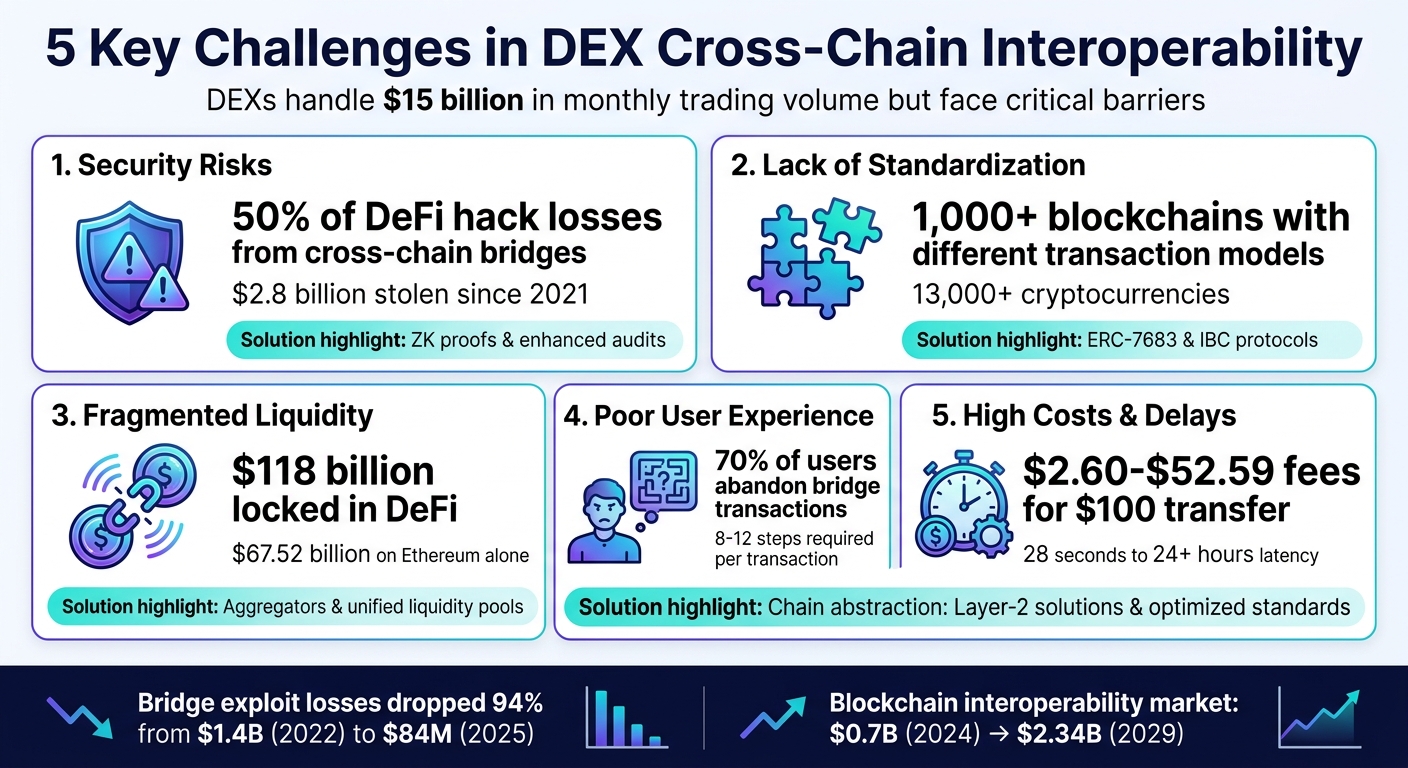
5 Key Challenges in DEX Cross-Chain Interoperability
Building a Cross-Chain DEX with Chain Abstraction & Intents by Shao | Devcon SEA
sbb-itb-c5fef17
Challenge 1: Security Risks in Cross-Chain Bridges
Cross-chain bridges may handle less than 10% of DeFi’s total value locked, but they account for more than 50% of all funds stolen in DeFi exploits [7]. Since 2021, hackers have siphoned off over $2.8 billion from these protocols [6][9][10], making security the most urgent issue in decentralized exchange (DEX) interoperability.
Common Exploits in Cross-Chain Transfers
Hackers often exploit three primary vulnerabilities in cross-chain bridges:
- Validator key compromise: This is the most damaging type of attack. For instance, in the Ronin Bridge hack (March 2022), attackers stole 5 out of 9 validator private keys – 4 from Sky Mavis and 1 from Axie DAO – through phishing and social engineering. They then forged withdrawal attestations to steal $625 million [6][7]. The issue stemmed from overly concentrated key control and failure to revoke temporary signing access.
- Signature and proof verification bugs: Smart contract flaws provide another attack route. In February 2022, Wormhole Bridge lost $326 million when a contract bug on Solana failed to properly verify a system account during signature validation. This allowed a hacker to forge a message claiming a deposit of 120,000 ETH on Ethereum [6][10]. Similarly, in October 2022, the BNB Bridge hack exploited faulty Merkle tree path validation, enabling an attacker to forge a proof for 2 million BNB (worth $570 million) [6].
- Logic and initialization errors: These can bypass verification entirely. The Nomad Bridge hack (August 2022) is a prime example. A routine upgrade accidentally set the "trusted root" to
0x00, causing the system to accept any message with this root as valid. Exploiting this, attackers drained $190 million through fraudulent withdrawals [6][7].
| Verification Type | Trust Assumption | Primary Vulnerability |
|---|---|---|
| External Validators | Majority of validators are honest | Key compromise, collusion, signature bugs [6] |
| Optimistic | At least one honest watcher exists | Dispute mechanism bugs, short challenge windows [6] |
| Light Client | Source chain consensus is secure | Proof verification bugs, consensus attacks [6] |
| ZK Proofs | Mathematics and implementation | Circuit bugs, prover/verifier flaws [6] |
Solutions: Advanced Cryptography and Security Audits
Addressing these vulnerabilities requires stronger, mathematically grounded defenses. One promising approach is zero-knowledge (ZK) proofs, which remove reliance on external validators. Instead, they cryptographically verify that a transaction occurred on the source chain. As NomosLabs puts it:
"ZK bridges use zero-knowledge proofs to cryptographically prove that a transaction occurred on the source chain without trusting any external validator" [6].
While ZK-based bridges currently cost 8–12x more than optimistic bridges, they provide unmatched security by replacing human trust with mathematical guarantees [8].
Other solutions include Multi-Party Computation (MPC) and Threshold Signature Schemes (TSS), which eliminate single points of failure in traditional multisig setups. These techniques allow validators to collaboratively generate signatures without any single party holding the full private key [11][6][12]. LayerZero v2 enhances this by separating the "oracle" (which attests to block headers) from the "relayer" (which submits transaction proofs), making it harder for attackers to forge messages without collusion between independent systems [8].
Comprehensive security audits are essential for preventing exploits. These audits should go beyond code reviews to include thorough testing of attestation verification logic, ensuring validator independence, and implementing timelocks of 7+ days for contract upgrades [6][7][13]. Additional safeguards, like rate limiting, can cap the maximum transferable volume over a set time, reducing the risk of draining an entire treasury in a single attack [7][9].
The results of these efforts are encouraging. From a peak of $1.4 billion in 2022, bridge exploit losses dropped 94% by value to just $84 million in 2025 [8]. However, with billions of dollars still locked in bridges, ongoing vigilance through regular audits, bug bounty programs, and cautious rollouts with low total value locked (TVL) caps remains critical [7][14].
Challenge 2: Lack of Standardization Across Blockchains
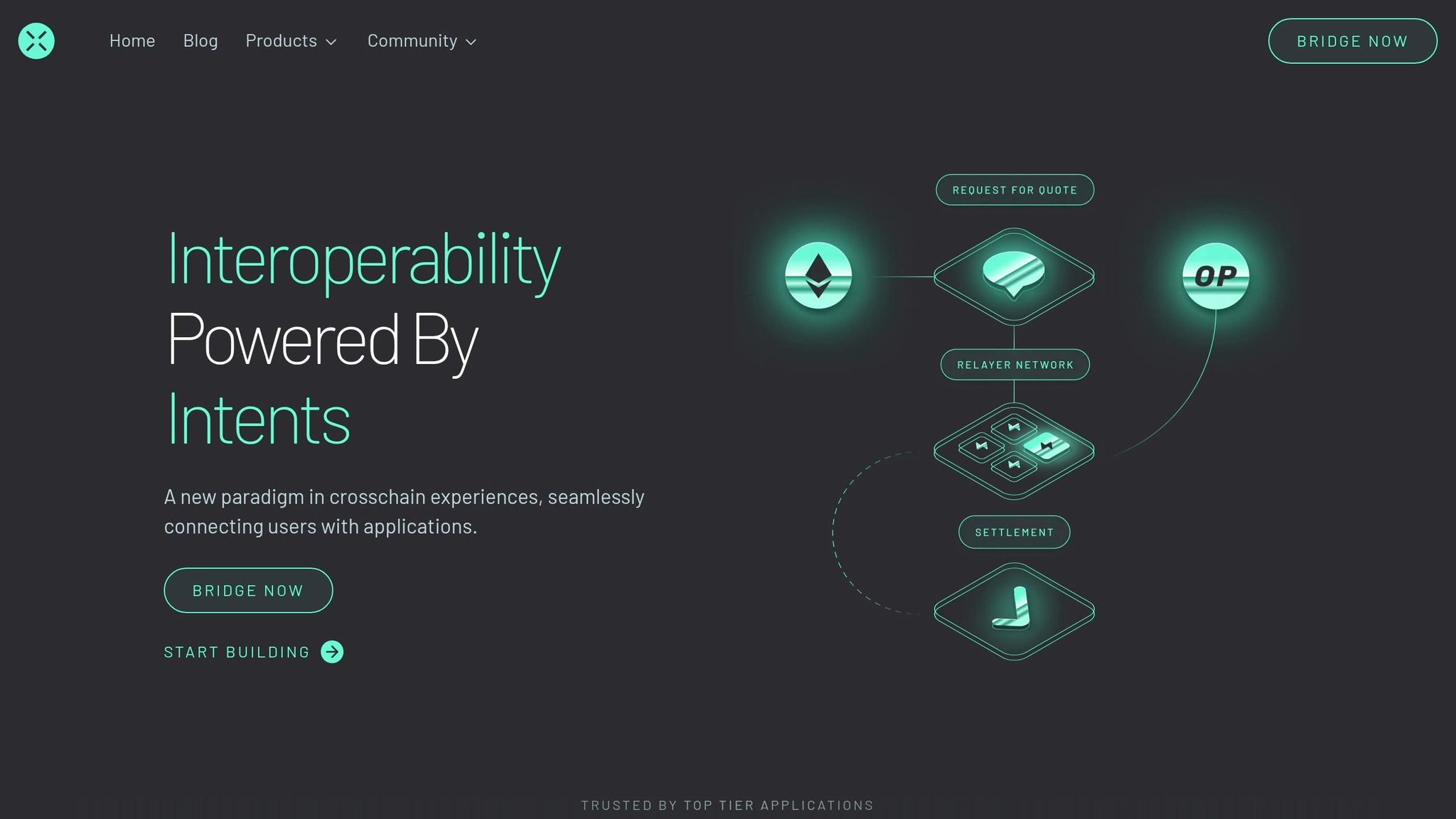
Each blockchain operates in its own unique way. For instance, Ethereum uses an account-based system with nonces and gas, while Bitcoin adopts a UTXO (Unspent Transaction Output) model. These differences in transaction structures make it nearly impossible to directly map data between blockchains [1][2]. With over 13,000 cryptocurrencies spread across more than 1,000 blockchains [20], the variety of execution environments – like Ethereum’s EVM, Solana’s SVM, MoveVM, and CosmWasm – adds another layer of complexity. Smart contracts written in one language, such as Solidity, can’t naturally interact with those written in another, like Rust, requiring intricate translation layers that increase both costs and risks.
How Fragmented Standards Block Communication
Transaction finality is another hurdle that amplifies the challenge of interoperability. Ethereum takes around 13 minutes to achieve deterministic finality, Solana does it in under a second, and Bitcoin relies on probabilistic finality, typically needing six or more blocks [1][14]. For a decentralized exchange (DEX) executing a cross-chain trade, these discrepancies create vulnerabilities, such as double-spending risks. If a bridge releases assets on the destination chain before the source transaction is fully confirmed, it opens the door to potential exploitation.
Token standard inconsistencies also disrupt liquidity. The rise of "wrapped" tokens – different versions of WETH minted by various bridges – has led to what experts call "token identity confusion" [15]. This fragmentation directly affects capital efficiency, especially when you consider the $118 billion locked in DeFi as of November 2024, with $67.52 billion concentrated on Ethereum Mainnet [17]. Traders face challenges in finding optimal prices, often encountering increased slippage. Addressing these fragmented standards is crucial for achieving smooth DEX interoperability.
Universal Protocols and APIs as a Solution
Standardized frameworks are emerging to bridge these gaps. Protocols like ERC-7683 and the Inter-Blockchain Communication (IBC) protocol serve as a "TCP/IP layer" for blockchains, enabling seamless data exchange across networks without intermediaries [17][19]. Over 40 projects have already pledged support for ERC-7683, aiming to unify the Ethereum ecosystem and reduce cross-chain friction [17].
In 2024, the Australia and New Zealand Banking Group (ANZ) successfully used Chainlink‘s Cross-Chain Interoperability Protocol (CCIP) to facilitate the cross-chain transfer of its A$DC stablecoin, enabling clients to purchase tokenized assets across various networks [19]. Similarly, Lido, a liquid staking provider, adopted Wormhole’s Native Token Transfer (NTT) infrastructure to bridge tokens to the BNB Chain while maintaining their original properties [19]. These examples highlight how universal protocols simplify multi-chain interactions, allowing developers to create DEXs that interface with multiple blockchains through a single platform. The momentum toward standardization is evident, with the blockchain interoperability services market expected to grow from $0.7 billion in 2024 to $2.34 billion by 2029, representing a compound annual growth rate of 26.8% [16].
Challenge 3: Fragmented Liquidity Across Chains
Most blockchains operate as isolated silos, with assets and liquidity confined to their own ecosystems [22]. Every time a new blockchain is launched, it usually spawns its own set of DEXs and AMMs, creating separate pools of capital [21][23]. This setup often results in the same token having different prices across various blockchains, leading to market inefficiencies that negatively impact both traders and liquidity providers [21].
Despite DEX aggregators handling over $13.5 billion in daily trading volume [24], they face the persistent challenge of fragmented liquidity spread across numerous networks that don’t communicate with one another. Moving assets between chains isn’t seamless – users must rely on manual processes like bridging or wrapping tokens, which introduces technical hurdles [21][22]. This fragmentation forces liquidity providers to spread their funds across multiple ecosystems to chase returns, leaving individual pools with lower liquidity depth [22]. This isolation not only divides markets but also creates unique liquidity challenges for each blockchain.
The Problem of Isolated Liquidity Pools
When liquidity is shallow on a single chain, traders face higher slippage or even failed transactions [21]. Transferring capital between chains adds multiple layers of cost, including gas fees on both ends and bridge fees, which discourages smooth asset movement and contributes to high rates of abandoned transactions [22][5].
Another complication is the "oracle problem." Price oracles across DEXs update at different speeds, making accurate cross-chain price comparisons difficult [24]. For instance, Ethereum’s 12-second block times differ significantly from Solana’s 400ms blocks, creating challenges for aggregators trying to provide accurate price data across chains. As one protocol researcher noted:
"The aggregator’s entire value proposition – finding you the best execution – gets undermined by oracle coordination failures it has no control over." – Raphthelight [24]
This fragmented setup reduces the efficiency of DEXs and highlights the urgent need for interconnected liquidity solutions.
Aggregator Protocols and Unified Liquidity Pools
To address these liquidity challenges, new solutions such as aggregators and unified liquidity protocols have emerged. DEX aggregators like 1inch, ParaSwap, and Jupiter use smart order-routing to scan hundreds of liquidity pools across multiple chains, minimizing price impact by splitting orders efficiently [26]. Similarly, bridge aggregators like LI.FI and Rango combine various bridges and DEXs into a single routing engine, enabling users to perform cross-chain swaps in one step [21].
In March 2025, BlackRock’s USD Institutional Digital Liquidity Fund expanded beyond Ethereum to include Aptos, Arbitrum, Avalanche, Optimism, and Polygon, boosting cross-chain liquidity [27]. Likewise, in November 2024, JPMorgan’s Tokenized Collateral Network (TCN) reported processing over $300 billion in repo and collateral transactions, leveraging blockchain infrastructure to unify institutional liquidity [27].
The emerging concept of a Unified Liquidity Layer (ULL) aims to tackle liquidity fragmentation. This invisible framework allows liquidity from any source to be accessed on demand by any application or protocol [21]. Intent-based execution models, where users specify their desired outcomes and professional "solvers" compete to find the best route, are gaining momentum as a way to simplify the process [23][24]. As one industry expert put it:
"DEXs that don’t go cross-chain will be irrelevant faster than they expect." – Evan Walker [23]
Challenge 4: Complexity and Poor User Experience
Cross-chain transactions face more than just technical and liquidity hurdles – user experience issues significantly hinder trust and adoption.
One of the biggest obstacles to mainstream adoption is the complicated nature of cross-chain trading. Right now, using a typical cross-chain bridge can involve 8–12 steps, requiring users to deal with a maze of technical details [5]. This complexity overwhelms many and makes the process feel anything but user-friendly.
The Problem with Gas Tokens and Unpredictable Timelines
A major pain point is managing gas tokens. Users need to hold native gas tokens for both the source and destination chains (like ETH for Ethereum and MATIC for Polygon). Many wallets, including MetaMask’s mobile app, don’t offer integrated bridge functionality to streamline this process [4][5]. If users don’t have enough gas tokens on the destination chain, their assets can get stuck.
Adding to the frustration, transaction times vary wildly. Depending on the protocol and chain finality rules, transfers can take anywhere from 28 seconds to over 24 hours [5]. These challenges highlight the need for a simpler, more intuitive system to manage cross-chain transactions.
How Complexity Affects Adoption
The numbers tell a clear story: complexity is driving users away. A staggering 70% of users abandon bridge transactions during the approval process due to the confusing steps and high costs involved [5]. On top of that, 5–15% of transactions fail during periods of network congestion, and 15–30% of those failures require manual troubleshooting to recover funds [5]. This often means users must understand advanced concepts like "transaction replay" – a skill most don’t have.
The time investment is another issue. By late 2025, the average DeFi user was spending over 40 minutes per week just managing cross-chain operations [28]. Costs are equally unpredictable: transferring $100 can cost anywhere from $2.60 to $52.59, depending on the protocol and network congestion [5]. Monthly expenses for token approvals alone can range between $100 and $300 [5].
The complexity is also deterring new users. A survey by RIF found that 19.8% of participants hesitate to enter the market due to the overwhelming variety of networks, while 13.5% cited onboarding and accessibility challenges as their primary barriers [4]. As Kostiantyn Tsentsura from Yellow.com put it:
"Today’s bridge experience requires users to understand technical concepts that shouldn’t be their responsibility: validator signatures, finality periods, wrapped token mechanics, and gas estimation across multiple chains." [5]
The Role of Simplified Interfaces and Abstraction Layers
Simplifying the user experience isn’t just about convenience – it’s key to enabling broader decentralized exchange (DEX) interoperability. Chain abstraction hides the underlying blockchain complexities, making the process feel seamless, much like how the TCP/IP layer works invisibly for internet users [28].
With intent-based architecture, users no longer need to micromanage every step. Instead, they simply state their desired outcome. From there, off-chain agents known as "solvers" handle the execution, finding the best path to complete the transaction. This removes much of the execution risk from users, ensuring funds don’t get stuck if something goes wrong [28][29].
Real-World Solutions in Action
Some platforms are already making strides in simplifying cross-chain interactions:
- Particle Network‘s Universal Accounts: These accounts consolidate balances from over 60 chains into a single view. Users can execute transactions on any chain, with the system automatically moving funds as needed [28].
- Etherspot‘s Pulse Engine: Introduced in late 2024, this tool allows users to perform cross-chain swaps (like Ethereum to Base) with a single click. It bundles multiple actions into a single meta-transaction [29].
- Gas Abstraction: New systems let users pay gas fees in any asset or have them sponsored by the application, eliminating the need to hold native tokens for every chain [28][29].
Standards like ERC-7683 are also helping reduce fragmentation by allowing different filler networks and protocols to work together [29][30].
"A truly user-centric Web3 future must abstract away blockchains, making the multi-chain world feel as easy as a single network." [29]
Challenge 5: High Transaction Costs and Latency
Even after overcoming the complexities of cross-chain trading, users face another significant obstacle: unpredictable and often high transaction costs. These costs, combined with delays, make cross-chain DEX trading feel inefficient compared to sticking with a single blockchain. The financial strain and time lags further complicate the adoption of cross-chain decentralized exchanges.
The Impact of Fees and Delays
Transaction costs in cross-chain trading come from multiple sources. These include gas fees on both blockchains, relayer charges, protocol markups, fees from liquidity imbalances, slippage, and MEV premiums [32]. For ERC-20 tokens, users often need to pay for an additional approval transaction before bridging, effectively doubling the gas fees [5]. This layered fee structure makes cross-chain trading not only expensive but also unpredictable, adding another layer of difficulty for users seeking smooth and secure interoperability.
| Route Type | Average Fee (ETH Transfer) | Latency |
|---|---|---|
| Direct/Canonical Bridge | $12 – $25 | 15 – 30 minutes |
| Fast Messaging (LayerZero/Wormhole) | $8 – $18 | 2 – 5 minutes |
| Liquidity Pool (Stargate) | $5 – $12 | 1 – 3 minutes |
| Optimized Arbitrage Route | $3 – $8 | 3 – 8 minutes |
Source: [32]
Delays in transaction processing further compound the inefficiencies. Completion times can range from as short as 28 seconds to over 24 hours, depending on the method and network conditions [5]. For example, Ethereum’s finality period takes around 15 minutes before assets can be safely transferred across a bridge [5]. In the case of optimistic rollups, native withdrawals involve a 7-day challenge period [18]. Furthermore, during high network congestion, bridge success rates can plummet from over 95% to as low as 60% [5].
Layer-2 Solutions and Optimized Standards
Layer-2 (L2) networks offer a practical way to cut both costs and delays. By processing transactions off-chain and bundling thousands of them into a single proof submitted to the main chain, L2 networks significantly reduce the computational burden on Layer-1 (L1) blockchains [33][31]. This approach results in L2 transactions being 10–100 times cheaper than those on Ethereum L1 [33]. Following the adoption of EIP-4844 in early 2025, L2 fees dropped another 10× [33].
For example, a Uniswap swap costing $5–$30 on Ethereum L1 might only cost $0.10–$0.50 on Arbitrum and as little as $0.01–$0.05 on Base [33]. These lower fees make smaller trades feasible again, addressing a key pain point for users.
Building on these advancements, optimized standards like ERC-7683 have emerged to further streamline costs and reduce delays. Intent-based bridging, enabled by ERC-7683, allows competitive solvers to find the most efficient routes for transactions [31][25]. Solutions like Across and Connext use pre-funded transactions to deliver assets instantly on the destination chain, avoiding the slow settlement times of traditional methods [31][5].
In September 2025, Circle’s Cross-Chain Transfer Protocol (CCTP) introduced native USDC transfers with fees as low as $0.01–$0.10 per message and latency of just 1–5 minutes [5]. Additionally, L2-to-L2 routes have proven particularly effective for smaller transfers. For instance, 91% of transfers on router-based networks like Connext are completed in under an hour [31].
Conclusion
The challenges of security vulnerabilities, fragmented standards, isolated liquidity, poor user experience, and high costs represent more than just technical hurdles – they are major roadblocks to creating a unified ecosystem where decentralized exchanges can rival centralized platforms. Together, these issues highlight the stark divide between the current fragmented blockchain landscape and the vision for seamless cross-chain interoperability. As Arthur C. Codex from Reintech explains:
"Cross-chain interoperability… is the technology that enables blockchains to exchange data and value without intermediaries – think of it as the TCP/IP layer for blockchain networks" [1].
The risks tied to these challenges are hard to ignore. In just the first half of 2025, bridge exploits resulted in losses exceeding $2.3 billion, and high user abandonment rates emphasize the need for simpler, more intuitive systems [5]. These numbers underline one thing: solving interoperability isn’t just a technical goal – it’s essential for DeFi to gain mainstream traction.
Fortunately, new solutions are emerging to address these barriers. Intent-based architectures simplify the user experience, letting users focus on their goals without worrying about gas tokens or wrapped assets [5][1]. Meanwhile, advancements like zero-knowledge proofs are replacing older, riskier methods [1][2]. Transaction costs have also dropped significantly thanks to improvements in Layer-2 and Layer-3 technologies. For instance, Circle’s CCTP has shown that native asset transfers can scale effectively, with fees as low as $0.01–$0.10 and transaction times ranging from 1 to 5 minutes [5].
Caldera highlights the importance of solving these issues:
"The future of Ethereum scalability depends on solving this interoperability challenge. Rollups must function not as isolated chains but as cohesive components of a unified ecosystem" [3].
The ability to scale Ethereum – and blockchain networks as a whole – rests on overcoming these obstacles. Transitioning from isolated blockchain silos to an interconnected network is key to delivering secure and efficient decentralized financial services.
Tackling these challenges calls for a collaborative approach, involving efforts in security audits, standardizing protocols, aggregating liquidity, improving user interfaces, and optimizing scalability. Successfully addressing these issues will lay the groundwork for a safer, more unified, and accessible decentralized exchange ecosystem. At Bestla VC, we believe that overcoming these barriers is crucial to building the interoperable and decentralized future that the Web3 community envisions.
FAQs
What’s the safest way to swap tokens across chains?
When swapping tokens across different blockchains, it’s best to stick with reputable cross-chain bridges or DEX aggregators that prioritize security. Look for tools that use features like audited smart contracts and intent-based settlements to minimize risks, such as bugs or asset de-pegging. Always ensure you’re using official interfaces and steer clear of unverified services to avoid phishing scams or hacking attempts. By combining trusted bridges with secure aggregators, you can create a safer and more reliable way to handle cross-chain token swaps.
Will one interoperability standard win out?
The Web3 ecosystem probably won’t settle on a single interoperability standard. Instead, the space remains divided, with different methods tailored to meet specific demands. Experts describe interoperability as a spectrum – gradually moving toward more connected solutions. Still, it’s likely that multiple standards will coexist, each designed for unique use cases, rather than one universal standard taking over. This mirrors the varied and shifting requirements within decentralized finance.
How can cross-chain swaps get cheaper and faster?
Cross-chain swaps get a boost in both speed and cost efficiency with Layer-2 scaling solutions like rollups and sidechains. These technologies work by processing transactions off-chain and then settling them in batches, which helps cut down on fees and processing times. On top of that, improvements in cross-chain liquidity protocols, messaging layers, and secure bridges simplify asset transfers, fine-tune routing, and reduce the need for intermediaries. The result? Faster and more affordable swaps for DeFi users.