


KYC-gated DeFi pools are reshaping decentralized finance by creating secure, controlled environments tailored for institutional investors. Unlike traditional DeFi, these pools require participants to pass identity verification (KYC) and adhere to regulatory standards, making them more appealing for banks, hedge funds, and asset managers. Key features include:
- Compliance-first approach: Ensures adherence to anti-money laundering (AML) laws and counterparty verification.
- On-chain transparency: Uses whitelists and attestations to allow only verified wallets to interact with smart contracts.
- Institutional adoption: By mid-2025, over 900 institutions engaged with permissioned platforms, managing $41 billion in DeFi exposure.
These pools address institutional concerns around legal risks, counterparty exposure, and regulatory obligations while offering competitive yields (8–15%) compared to traditional investments like U.S. Treasuries (2–4%). Challenges like low liquidity, fragmented onboarding, and technical hurdles remain, but evolving frameworks like the GENIUS Act of 2025 are paving the way for broader adoption.
KYC-gated pools bridge the gap between decentralized innovation and institutional requirements, offering a compliant pathway for professional capital to enter the Web3 ecosystem.
Digital Assets 101: Intro to Permissioned DeFi | Fireblocks Academy

sbb-itb-c5fef17
How Permissioned Liquidity Works
Permissioned liquidity operates through a layered verification system that restricts access to decentralized finance (DeFi) while ensuring blockchain transparency. It starts with identity checks conducted off-chain, followed by registering credentials on-chain, and ends with smart contract enforcement to manage transactions.
KYC and AML Verification Process
The process kicks off off-chain, where users provide identity documents to an approved custodian. These custodians handle Know Your Customer (KYC) and Anti-Money Laundering (AML) checks, verifying details like government-issued IDs, conducting background checks, and cross-referencing global sanctions lists. Once a user is approved, their wallet address is submitted to an on-chain "Allowlister" smart contract. This grants them transaction permissions while keeping sensitive personal details off the blockchain [5][2].
Some systems incorporate Zero-Knowledge Proofs (ZKPs), which allow users to prove compliance – like confirming they’re not on a sanctions list – without revealing personal information [6][3]. This approach ensures that compliance is managed off-chain while credentials are verified on-chain [6].
By late 2025, Keyring Connect, a tool designed for on-chain institutional verification, had secured $105 million in Total Value Locked (TVL), highlighting the growing reliance on these mechanisms [3].
On-Chain Whitelists and Access Control
After verification, a user’s wallet is added to an on-chain whitelist. Smart contracts then consult a "Permission Manager" before processing any transaction, whether it’s a deposit, borrowing, or trading tokens [7]. This setup allows compliance providers or custodians to manage eligibility without requiring protocol teams to redeploy contracts.
A practical example of this is Coinbase Verified Pools on the Base network. These pools use attestations registered via the Ethereum Attestation Service (EAS) as access credentials [1]. When a user interacts with a pool, the smart contract checks the registry to confirm their "Coinbase Verification." Verified users can proceed, while others are blocked.
Permissions aren’t permanent. Protocols include mechanisms to revoke access if compliance status changes – for instance, if accreditation expires or a wallet is flagged for suspicious activity [5][7]. As noted by Vectorlane:
"Permissioned pools on public blockchains aren’t a contradiction. They’re a design stance: Open infrastructure, controlled participation."
- Vectorlane [7]
This dynamic approach to access control paves the way for specialized permissioned pools tailored to institutional needs.
Types of Permissioned DeFi Pools
Permissioned pools are designed to meet different institutional requirements:
- Lending Pools and RWA Tokenization Pools: These pools provide compliant on-chain markets for institutions, addressing counterparty risk and AML needs [3].
- Liquid Staking Protocols: Solutions like Liquid Collective require users to be on an allowlist before depositing or redeeming assets like LsETH, ensuring enterprise-level stakers only interact with verified participants [5].
- Curated Vaults: Managed by third-party experts or compliance providers, these vaults oversee risk and KYC verification. For example, Euler vaults curated by Keyring offered delta-neutral stablecoin strategies with 8–15% base yields by mid-2025, far surpassing the 2–4% yields from U.S. Treasuries [3].
Regulatory Requirements and Compliance Benefits
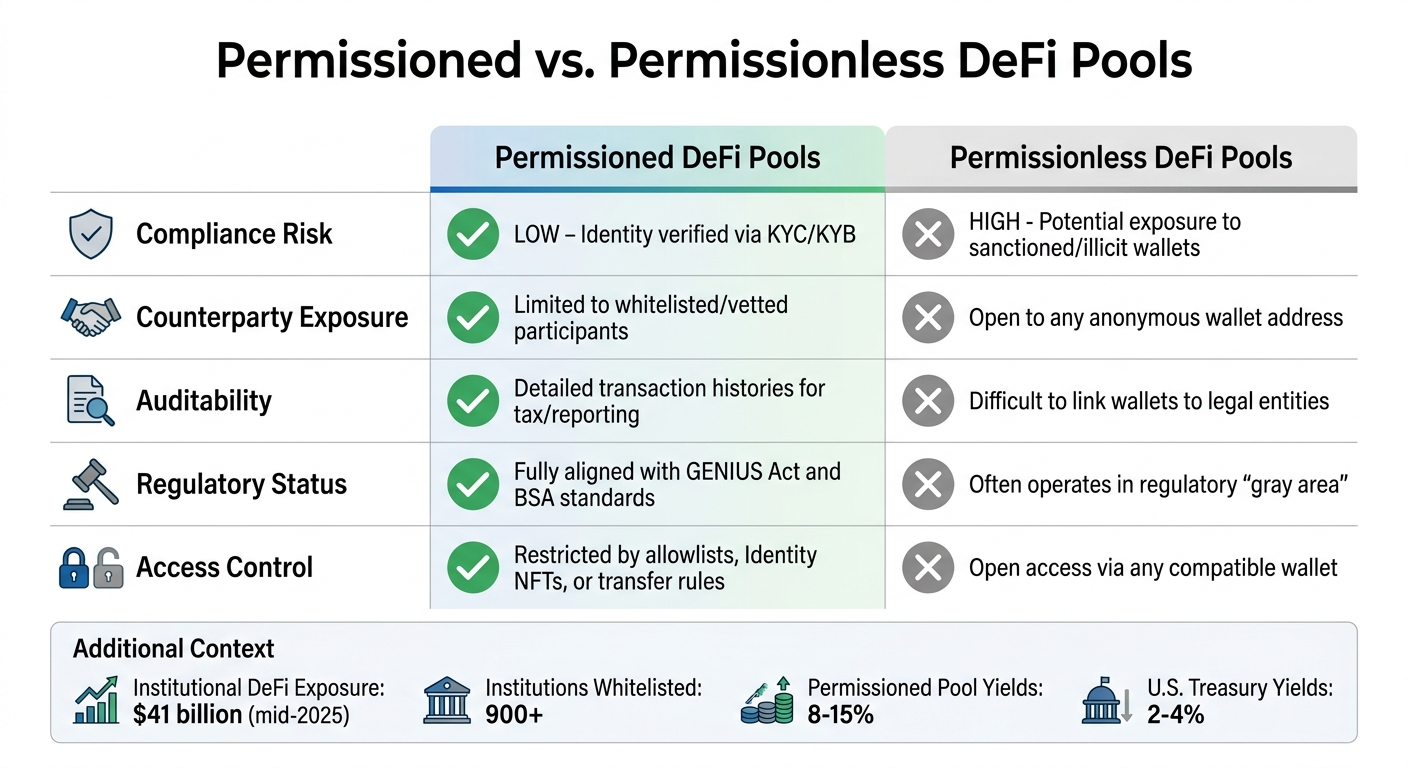
Permissioned vs Permissionless DeFi Pools: Key Differences for Institutions
The regulatory framework in the United States has evolved significantly to encourage institutional involvement in decentralized finance (DeFi). These changes validate the layered KYC mechanisms discussed earlier, creating a safer environment for institutional investors. On July 18, 2025, the GENIUS Act (Guiding and Establishing National Innovation for U.S. Stablecoins Act) introduced a federal framework that requires stablecoin issuers to obtain licensing as Permitted Payment Stablecoin Issuers (PPSIs). Under this framework, PPSIs are classified as "financial institutions" per the Bank Secrecy Act (BSA), making them subject to strict Anti-Money Laundering (AML) and Counter-Terrorism Financing (CFT) program requirements [9][10].
The GENIUS Act also mandates that stablecoin issuers have the technical ability to block, freeze, and reject transactions tied to illicit activities [9]. Evan T. Abrams, a Partner at Steptoe, highlighted the significance of these measures:
"The GENIUS Act weaves robust economic sanctions, anti-money laundering / countering the financing of terrorism (AML/CFT), and other financial crime compliance requirements into the fabric of stablecoin regulation." [9]
Other regulatory developments have further reduced uncertainties for institutions. The Digital Asset Market Clarity Act clarified obligations around counterparty verification and reporting, while updated SEC Custody Guidance provided concrete rules for managing institutional assets [3]. By mid-2025, these changes propelled institutional capital exposure in DeFi to $41 billion, with over 900 institutions whitelisted across permissioned platforms [3]. Together, these regulations form the backbone of permissioned DeFi pools.
Key Regulations Driving Institutional Adoption
Several regulatory advancements have bolstered trust and operational reliability in permissioned pools. For instance, payment stablecoins are now explicitly classified as neither "securities" nor "commodities" under federal law. Furthermore, PPSIs are not considered "investment companies" under the Investment Company Act of 1940 [10]. This legal clarity has removed significant barriers, enabling banks, funds, and insurance firms to participate more confidently.
PPSIs are also required to maintain reserves backing their tokens on at least a 1:1 basis. Additionally, they must submit annual certifications to regulators, confirming the effectiveness of their AML and sanctions compliance programs [9][10]. These measures align with institutional risk management practices, making permissioned pools an appealing option. As noted by CryptoRank:
"The GENIUS Act now provides a framework that enables participation in permissioned pools." [3]
Permissioned vs. Permissionless Pools Comparison
The contrast between permissioned and permissionless pools becomes apparent when examining compliance and risk management:
| Feature | Permissioned DeFi Pools | Permissionless DeFi Pools |
|---|---|---|
| Compliance Risk | Low; identity verified via KYC/KYB | High; potential exposure to sanctioned/illicit wallets |
| Counterparty Exposure | Limited to whitelisted/vetted participants | Open to any anonymous wallet address |
| Auditability | Detailed transaction histories for tax/reporting | Difficult to link wallets to legal entities |
| Regulatory Status | Fully aligned with GENIUS Act and BSA standards | Often operates in a regulatory "gray area" |
| Access Control | Restricted by allowlists, Identity NFTs, or transfer rules | Open access via any compatible wallet |
This regulatory clarity and alignment underscore why institutions are gravitating toward permissioned pools for their DeFi engagements.
Platforms Using KYC-Gated DeFi Pools
Some platforms are combining KYC (Know Your Customer) mechanisms with DeFi (Decentralized Finance) to create systems that cater specifically to institutional investors. Here’s a look at a few key players leading this charge.
Aave Arc
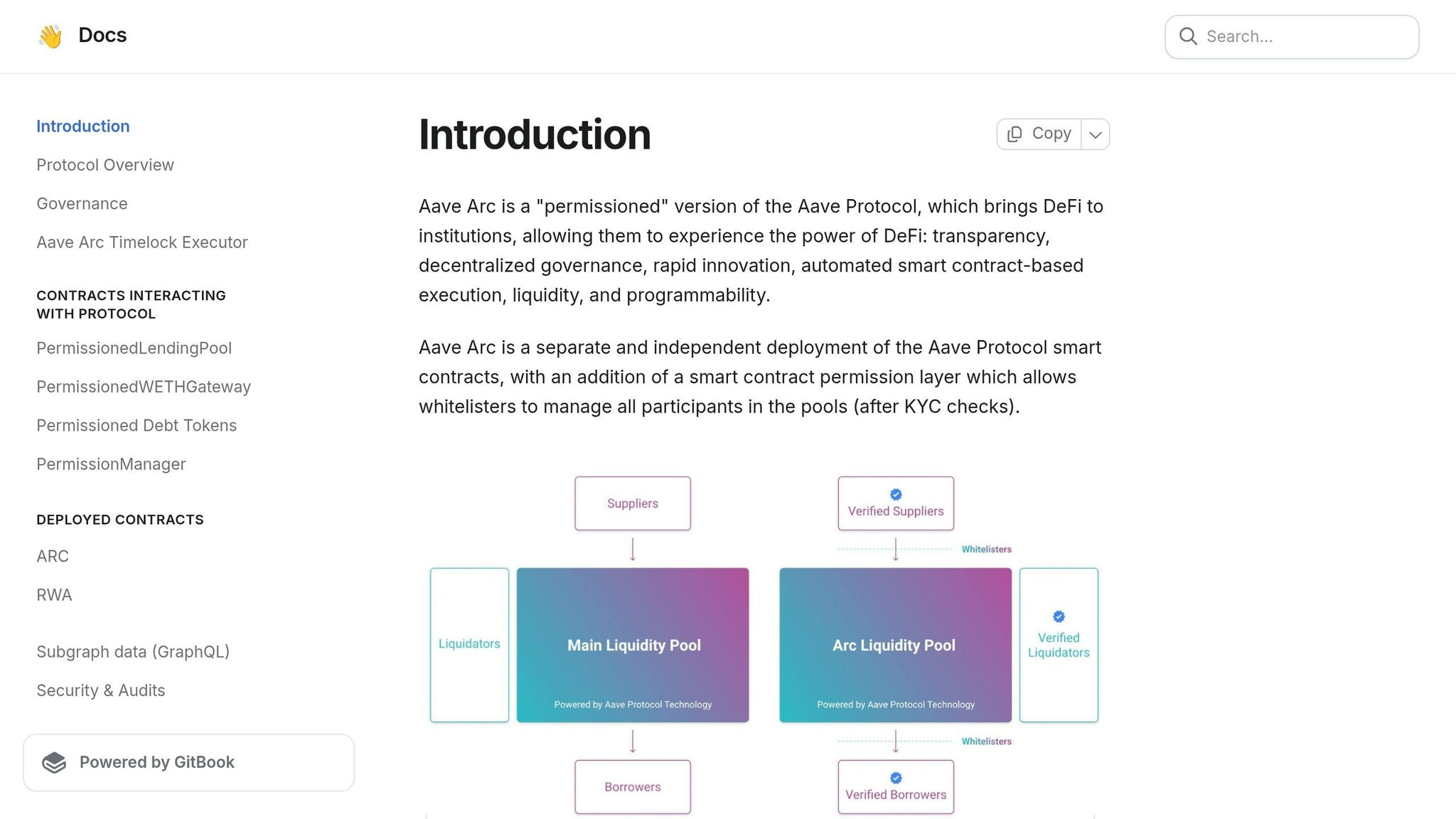
Aave Arc is a specialized version of the Aave Protocol that adds a permission layer, granting access only to verified institutions. As described in its documentation:
"Aave Arc is a ‘permissioned’ version of the Aave Protocol, which brings DeFi to institutions, allowing them to experience the power of DeFi: transparency, decentralized governance, rapid innovation, automated smart contract-based execution, liquidity, and programmability." [12]
The system relies on governance-approved Permission Admins who perform off-chain KYC/AML checks to whitelist Ethereum addresses [12][13]. Participants are assigned specific roles, such as Depositor, Borrower, Liquidator, or Stable Rate Manager, through the PermissionManager contract [13]. As of March 2026, Aave Arc has $8.7 billion in deposits from 31 whitelisted institutions, with an average loan-to-value ratio of 42%, noticeably lower than the 67% seen in retail Aave pools [15].
XRPL Credentials and Lending Protocol
The XRP Ledger employs decentralized identifiers (DIDs) and Verifiable Credentials to handle KYC. This approach allows institutions to verify their identity and compliance across multiple protocols without relying on centralized data storage [15].
Ondo Finance, Clearpool, Goldfinch, and TrueFi (BrilaRWA)

Other platforms are also making strides in integrating compliance with DeFi:
- Ondo Finance: Focuses on tokenizing real-world assets like U.S. Treasuries, creating compliant investment opportunities for institutions.
- Clearpool: Offers fixed-rate, permissioned lending pools that require customized KYC/AML checks [8].
- Goldfinch: Manages $267 million in total value locked and provides an average yield of 12.1% to institutional users [15].
- TrueFi (now BrilaRWA): Since its launch in November 2020, it has facilitated over $1.7 billion in loans to more than 30 borrowers, distributing $40 million in interest to participants [14].
These platforms are effectively bridging the gap between traditional finance and DeFi by building compliant lending and investment frameworks tailored to both crypto-native and conventional institutions [14].
Benefits and Challenges for Institutional Investors
This section takes a closer look at how KYC-gated DeFi pools impact institutional investors, building on the mechanics and regulations discussed earlier.
Benefits of KYC-Gated Pools
KYC-gated DeFi pools address some of the key barriers that have kept institutional investors at bay. By aligning with AML/KYC requirements, securities laws, and fiduciary duties, these pools offer a compliance-friendly environment. This makes them particularly appealing to regulated entities like banks and hedge funds, which have shown growing interest in compliant DeFi platforms [3].
Another major advantage is improved risk management. Permissioned pools ensure that only verified participants can interact with the liquidity, reducing the chances of dealing with sanctioned entities or wallets tied to illicit activities [11][3]. These pools also generate detailed transaction histories and audit trails, simplifying both tax reporting and regulatory compliance [3].
Operationally, the use of blockchain technology brings significant efficiencies. Instant settlements replace the traditional T+2 cycle, cutting down transaction costs compared to conventional financial systems [2]. Moreover, institutions can tap into delta-neutral stablecoin strategies that deliver returns of 8–15%, far exceeding the 2–4% typically offered by U.S. Treasuries [3]. For example, Gate‘s tokenized U.S. Treasury product (GUSD) saw strong uptake among institutional investors by late 2025 [3].
Despite these clear advantages, there are still hurdles that limit broader adoption.
Challenges and Adoption Barriers
While the benefits are clear, institutions face several challenges when engaging with KYC-gated pools. One major issue is low utilization. For instance, Aave Arc, a permissioned platform, reported holding only $50,000 in TVL by late 2024, illustrating that compliance alone does not guarantee liquidity [17].
Regulatory uncertainty is another significant obstacle. Institutions are under intense scrutiny from regulators like the SEC and FCA. Engaging with platforms that lack robust AML controls could expose them to legal risks [3]. Although the 2025 GENIUS Act provided a federal framework for stablecoins in the U.S., many countries still lack clear guidelines [3].
Technical issues also pose a challenge. Traditional compliance systems, designed for processes like T+2 settlements and manual reviews, are too slow for blockchain’s instant finality [16]. According to BlockSec:
"The challenge isn’t whether to have compliance. It’s about how compliance frameworks can grow while keeping decentralization intact" [16].
Legacy tools often struggle to track assets as they move across multiple protocols in DeFi’s complex ecosystem [16].
Liquidity fragmentation is yet another barrier. Without standardized onboarding processes across platforms, permissioned pools risk becoming isolated, splitting capital into smaller, less efficient pools [4].
Benefits vs. Challenges Comparison
Here’s how the benefits stack up against the challenges:
| Feature | Benefits | Challenges |
|---|---|---|
| Regulatory Compliance | Meets AML/KYC and fiduciary duties; offers legal protection for regulated entities [3] | Regulatory uncertainty and scrutiny from agencies like the SEC and FCA [3] |
| Liquidity & Utilization | Access to verified, institutional-grade pools [2] | Low adoption rates and fragmented liquidity; minimal TVL in some pools [17][4] |
| Risk Management | Reduces counterparty risk; prevents interaction with sanctioned entities; provides audit trails [11][3] | Potential exposure to "tainted" wallets that compliant platforms might block [16] |
| Operational Efficiency | Enables instant settlements; reduces costs; offers yields of 8–15% compared to 2–4% in traditional instruments [2][3] | Legacy systems struggle with blockchain’s instant finality, creating technical gaps [16] |
| Onboarding & Access | Standardized identity credentials allow cross-protocol participation [4] | Separate KYC processes for each platform increase onboarding friction [4] |
What KYC-Gated Pools Mean for Institutional Web3 Participation
Institutional Requirements in Permissioned DeFi
Institutions need secure environments where every participant is verified to meet fiduciary responsibilities and adhere to global AML and KYC regulations [3][11]. Permissioned pools address this by embedding verification processes directly into the smart contract layer. This creates both a legal and technical safeguard, ensuring that only verified participants can access these ecosystems [18].
The push for verified environments stems from necessity. Regulated entities like banks and asset managers cannot engage with anonymous wallets, especially those that could belong to sanctioned parties. This is why institutional capital in DeFi hit $41 billion by mid-2025, with more than 900 institutions approved on various permissioned platforms [3][11].
These permissioned pools also offer a major advantage: capital efficiency. By enabling under-collateralized credit based on legal identity and off-chain agreements, they reduce collateral requirements to 150-200%, compared to the 400% or more often required in permissionless DeFi [18]. Add to this the appeal of delta-neutral stablecoin strategies yielding 8–15%, far surpassing the 2–4% returns from U.S. Treasuries, and the financial benefits become hard to ignore [3].
To address these challenges, strategic partners are stepping in with tailored solutions to help institutions integrate seamlessly into this compliant and efficient ecosystem.
How Bestla VC Supports Institutional Web3 Strategies

Bestla VC leverages the advantages of KYC-gated pools to offer specialized advisory services for institutions entering the DeFi space. The firm assists clients in choosing audited protocols and designing compliant treasury management strategies, ensuring secure and strategic Web3 investments.
Conclusion: The Future of KYC-Gated DeFi Pools
KYC-gated DeFi pools are shaping a new path where traditional finance meets decentralized innovation. By mid-2025, institutional DeFi exposure is projected to hit $41 billion, with over 900 institutions already whitelisted [3]. Rather than acting as a hurdle, compliance is becoming the driving force that allows regulated capital to flow into Web3 ecosystems.
The future of DeFi lies in a balance between permissioned and permissionless protocols. Permissioned pools create a compliant entry point for institutional investors, while permissionless protocols continue to fuel creativity and growth among retail participants [3]. This dual approach ensures that DeFi can scale without compromising its core values of decentralization and innovation.
"The goal is not to abandon decentralization but to build bridges that allow regulated capital to flow safely into DeFi." – CryptoRank [3]
Advancements in credential systems – like non-transferable NFTs and zero-knowledge proofs – are making it possible to verify identities while maintaining privacy [4][3]. Additionally, smart contracts are evolving to include "compliance hooks" for real-time sanctions checks and automated transaction monitoring [2]. These developments enhance operational efficiency without sacrificing user privacy, reinforcing the importance of permissioned pools in fostering secure institutional participation.
For institutions aiming to engage with Web3 securely, permissioned pools offer a clear advantage. With yields ranging from 8–15%, they outperform U.S. Treasury returns of 2–4%, offering both higher efficiency and better returns [18][3]. As regulatory frameworks, such as the GENIUS Act of 2025, provide further clarity [3], institutional adoption is expected to grow, transforming compliant DeFi into a fundamental part of professional capital deployment. By aligning institutional requirements with DeFi’s innovative potential, KYC-gated pools are redefining how secure and efficient capital flows in the Web3 era.
FAQs
What’s the difference between an allowlist and an attestation?
In permissioned DeFi pools, an allowlist is essentially a roster of approved participants who are granted access to a specific pool. This access is typically given after they pass verification processes like KYC checks. On the other hand, an attestation serves as cryptographic proof that a participant meets specific requirements without revealing personal information. This is often achieved through privacy-focused techniques like Zero-Knowledge Proofs. While allowlists offer straightforward access, attestations enable more private and flexible verification across multiple protocols.
How do KYC-gated pools protect privacy if verification happens off-chain?
KYC-gated pools offer a way to balance privacy with compliance by verifying user identities off-chain. They use cryptographic methods like Zero-Knowledge Proofs to confirm that users meet eligibility requirements. The key advantage? This process ensures that sensitive personal details stay private and aren’t exposed on the blockchain, maintaining both security and confidentiality.
What happens to my funds if my wallet’s permission is revoked?
If your wallet’s permission gets revoked, you won’t be able to access or transfer your funds within that specific permissioned pool. These pools are restricted to allowlisted addresses, and revocation usually means your wallet is removed from the allowlist, cutting off any further involvement.