


If you’re managing over $10 million in idle capital, stablecoins offer a way to earn higher returns compared to low-yield bank deposits while maintaining liquidity and regulatory compliance. By leveraging stablecoins like USDC or USDT, institutions can access yields from decentralized finance (DeFi) platforms, tokenized U.S. Treasuries, and other mechanisms. Here’s what you need to know:
- Stablecoins’ Growth: By 2026, stablecoins reached a $312 billion market cap, with $45 trillion in annual transaction volume, surpassing Visa.
- Regulation: The 2025 GENIUS Act provided clear U.S. guidelines, requiring 100% reserves in liquid assets and excluding stablecoins from securities classification.
- Yield Opportunities: Institutions can earn 3–15% APY through DeFi lending, liquidity provision, tokenized assets, and advanced strategies like yield stacking.
- Risk Management: Key practices include setting liquidity buffers, monitoring protocol utilization rates, and adhering to regulatory frameworks like the GENIUS Act.
- Protocol Selection: Aave V3, Morpho Blue, and Maple Finance are popular platforms for large allocations, offering deep liquidity and stable yields.
For treasury teams, balancing yield with liquidity and risk is essential. A structured approach – dividing funds into operating cash, short-term yield, and strategic investments – can help optimize returns while staying compliant.
Chasing Stablecoin Yield: Greed, Risk, and How Institutions Can Have an Edge
sbb-itb-c5fef17
How Stablecoins Generate Yield
Before deploying over $10 million in stablecoins, it’s essential to understand how these assets generate returns. At this scale, balancing potential earnings with operational and risk management considerations is critical.
DeFi Yield Sources Explained
Stablecoins generate yield through several mechanisms, each with its own dynamics. Here’s a breakdown of the main methods:
- DeFi Lending: This is the cornerstone of stablecoin yield generation. By supplying stablecoins like USDC or USDT to platforms such as Aave or Compound, lenders earn interest from borrowers who use the capital. For instance, Aave V3 manages over $20 billion in stablecoin deposits on Ethereum, controlling more than 80% of USDC and USDT liquidity [2][10].
- Liquidity Provision: By depositing stablecoin pairs into decentralized exchanges like Curve or Uniswap, users earn trading fees and arbitrage profits. These liquidity pools typically offer annual yields of 2–5%, with occasional boosts from protocol incentives [5].
- Tokenized Real-World Assets: Products like BlackRock‘s USD Institutional Digital Liquidity Fund (BUIDL) provide yields of 3.5–5.5% while carrying lower smart contract risks compared to purely digital assets [8].
- Delta-Neutral Strategies: These strategies exploit funding rate differences. For example, holding stablecoins while shorting perpetual futures contracts can generate returns through funding payments. While some platforms offer temporary governance token rewards, these shouldn’t be factored into long-term yield calculations [4].
- Recursive Lending (Looping): Institutions can amplify base yields by using stablecoins as collateral to borrow additional assets, repeating the process to multiply returns [2].
The market has matured significantly in recent years. For example, Tether reported $13.7 billion in profits for 2024, with $6 billion earned in the fourth quarter alone – largely from yields on its treasury reserves [9]. Similarly, tokenized U.S. Treasuries on public blockchains surpassed $10 billion by early 2026 [3].
Understanding these mechanisms is just the first step. Evaluating their sustainability and associated risks is equally important.
Evaluating Yield Sustainability and Risk
Not all yields are created equal. Some are rooted in real economic activity – such as borrower interest, trading fees, or treasury income – while others depend on temporary token rewards that diminish over time [10].
"Structural yields (real borrower demand, real staking income, real funding rates) are what separate 3% from 15% APY."
- DeFi Risk Monitor [10]
As the DeFi market has matured, yields have compressed. Strategies that once offered 15–20% APY have normalized to 4–8%. For example, Aave reduced its target borrow rates from 9.50% to 6.50%, and Ethena‘s sUSDe yields dropped from double digits to 3.72% [10].
"Yield compression isn’t a bug. It’s a correction… Capital is shifting toward structural yield – the kind that persists after incentives end."
- DeFi Risk Monitor Blog [10]
For institutions managing large allocations, sustainability hinges on factors like utilization rates. Lending protocols use models that adjust interest rates based on capital availability. When utilization exceeds 85–90%, rates increase to attract new deposits and prevent withdrawal bottlenecks. Consistently high utilization rates (above 90%) may signal a need to reduce exposure [6][11].
To navigate these opportunities, it’s helpful to categorize them by risk and yield:
- Tier 1 (3–5% APY): Includes tokenized T-bills and blue-chip lending strategies with minimal smart contract risk.
- Tier 2 (5–8% APY): Covers optimized lending vaults and liquid staking token pairs.
- Tier 3 (8–15% APY): Involves basis trading and more complex liquidity provision setups.
- Tier 4 (15%+ APY): Comprises high-risk strategies like recursive looping and leveraged composites, which carry greater risks of liquidation cascades [10].
When assessing yield opportunities, ask yourself three key questions: What is the yield source (borrower demand, trading fees, or token emissions)? What specific risks could disrupt it (smart contract bugs, depegging, or liquidity crises)? And how easily can you exit during stress – immediately, within 24 hours, or over a longer redemption period? These considerations will help differentiate stable, institutional-grade strategies from speculative ones and guide protocol selection in the next phase [10].
Choosing Protocols for $10M+ Allocations
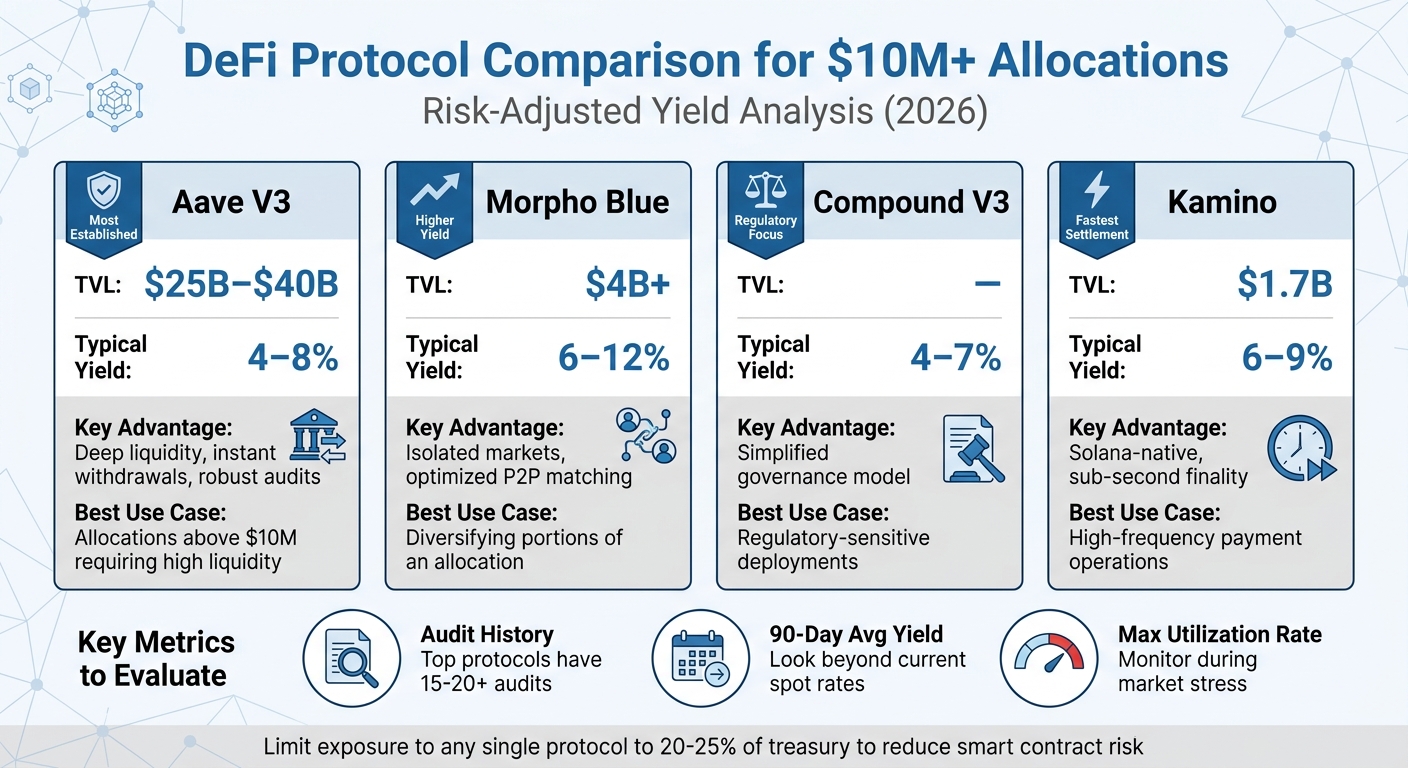
DeFi Protocol Comparison for $10M+ Stablecoin Allocations: TVL, Yields, and Use Cases
Now that we’ve covered how yields are generated and which ones are sustainable, the next step is identifying protocols capable of handling institutional-scale capital. When dealing with allocations exceeding $10M, not all DeFi platforms have the liquidity depth, governance stability, or operational infrastructure needed for treasury operations.
Assessing Liquidity Depth and Scalability
For large-scale investments, liquidity depth is critical. The ability to deploy or withdraw capital seamlessly can make or break a strategy. Total Value Locked (TVL) serves as a key indicator here. Protocols with higher TVL can handle large deposits or withdrawals without disrupting interest rates or creating delays.
Take Aave V3, for example. It’s viewed as a benchmark for institutional use, managing around $25.6 billion in TVL across 21 blockchains. It has facilitated over $1 trillion in lending volume with no lender principal losses and controls more than 80% of major stablecoin liquidity on Ethereum [5][12]. Beyond TVL, utilization rates – how much of the deposited capital is actively borrowed – are equally important. Utilization above 85% can signal potential illiquidity, leading to withdrawal delays. If utilization consistently exceeds 90%, it may be time to reduce exposure or prepare for exit delays.
Multi-chain protocols like Aave V3 also mitigate risks tied to a single blockchain, while offering opportunities if yields differ across networks [12]. For treasuries with high-frequency operations, Solana-native platforms like Kamino, with a TVL of $1.7 billion, provide sub-second finality – something Ethereum-based solutions often can’t match [7].
These metrics form the groundwork for comparing protocols based on risk-adjusted yields.
Comparing Protocols by Risk-Adjusted Yield
Not all protocols offering similar yields carry the same level of risk. Here’s a comparison of major lending platforms suitable for large allocations:
| Protocol | TVL (2026) | Typical Yield | Key Advantage | Best Use Case |
|---|---|---|---|---|
| Aave V3 | $25B–$40B | 4–8% | Deep liquidity, instant withdrawals, robust audits | Allocations above $10M requiring high liquidity [12] |
| Morpho Blue | $4B+ | 6–12% | Isolated markets, optimized P2P matching | Diversifying portions of an allocation [7] |
| Compound V3 | – | 4–7% | Simplified governance model | Regulatory-sensitive deployments |
| Kamino | $1.7B | 6–9% | Solana-native, sub-second finality | High-frequency payment operations [7] |
Aave’s dominance is partly due to its reliable infrastructure and mature governance. However, governance risks do exist. For instance, in 2025, BGD Labs – a key contributor to Aave – ceased involvement, raising concerns about future updates to interest rate models and protocol upgrades [12]. Staying informed about governance changes and key contributor shifts is essential.
Morpho Blue offers a different approach with its isolated market design, which limits risk spread. Its peer-to-peer matching can result in higher yields, but liquidity in some markets may not match Aave’s larger pools.
"A well-constructed institutional stablecoin portfolio does not live at a single layer. It is a portfolio of yield engines, sized according to their risk-adjusted return, liquidity profile, and fit within the mandate." – Conner Romanov, Founder, ArkenYield [5]
When evaluating protocols, ask these questions: What’s the audit history (top-tier protocols often have 15–20+ audits)? What’s the 90-day average yield rather than just the current spot rate? And what’s the maximum historical utilization rate during market stress?
After evaluating yields and risks, institutions should follow a structured deployment strategy.
Implementation Steps for Institutions
Allocating over $10M into DeFi protocols requires careful planning to balance yield optimization with operational safeguards. Here’s a commonly used framework:
- Quantify Liquidity Needs and Set Concentration Limits
Divide capital into three categories: operating cash (accessible within one hour), short-duration yield (available within 24 hours), and strategic reserves (accessible within 2–7 days). Historical data shows peak 24-hour withdrawals can range from 15–25% [11]. To meet immediate needs, maintain a “hot wallet” buffer in non-yield-bearing stablecoins. Also, limit exposure to any single protocol to 20–25% of the treasury to reduce smart contract risk, which historically has led to around 1% annual losses [6][11]. - Implement Know Your Transaction (KYT) Screening
Use transaction monitoring tools to ensure compliance with regulations, particularly for U.S.-based institutions operating under the GENIUS Act passed in July 2025 [6][11]. This ensures interactions with sanctioned addresses or tainted funds are avoided. - Set Up Automated Monitoring and Redemption Triggers
Regularly track protocol utilization rates. If they exceed 85%, consider reducing exposure. Additionally, configure automatic redemptions if a stablecoin’s peg deviates by more than 0.5% from $1.00 [11]. These measures can prevent liquidity issues during market turmoil. - Ensure Robust On-Chain Accounting
Under FASB ASU 2023-08, USDC positions must be marked to market, with yield recorded as interest income as it accrues. On-chain accounting tools are essential for maintaining audit trails and preparing financial reports, especially during quarterly closes or external audits [11].
In January 2026, Maple Finance introduced syrupUSDC on the Base network, integrating it into Aave V3 with a 90% E-Mode Loan-to-Value ratio. This allowed institutions to borrow against yield-bearing collateral while continuing to earn yields of 5–9%. The $50M deposit cap was quickly filled, highlighting the demand for efficient yield structures [5].
The entire process, from due diligence to deployment, typically takes 4–6 weeks. This includes legal reviews, infrastructure setup, and securing internal approvals. Rushing these steps for allocations above $10M can lead to costly mistakes.
Advanced Yield Strategies for $10M+ Treasuries
Once the foundational principles of yield and liquidity are in place, treasuries exceeding $10M can adopt advanced strategies to further boost returns. By incorporating methods like tokenized assets and yield stacking, institutions can aim for higher yields while keeping liquidity and risk under control.
Using Tokenized Real-World Assets for Higher Yields
Tokenized U.S. Treasuries and money market funds have become a go-to choice for institutional stablecoin portfolios. Products such as Ondo‘s USDY and Mountain’s USDM provide traditional Treasury yields, offering 3.5–5.5% APY with T+0 settlement and 24/7 liquidity [5].
In March 2024, BlackRock introduced the USD Institutional Digital Liquidity Fund (BUIDL), which grew to $1.9 billion in assets by early 2026. This fund, designed for qualified investors, requires a $5 million minimum investment and supports 24/7 peer-to-peer transfers among whitelisted participants [8].
For those seeking higher returns, institutional credit markets offer opportunities by lending directly to market makers, trading firms, and hedge funds. Platforms like Maple Finance facilitate secured loans with yields typically ranging from 10–15% APY [5]. However, risk management is crucial. After Orthogonal Trading defaulted on $36 million in loans on Maple Finance in late 2022, the platform transitioned from unsecured to secured lending. This change introduced qualified custodians like Anchorage Digital and Zodia Custody to oversee collateral, reducing risk while maintaining access to double-digit yields.
A diversified approach is essential for treasuries exceeding $10M. Allocating capital across T-bill wrappers, on-chain money markets, and institutional credit can help balance safety, liquidity, and return [5].
Leverage and Yield Stacking Methods
Institutions looking to maximize returns can explore leverage and yield stacking techniques to optimize capital efficiency. Yield stacking involves using yield-bearing stablecoins as collateral to borrow additional funds, allowing the same capital to generate multiple returns. For instance, Maple Finance’s syrupUSDC deployment on Aave V3 enables borrowing against yield-bearing collateral while continuing to earn the underlying yields.
This approach works best when borrowing costs are lower than the yields on the collateral. For example, if syrupUSDC generates 7% APY and the borrowing rate is 5%, the spread remains positive even before reinvesting the borrowed funds.
Another strategy is delta-neutral basis trading, where treasuries hold a spot long position while shorting an equivalent perpetual futures position. This captures funding rates and can yield 8–20% APY, depending on market conditions. At a funding rate of 0.01% every 8 hours, this method could deliver approximately 10.95% annualized [5].
However, leveraging comes with risks, especially liquidation. To mitigate this, maintaining a conservative loan-to-value (LTV) ratio – ideally ≤35% – helps keep the Health Factor in a safe range (2.5 to 3.0), offering protection against sudden market shifts or depegging events [10].
"The yield stack is well-understood. Executing it well is the hard part." – Conner Romanov, Founder, ArkenYield [5]
It’s also wise to keep 10–20% of the treasury in non-yield-bearing stablecoins as a buffer for immediate withdrawal needs or margin calls [6]. While leveraging can amplify returns, it also increases liquidity risks, making careful management essential.
Risk Management and Regulatory Compliance
When managing $10 million or more in stablecoin yield strategies, having a solid risk management plan is non-negotiable. By early 2026, the stablecoin market grew beyond $310 billion in total market capitalization. Alongside this growth came stricter regulatory frameworks and operational hurdles that institutions must navigate carefully [1].
Building an Institutional Risk Framework
Creating a strong risk framework begins with organizing your treasury into three tiers:
- Tier 1: This tier holds operating cash in traditional bank deposits or money market funds, ensuring immediate liquidity. Stablecoins are not included here.
- Tier 2: Designed for short-duration yield positions, this tier invests in GENIUS Act-compliant stablecoins with same-day to T+1 liquidity, aiming for 4–5% yields.
- Tier 3: Reserved for strategic investments, this tier allocates 10–15% of the treasury to DeFi lending protocols. Here, you can take on 30+ day liquidity windows for potential returns of 5–7% or higher [7].
Selecting the right custody model is critical to minimizing risks. Self-custody offers maximum control and removes third-party insolvency risks but requires advanced infrastructure like Hardware Security Modules (HSM) or Multi-Party Computation (MPC). Regulated custodians, compliant with the GENIUS Act, provide bankruptcy-remote protection similar to traditional securities custody. On the other hand, exchange accounts pose the highest risk, as assets could become unsecured creditor claims if the platform fails [7].
Liquidity management is another key element. Institutions should monitor peak 24-hour withdrawal demands, which typically range from 15–25% of balances. Maintaining adequate buffers is crucial under the latest regulatory guidelines. For example, top-of-book liquidity for 4-week Treasury bills averages under $25 million but can drop by 70% during tax days or quarter-ends. Setting automatic redemption triggers when protocol utilization exceeds 85% can help mitigate risks [13][11].
"The GENIUS Act doesn’t eliminate risk. Instead, the new law results in stablecoin-related risks being more distributed to a variety of interconnected stakeholders." – Emily Goodman, Partner at FS Vector [13]
To ensure preparedness, conduct quarterly redemption drills. These involve controlled $5–$25 million withdrawals for each token to assess real-world settlement lags and wire-receipt times. Combine this with live reserve telemetry by integrating on-chain proof-of-reserves data into your treasury dashboard. Any deviation greater than 10 basis points from the 1:1 peg should trigger immediate review [13].
This structured approach not only protects institutional operations but also aligns with the evolving regulatory landscape in the U.S.
Meeting U.S. Regulatory Requirements
A strong risk framework must be paired with strict adherence to U.S. regulatory standards. The GENIUS Act, signed on July 18, 2025, redefined how institutions earn yield on stablecoins. It prohibits stablecoin issuers from directly paying interest to holders, preventing these assets from being classified as securities. However, third-party infrastructure providers can legally offer returns through alternative mechanisms [14][16].
Under the Act, all "Payment Stablecoins" must be fully backed by high-quality liquid assets. These include U.S. Treasuries with maturities of 93 days or less, repos, or Federal Reserve balances [1][13]. The OCC’s 2026 guidelines introduced a $5 million capital floor for new stablecoin issuers and a "rebuttable presumption" that treats certain issuer-affiliate arrangements, such as rewards programs, as potential violations of the yield ban [15].
Operational compliance requires implementing a five-layer wallet architecture:
- Customer Deposits: Initial holding layer.
- Operational Wallets: For day-to-day transactions.
- KYT Clean Room: Ensures all transactions pass Know-Your-Transaction (KYT) checks.
- Treasury Wallets: Reserved for institutional treasury management.
- DeFi Wallets: Used for decentralized finance activities.
This layered setup isolates funds and ensures KYT screening at every stage, preventing contamination of institutional wallets [14]. Additionally, maintaining strict separation of duties helps ensure no single individual can handle an entire transaction cycle [17].
Under FASB ASU 2023-08, institutions must mark stablecoin positions to market and record yield as separate interest income. Audit readiness requires detailed documentation for every transaction, including on-chain data, business purpose, approval records, and general ledger mapping [11][7][17].
Conclusion
Managing over $10 million in stablecoins requires a disciplined approach to yield strategies and strong risk management practices. A three-tier segregation model serves as the backbone of this strategy:
- Operating cash: Keep this in traditional bank deposits for immediate liquidity.
- Short-duration funds: Allocate these to GENIUS Act-compliant stablecoins yielding 4–5% annually.
- Strategic DeFi positions: Reserve 10–15% of your treasury for these opportunities to balance liquidity and returns[7].
This framework ensures liquidity is preserved while generating yield across varying time horizons.
The strategy aligns with established protocols and the latest U.S. regulatory standards, which now offer clearer guidelines on reserve requirements, custody practices, and yield mechanisms. Opt for non-custodial custody solutions to maintain control while adhering to KYT screening requirements. Diversification remains key – limit exposure to any single protocol to 20–25% of deployed capital to mitigate smart contract risks[2].
As PwC Treasury Guidance highlights:
"No longer a fringe concept or used only by crypto natives, stablecoins now represent a functional, increasingly compliant, and institutionally supported payment option that can reduce real operational friction." – PwC Treasury Guidance[1]
Before fully committing to this approach, start with a Tier 2 pilot program. Test your infrastructure by validating RPC connections, setting up gasless transaction systems, and performing quarterly redemption drills with $5–$25 million test withdrawals[8]. Continuously monitor protocol utilization rates, and set automatic alerts for when usage exceeds 85–90% to avoid liquidity issues[6].
With stablecoins now boasting a market cap of over $310 billion and annual transaction volumes exceeding $45 trillion, they’ve surpassed traditional payment systems in scale[1]. Institutions that adopt these structured yield strategies can improve capital efficiency while staying compliant with regulatory standards.
FAQs
What’s the safest stablecoin yield option for a $10M+ treasury?
When managing a treasury exceeding $10 million, prioritizing safety while earning yields on stablecoins is crucial. Low-risk strategies include using on-chain U.S. Treasury-backed products or lending stablecoins like USDC and USDT through trusted platforms.
Protocols such as Aave and Compound are well-established options, typically offering yields in the range of 3.5% to 8%. These platforms strike a balance between generating returns and maintaining security with minimal volatility.
How do we exit large DeFi positions fast during market stress?
During times of market stress, exiting large DeFi positions quickly requires careful planning and specific strategies. One key approach is to keep treasury funds separate from customer assets. This avoids mixing funds, helps maintain clarity, and ensures liquidity is readily available.
Another effective method is using permissionless vaults or liquidity pools, which allow for rapid unwinding of positions without unnecessary delays. Additionally, on-chain credit protocols can be leveraged to secure instant liquidity, providing the flexibility needed to reallocate assets swiftly and efficiently.
By adopting these strategies, you can navigate volatile conditions while staying compliant and preserving financial stability.
What controls are needed to stay GENIUS Act compliant while earning yield?
To stay compliant with the GENIUS Act while pursuing yield opportunities, it’s essential to follow several key practices:
- Ensure traceable fund provenance by leveraging on-chain audit trails and KYT (Know Your Transaction) screening tools.
- Keep customer funds segregated, ensuring they are not mixed or deployed into yield protocols.
- Generate yield exclusively from clean, non-commingled funds.
- Use a non-custodial architecture to maintain signing authority over treasury wallets.
These measures help align yield-generating activities with compliance standards, reducing risk while adhering to regulatory requirements.