

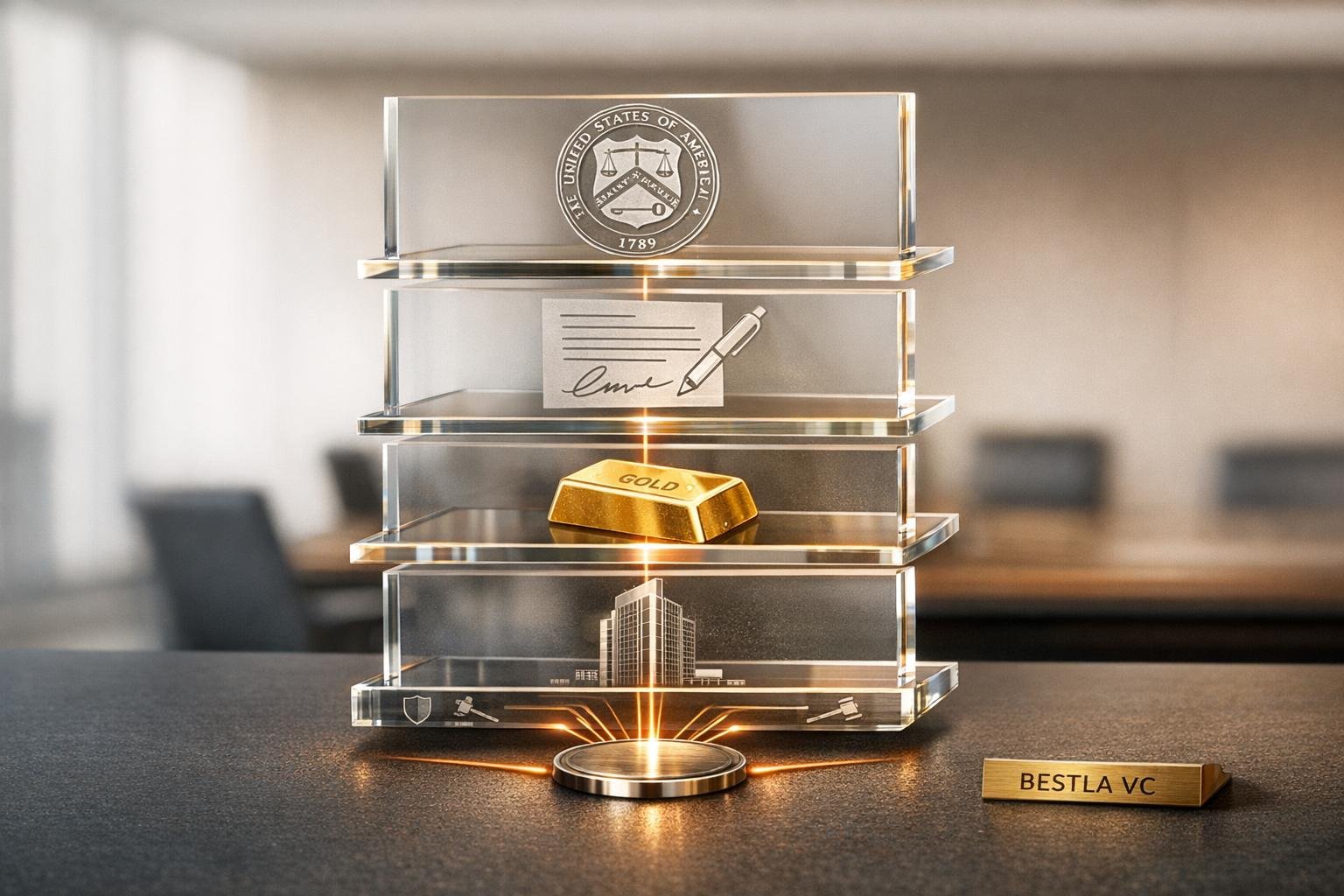
Tokenizing real-world assets (RWAs) is transforming how institutions invest by digitizing physical assets like U.S. Treasuries, private credit, commodities, and real estate on blockchain. This process lowers barriers to entry, enables fractional ownership, and improves efficiency with instant settlements and 24/7 trading. By March 2026, tokenized assets exceeded $12 billion, with predictions estimating growth to $2–16 trillion by 2030. Institutions are leveraging tokenized assets to reduce costs, mitigate risks, and access diverse yield opportunities.
Key Highlights:
- U.S. Treasuries: Low-risk investments offering 4–5% annual yields with instant settlement and liquidity.
- Private Credit: Higher returns (8–12%) but with greater risks and limited liquidity.
- Commodities (Gold): Primarily used as inflation hedges; $4.6 billion tokenized gold by early 2026.
- Real Estate: Fractional ownership provides rental income and value appreciation, though liquidity is limited.
Benefits for Institutions:
- Efficiency: Instant settlements and reduced counterparty risks.
- Transparency: On-chain auditability and compliance embedded in smart contracts.
- DeFi Integration: Tokenized assets can be collateralized for additional yield opportunities.
Market Trends:
- BlackRock’s BUIDL fund reached $1.9 billion in tokenized U.S. Treasuries by March 2026.
- Private credit dominates on-chain RWAs, with $18.91 billion in value by late 2025.
- Regulatory clarity is driving adoption, with the SEC approving tokenized mutual funds and exploring blockchain-based settlement systems.
Tokenized assets are bridging finance and blockchain, offering institutions new ways to manage portfolios, optimize yields, and improve operational efficiency.
Tokenized RWAs Could Be Crypto’s Biggest Long-Term Opportunity w/ Olivier Dang
sbb-itb-c5fef17
Main Yield Sources in RWA Tokenization
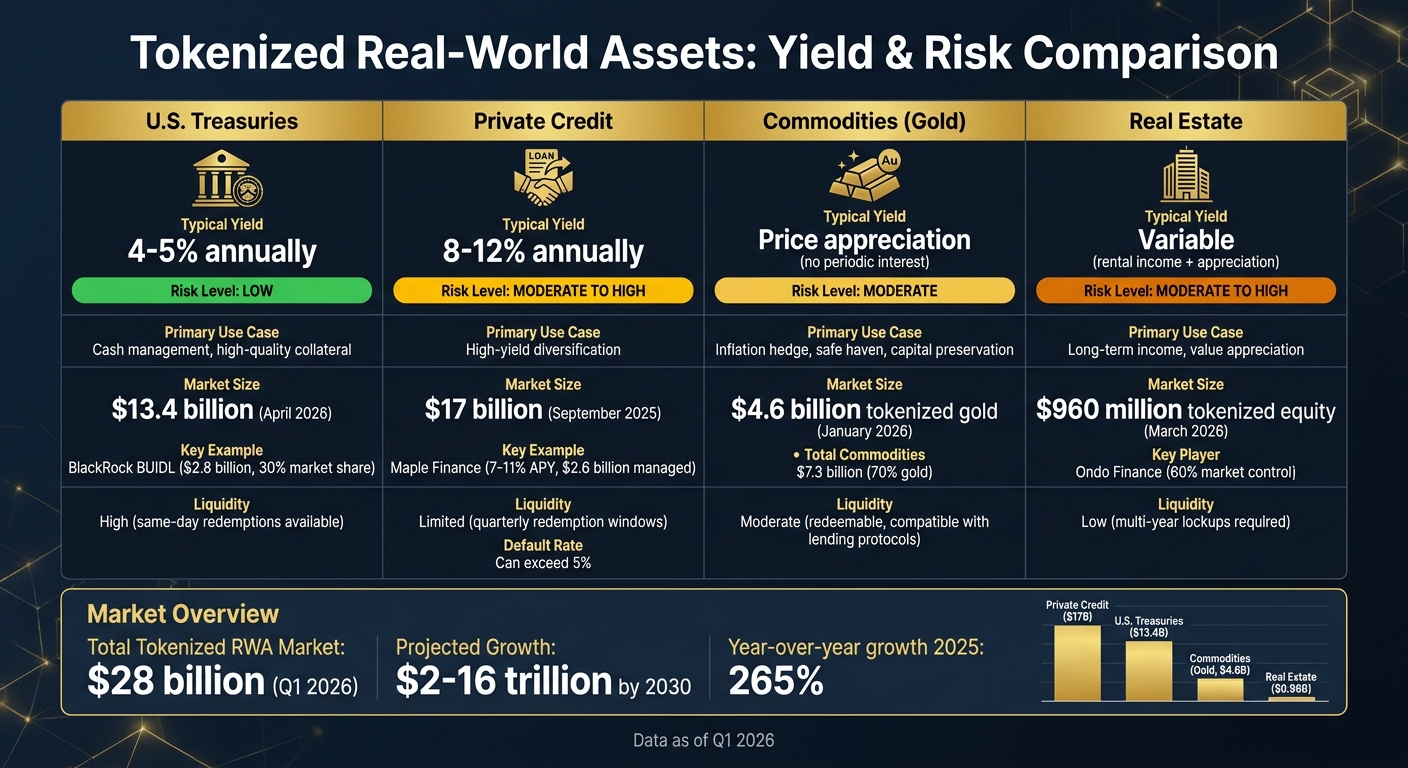
RWA Tokenization Yield Comparison: Asset Classes, Returns, and Risk Levels
Tokenized U.S. Treasuries: Stable Returns
Tokenized U.S. Treasuries have become a popular gateway for institutions bringing capital on-chain. By April 2026, this market reached a total value of $13.4 billion, offering annual yields of 4%-5% [4]. These assets are known for their low risk, instant settlement, and round-the-clock trading.
Leading the way is BlackRock’s BUIDL fund, managing $2.8 billion in assets as of February 2026 and holding 30% of the market share [9]. This fund focuses on short-term U.S. Treasuries and repos, distributing daily yields to token holders. It also provides same-day redemptions through Circle’s USDC liquidity facility. Franklin Templeton’s BENJI token, tied to the FOBXX fund, reached $1 billion in total value locked by early 2026, becoming the first U.S.-registered mutual fund to process transactions on a public blockchain [4].
Institutions often turn to these tokens for cash management and as high-quality collateral in both decentralized finance (DeFi) and traditional finance. In February 2026, the SEC approved intraday trading for WisdomTree‘s Treasury Money Market Digital Fund (WTGXX). This fund trades at a fixed $1 price with instant settlement, marking a first for tokenized mutual funds in the U.S. [4].
While these tokens offer stable returns, they also pave the way for exploring higher-yield opportunities in credit markets.
Tokenized Private Credit: Higher-Yield Options
For those seeking higher returns, tokenized private credit offers yields ranging from 8% to 12%, though with increased risks. By September 2025, the on-chain value of this market reached $17 billion, supporting small and medium-sized enterprises, trade finance, and asset-backed loans [7][8].
Maple Finance, for example, offers pools yielding 7%-11% APY. Mikro Kapital‘s ALTERNATIVE eNote™ targets returns of 9.5% over 6-12 months [8][7][2]. By March 2026, Maple Finance managed $2.6 billion across its institutional lending pools. Its Blue Chip Secured Pool, backed by Bitcoin and Ethereum, yields about 7% APY, while its High Yield Pool provides returns exceeding 11% [8].
In early 2026, Galactica completed "Pegasus 1", a tokenized bridge financing deal for an LNG vessel, and followed up with "Pegasus 2" two months later. The latter aims for returns of up to 10% annually, funding fleet modernization for an Indonesian shipping company [4]. Additionally, TradeFlow’s Tokenized Trade Finance Bond offers an annual return of 8.25% through short-term commodity-backed trade finance portfolios [7][2].
However, these higher yields come with trade-offs. Default rates in private credit can exceed 5%, and liquidity is often limited, with redemption windows typically available only quarterly [6].
Tokenized Commodities and Real Estate
The tokenized commodities market reached $7.3 billion in value by April 2026, with gold making up 70% of that figure [4]. In January 2026, tokenized gold hit an all-time high of $4.6 billion [3]. Unlike assets that generate periodic interest, commodities primarily serve as inflation hedges or tools for capital preservation, offering returns through price appreciation.
Gold tokens are redeemable and compatible with lending protocols, allowing holders to earn additional returns by using them as collateral.
Tokenized real estate, while less liquid, is transitioning from pilot projects to live offerings in regulated markets like Dubai and Hong Kong. By March 2026, tokenized equity – primarily real estate – was valued at $960 million, with Ondo Finance controlling about 60% through its Global Markets platform [4]. These tokens provide yield through fractional property ownership, offering rental income and potential value appreciation. However, they often require multi-year lockups, making them more suitable for institutions with long-term investment horizons [6].
Both commodities and real estate tokens extend blockchain’s utility to inflation protection and long-term income generation. Whether through U.S. Treasuries, private credit, or asset-backed tokens, these options allow institutions to diversify their on-chain portfolios strategically.
| Asset Class | Typical Yield | Risk Level | Primary Use Case |
|---|---|---|---|
| U.S. Treasuries | 4% – 5% | Low | Cash management, collateral |
| Private Credit | 8% – 12% | Moderate to High | High-yield diversification |
| Commodities (Gold) | Price appreciation | Moderate | Inflation hedge, safe haven |
| Real Estate | Variable (rental income) | Moderate to High | Long-term income, appreciation |
Platforms and Technologies for RWA Access
Bestla VC‘s RWA Investment Services
Bestla VC provides institutions with three main services to access tokenized real-world assets. Their OTC market solutions facilitate off-exchange transactions and include collateral mirroring programs, which improve capital efficiency while safeguarding institutional positions[2][10].
For institutions pursuing yield-driven strategies, Bestla VC offers DeFi yield options, connecting them to high returns through tokenized private credit and U.S. Treasuries via decentralized protocols. Additionally, they provide legal consultancy to guide institutions in structuring "legal wrappers" like SPVs or trusts, ensuring compliance with U.S. regulations before deploying capital on-chain[2][10]. These services are tightly integrated with advanced blockchain technologies, which are discussed next.
Blockchain Infrastructure for Tokenized Assets
Blockchain infrastructure for tokenized assets has evolved significantly, going beyond basic record-keeping. With programmable ownership, compliance measures like KYC/AML checks and transfer restrictions are embedded directly into smart contracts. This enables atomic transfers of assets and payments, eliminating T+2 settlement delays and reducing counterparty risks[11][10].
"Tokenization isn’t simply digitizing a document or creating a database entry. The innovation is programmable ownership."
- Oscar Garcia, Founder & CEO, Starke Finance[11]
In July 2024, Backed, a tokenized asset issuer, adopted Fordefi‘s MPC wallet infrastructure to automate large-scale on-chain transactions and streamline back-office operations. This allowed them to tokenize assets like Coinbase stock and government bonds for use in DeFi, while maintaining high security standards[12]. Multi-Party Computation (MPC) technology and key-sharding models strengthen security by ensuring no single entity has complete control over fund access[11][12].
Blockchain platforms also offer API-driven automation for tasks like minting, burning, and whitelisting tokens. This reduces operational errors and cuts overhead for asset managers[12][10]. For instance, Solana‘s infrastructure supports sub-second transaction finality and average fees of just $0.00025, making it ideal for high-frequency asset transfers[11].
Custody and Security Solutions for Institutions
Secure custody solutions are essential for institutional investors moving capital on-chain. Regulated, insured custodians provide legal protections and bankruptcy-remote structures to secure off-chain assets, addressing key concerns for institutional participants[10][13]. Hybrid settlement models allow for traditional custody of physical assets while transferring economic and settlement logic on-chain via tokens[10].
To ensure robust security, institutions rely on multisig authority, routine third-party smart contract audits, and formal verification processes[11][10]. Platforms that achieve ISO 27001 and SOC 2 certifications demonstrate strong operational and security controls, which are critical for institutional confidence[11].
Some platforms take it a step further by using NFT-based "passports" for assets. These tokens embed metadata, legal documents, and performance reports, creating a transparent audit trail and clear asset provenance[10][13]. Before committing capital, investors should verify the custodian’s identity, insurance coverage, and ensure that transfer restrictions are enforced directly through smart contracts rather than relying on side agreements[11].
Strategies for Maximizing Institutional RWA Returns
Portfolio Diversification with Tokenized Assets
Tokenized assets allow institutions to access previously exclusive investments like private equity, commercial real estate, and fine art through fractional ownership. These assets, which once required multi-million-dollar commitments and lengthy lock-up periods, are now accessible with far smaller capital requirements. By March 2026, tokenized real-world assets (RWAs) surpassed $25 billion, showcasing their growing appeal as a tool for diversification across asset classes that were once out of reach [1][2][16][17].
Collateral optimization is another key benefit. Tokenized RWAs can serve as productive collateral in both decentralized (DeFi) and centralized finance systems. With near-instant settlement, institutions can reduce counterparty risk and free up capital compared to the traditional T+2 settlement cycles [1][16]. To start, institutions might test the waters with small positions during market stress events to assess secondary market liquidity. Reviewing SPV documents, redemption processes, and audits is critical to ensure that lock-up terms align with liquidity needs [1][14].
This strategy not only diversifies risk but also creates a pathway to leverage DeFi for even greater liquidity.
Using DeFi for Better Liquidity
DeFi protocols offer institutions the ability to borrow stablecoins against tokenized assets without needing to sell their holdings. For example, in 2023, MakerDAO integrated tokenized U.S. Treasuries as collateral for its DAI stablecoin, holding over $500 million in Treasuries to improve liquidity and capital efficiency [2]. By May 2025, the tokenized U.S. Treasuries market had grown by more than 380% year-over-year, reaching $1.2 billion [2][20].
Permissioned liquidity pools strike a balance between DeFi’s trustless design and institutional compliance needs. By implementing KYC/AML gates and role-based permissions, these pools enable compliant trading of security tokens. They also provide 24/7 instant redemption while maintaining regulatory oversight [2][20].
"DeFi has primarily catered to crypto holders and traders seeking to maximize yield on digital assets, and we’re starting to see a shift toward applying DeFi to traditional and real-world financial use cases." – Monica Long, President, Ripple [21]
To ensure sustainable returns, institutions should prioritize yield generated from real-world fees or cash flows rather than relying on inflationary token emissions [19]. For instance, smart contracts can automate the distribution of rental income, dividends, or coupon payments directly to token holders in stablecoins like USDC. Diversifying yield sources – such as combining protocol fees, tokenized short-term debt, and senior-tranche securitizations – can also help mitigate potential drawdowns [19].
While these liquidity tools are powerful, strong risk management practices are essential to protect institutional returns.
Risk Management Best Practices
Risk controls are a cornerstone of any strategy involving tokenized assets. Institutions should integrate regulatory compliance features, such as investor eligibility checks and transfer restrictions, directly into smart contracts [23][24]. Proof of Reserve services can provide autonomous, real-time verification that on-chain tokens are fully backed by off-chain assets, reducing valuation uncertainty. Additionally, automatic circuit breakers can protect against discrepancies between on-chain and off-chain values [22].
Initial allocations should focus on high-liquidity assets, like U.S. Treasuries or money market funds, which already have deep secondary markets. For example, BlackRock’s BUIDL fund reached $1.7 billion in assets by early 2026, offering tokenized U.S. Treasury products with instant redemption options for qualified purchasers [23][25]. Conducting thorough smart contract audits and accessing tokenized products through MAS-licensed or SEC-registered platforms ensures regulatory compliance and minimizes vulnerabilities [22][23][25].
Geopolitical events also play a role in shaping demand for safe-haven assets. For instance, tokenized gold reached a market cap of $5.9 billion by early 2026, with $178 billion in annual trading volume [1]. Institutions should require real-time reporting and custodial reconciliations to confirm that on-chain tokens accurately represent their off-chain collateral [14]. Finally, adopting multi-chain strategies – leveraging networks like Ethereum, Solana, or Avalanche – can enhance scalability and security [18].
"Tokenization has moved from pilot to product in 2026. For investors, the opportunity is real – but it requires combining legal clarity, governance, and integration with traditional finance plumbing." – Nora Aziz, FinTech Strategist, investments.news [14]
Regulatory Considerations and Market Trends
Navigating U.S. Regulatory Requirements
In the United States, the legal framework for tokenized assets is deeply rooted in traditional securities laws. Any tokenized security must either be registered with the SEC or qualify for an exemption. Under Section 3(a) of the Securities Exchange Act of 1934, these instruments are treated as "securities", meaning institutions must adhere to the same compliance standards as they would for traditional assets [26][27].
In April 2026, the SEC introduced a five-category taxonomy: Digital Commodities, Digital Collectibles, Digital Tools, Stablecoins, and Digital Securities. Of these, only "Digital Securities" are automatically considered securities, while the others are assessed based on their specific economic characteristics [31].
"The technological format in which a security is issued, recorded, or transferred does not alter its legal characterization or the applicability of the federal securities laws." – Joint Statement by SEC Divisions of Corporation Finance, Investment Management, and Trading and Markets [26]
Institutions managing tokenized assets must maintain real-time documentation of issuances and ensure that on-chain transfers align with the master securityholder file to avoid ownership disputes [27][28]. For tokens sponsored by third parties, it’s essential to evaluate the sponsor’s bankruptcy risk, as it may differ from the risk tied to the issuer of the underlying asset [27][28]. In December 2025, the SEC granted a no-action letter to the Depository Trust Company (DTC) for a three-year pilot program. This initiative, set to launch in late 2026, will allow participants to mint "Tokenized Entitlements" on a centralized ledger, enabling the controlled testing of distributed ledger technology for settlement processes [29].
These regulatory developments are shaping the rapid growth of tokenized asset markets.
Current Trends in Tokenized Asset Markets
Institutional adoption of tokenized assets has shifted from small-scale pilots to fully operational systems. By the close of Q1 2026, tokenized real-world assets (excluding stablecoins) held a combined value of approximately $28 billion. Tokenized U.S. Treasuries alone accounted for $13.4 billion by April 2026, reflecting a significant surge in demand. During 2025, the market for real-world assets grew by around 265%, fueled by regulatory clarity and the pursuit of higher yields [4][30].
Leading financial institutions are now embedding blockchain technology into their market infrastructure. Both the NYSE and Nasdaq are working on platforms for 24/7 trading and on-chain settlement of tokenized stocks and ETFs, with launches expected by late 2026 [5][16]. In March 2026, the SEC approved Nasdaq’s proposal to test a system where investors can decide, trade-by-trade, whether to settle transactions traditionally or on a blockchain via the DTC [5].
Stablecoins have become a crucial part of the payment ecosystem for tokenized asset settlements. Currently, the stablecoin market stands at $307 billion, providing the necessary support for atomic settlement of real-world assets [15]. Additionally, tokenized funds like BlackRock’s BUIDL are being used as collateral in crypto derivatives trading, signaling growing institutional trust in these instruments [5].
"Every stock and every bond could eventually be tokenized, making markets faster, more efficient, and cheaper." – Larry Fink, CEO, BlackRock [5]
Future Outlook for Institutional Investments
With regulatory frameworks becoming clearer, the outlook for institutional investments in tokenized assets is increasingly optimistic. The CLARITY Act (Digital Asset Market Clarity Act), currently under review in Congress, seeks to establish jurisdictional boundaries between the SEC and CFTC. If passed, it will allow new projects to raise up to $75 million annually without full SEC registration, provided they meet specific disclosure requirements [32].
In March 2026, the SEC and CFTC issued a joint 68-page interpretive release, reclassifying 16 assets, including Solana, Cardano, and Chainlink, as Digital Commodities rather than securities. This move is expected to ease compliance requirements for market participants [31]. Furthermore, guidance issued by the Federal Reserve, FDIC, and OCC in the same month confirmed that tokenized securities would receive the same capital treatment as traditional securities, addressing a key concern for banks [4].
McKinsey projects that the total value of tokenized assets could reach $2 trillion to $4 trillion by 2030, driven by infrastructure improvements, regulatory clarity, and the transformation of traditionally illiquid assets into accessible investments [5]. As these developments unfold, institutions should closely monitor the Senate Banking Committee’s progress on the Digital Asset Market Clarity Act and reassess their token classifications to stay aligned with the SEC’s updated taxonomy [31][32].
Conclusion: RWA Tokenization for Institutional Investors
Tokenization of real-world assets (RWAs) has transitioned from experimental phases to robust financial systems. With tokenized RWAs expected to reach around $28 billion by the end of Q1 2026 – and forecasts suggesting markets could grow to $18.9 trillion by the early 2030s – institutions now have a compelling opportunity to achieve better yields, increased capital efficiency, and more diverse portfolios [4][2][33]. These developments are paving the way for institutions to adopt yield-focused strategies.
The benefits of tokenization are clear. Instant settlement eliminates traditional delays, while 24/7 trading platforms provide uninterrupted market access [4][15]. Tokenized U.S. Treasuries, offering yields of approximately 4.14%, and private credit, with yields ranging from 8–12%, provide attractive opportunities for institutional investors [2][33]. These efficiencies are driving the convergence of traditional finance with Web3 technologies.
Regulatory advancements have also played a critical role, ensuring that tokenized securities are treated on par with their traditional counterparts [4]. This clarity has significantly boosted adoption rates.
Bestla VC’s RWA investment services are designed to help institutions navigate this rapidly evolving space. By providing expertise in regulatory compliance, platform selection, custody solutions, and yield strategies, Bestla VC equips investors to take advantage of tokenization’s benefits while effectively managing risks.
The pace at which institutions embrace these tools remains a crucial factor. Those who familiarize themselves with gateway assets like tokenized Treasuries today will be well-prepared to explore the broader range of yield opportunities as the market continues to grow [2][15].
FAQs
How do tokenized RWAs actually pay yield on-chain?
Tokenized real-world assets (RWAs) create on-chain yield by leveraging real-time, tamper-proof valuation data provided by decentralized oracles. This data feeds into blockchain protocols, enabling programmable smart contracts to automate processes like distributing interest payments or dividends. These systems offer institutional investors a secure and transparent way to generate yield.
What are the biggest risks with tokenized private credit?
The main risks tied to tokenized private credit involve limited secondary market trading, jurisdictional fragmentation, manual servicing workflows, and regulatory uncertainties. These hurdles can impact liquidity, reduce operational efficiency, and pose compliance challenges. Because of these factors, institutions need to thoroughly assess these risks before diving into such investments.
How can institutions use tokenized Treasuries as DeFi collateral?
Institutions now have the option to leverage tokenized U.S. Treasuries as collateral within DeFi protocols, unlocking liquidity and generating returns. These digital versions of government bonds bring several advantages, including instant settlement, round-the-clock liquidity, and greater transparency. By using these tokenized assets as collateral, institutions can secure financing without liquidating their holdings. This approach allows them to retain exposure to the underlying bonds while engaging in yield-generating activities, all while minimizing settlement risks.