
Retaining institutional investors in Web3 projects requires trust, transparency, and alignment with their expectations. Here’s how to keep them engaged:
- Clear Communication: Regular updates with detailed performance reports, key metrics, and actionable insights build trust.
- Regulatory Compliance: Secure necessary licenses, follow global standards, and maintain updated compliance documentation.
- Asset Security: Use advanced custody solutions like MPC, tiered storage systems, and insurance coverage to safeguard assets.
- Liquidity Options: Provide OTC trading desks and access to secondary markets for flexible asset management.
- Yield Opportunities: Offer staking programs and innovative yield strategies for consistent returns.
- Governance Participation: Engage investors in decision-making with structured governance models like veTokens.
- Partnerships: Build integrations that enhance utility and liquidity within the ecosystem.
- Data Rooms: Maintain well-organized, accessible investor documents and proactive relationship management.
- Long-Term Tokenomics: Design thoughtful vesting schedules to ensure token stability and align interests.
- Legal Support: Establish proper legal structures and compliance measures to minimize risks.
These strategies revolve around fostering trust and delivering consistent value to institutional investors, ensuring their long-term commitment to your project.
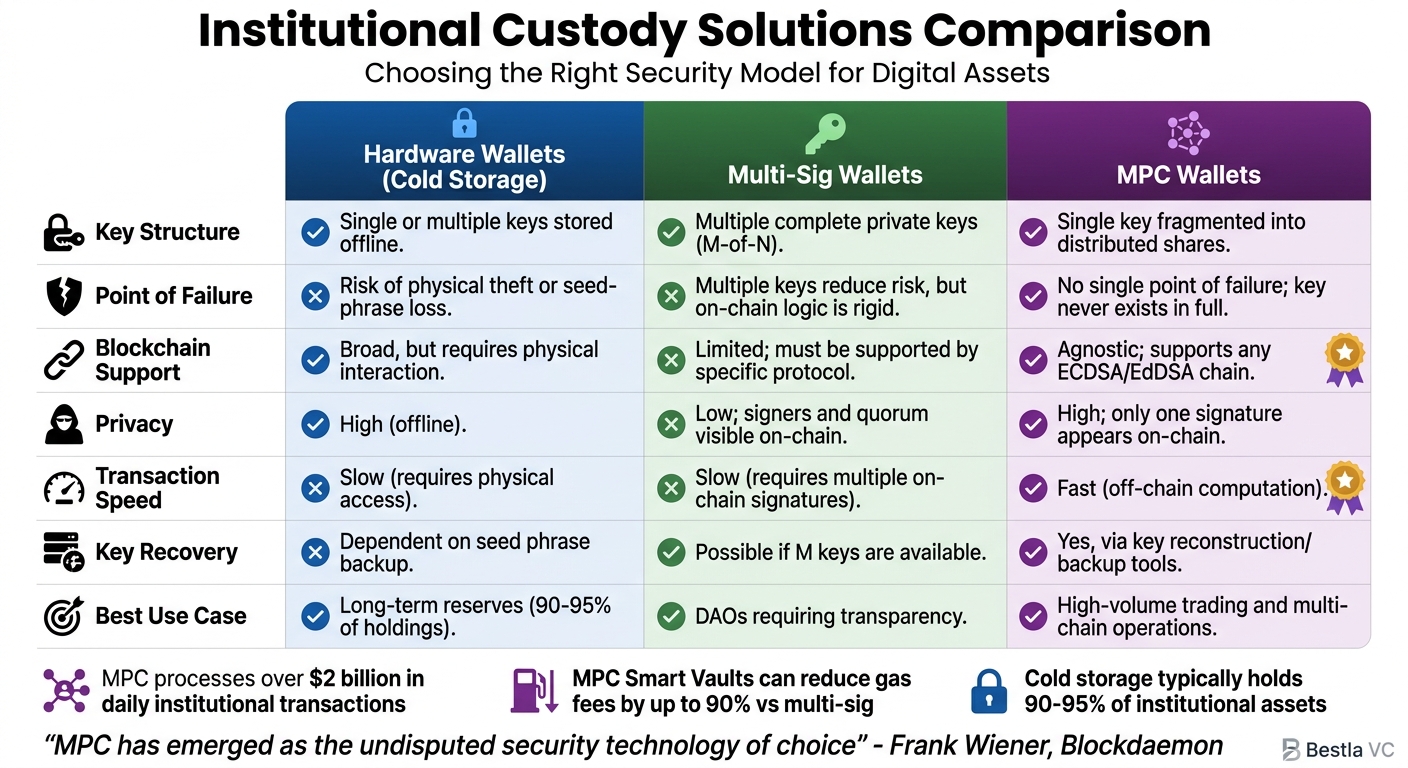
Comparison of Institutional Crypto Custody Solutions: MPC vs Multi-Sig vs Hardware Wallets
The SHOCKING Truth About Institutional Crypto Investment in 2025
1. Maintain Clear Communication and Regular Reporting
Institutional investors count on consistent updates to stay informed. Successful Web3 projects often implement a structured communication schedule: brief monthly check-ins to maintain relationships, detailed quarterly performance reports with key metrics, and annual reviews to reflect on achievements and set goals for the future. This approach not only keeps investors in the loop but also demonstrates operational discipline [3][5].
Here’s a compelling statistic: 89% of Limited Partners (LPs) rank regular, transparent reporting among their top three factors when deciding to reinvest with a fund manager [3]. Interestingly, the biggest complaint LPs have about emerging managers isn’t poor returns - it’s poor communication [5]. Michael Kaufman, Founder & Editor-in-Chief of VC Beast, captures this sentiment perfectly:
A fund that’s underperforming but transparent will retain LP support. A fund that’s outperforming but silent will lose LPs at re-up.
What Should Reports Include?
Each report should be detailed yet easy to digest. Start with a TL;DR-style executive summary, followed by key performance indicators (like IRR and TVPI), a financial overview (burn rate, runway), and updates on team or product developments [4]. But don’t stop at numbers - context is key. Explain what the metrics mean, the insights they provide, and how they align with your investment strategy. Institutional investors review countless portfolios, so pairing data with a clear narrative makes your reports stand out.
Handling Challenges Transparently
No one likes delivering bad news, but it’s essential to address challenges - like markdowns, security issues, or underperformance - immediately. Avoid burying these in footnotes or waiting for the next scheduled update [3][5]. Steven Plappert, CEO of Forecastr, advises:
Transparency wins every time. Be upfront about challenges, explain the cause, and share your plan of action.
Streamlining Investor Access
Make life easier for your investors by providing a secure, self-service portal where they can access capital account statements, tax documents (e.g., K-1s), and portfolio data whenever they need it [3]. Combine this with a disciplined monthly reporting schedule - close financials by day 3, collect metrics by day 5, draft by day 7, and issue the report by day 10 [4]. This level of reliability builds trust and encourages long-term investor support.
2. Provide Strong Compliance and Regulatory Support
Building trust with institutional investors goes beyond just being transparent - it requires demonstrating a firm commitment to meeting regulatory standards.
Institutional investors won’t touch a Web3 project unless it’s clear that regulatory groundwork is solid. As the Codono team bluntly states:
No license = no institutional business. Period.
By late 2025, institutional crypto assets under management surpassed $500 billion [7]. With such high stakes, investors expect strict compliance with established regulatory frameworks. This often includes certifications like MiCA authorization in the EU, MAS licensing in Singapore, or VARA approval in Dubai [14, 16]. These frameworks are non-negotiable for risk committees and compliance departments.
But securing licenses is just the starting point. Institutions also require robust systems to meet compliance standards like the FATF Travel Rule, which mandates the collection and transmission of originator and beneficiary information for transfers over $1,000 [14, 16]. Beyond that, investors expect seamless integration of AML/KYC tools, such as Chainalysis or TRM Labs, and demand quick access to comprehensive compliance records - policies, transaction logs, audit reports, and training documentation - within 24 hours of a request [8].
Another critical way to reassure investors is by providing formal token legal opinions prepared by qualified legal professionals. As Nestor Dubnevych, Co-founder & Head of Web3 Legal at Legal Nodes, explains:
Token Legal Opinion is a legal guarantee for the investor.
This document helps clarify whether a token qualifies as a security under the Howey Test in the US or aligns with MiCA’s Utility, ART, or EMT categories in the EU, reducing concerns about liquidity risks and regulatory challenges [9].
For DAO-based projects, adopting legal wrappers, such as Wyoming DAO LLCs, Marshall Islands DAO LLCs, or Cayman Foundations, can shield institutional contributors from personal liability [14, 17]. The Web3 Legal Consulting Team highlights the risks:
A DAO without a legal wrapper is an unincorporated association - meaning every token holder may be jointly and severally liable for the DAO’s obligations.
Staying ahead of evolving regulations is also essential. For example, the USA GENIUS Act, passed in July 2025, introduced federal oversight for payment stablecoins [8]. Meanwhile, the EU’s MiCA regulation now offers a unified “passport” for Crypto-Asset Service Providers across all 27 member states [6]. Keeping compliance documentation current, including a regulatory risk register, signals the operational rigor that institutional investors demand [14, 17].
3. Implement Secure Custody and Risk Management Solutions
For institutional investors, regulatory compliance is just the starting point. They also need top-tier security to safeguard their assets while enabling efficient transactions.
By 2026, Multi-Party Computation (MPC) has become the gold standard for secure custody. MPC works by splitting private keys into encrypted shards, which are then distributed across multiple parties. This ensures no single system ever holds a complete key. For instance, Fireblocks has safeguarded over $10 trillion in cumulative asset transfers for more than 2,400 organizations [10], while Blockdaemon processes upwards of $2 billion in daily transactions [12].
Most institutions rely on a tiered storage system, similar to traditional banking practices. Here’s how it typically breaks down:
- Cold storage holds 90% to 95% of assets offline, using HSMs (Hardware Security Modules) certified to FIPS 140-2 Level 3 or 4 standards. These systems are designed to destroy keys if tampering is detected [13][14].
- Warm vaults facilitate day-to-day operations through HSM clusters or MPC.
- Hot wallets handle immediate liquidity needs, usually comprising just 1% to 5% of total assets [11][15].
To further reduce risks, institutions turn to insurance coverage. Companies like Lloyd’s of London now provide policies exceeding $250 million, covering theft, cold storage breaches, and even employee misconduct [10][11]. Additionally, Anchorage Digital became the first crypto-native company to receive a federal bank charter in January 2021, granted by the Office of the Comptroller of the Currency (OCC). This status allows it to function as a “qualified custodian”, aligning it with traditional banks in terms of regulatory standards [10][11].
A major turning point came in early 2025 with the repeal of SEC Staff Accounting Bulletin 121. This change removed significant barriers for banks like JPMorgan, Wells Fargo, and BNY Mellon to offer custody services without accounting complications. As DegenSensei explains:
The repeal of SAB 121 in early 2025 opened doors for banks like JPMorgan, Wells Fargo, and BNY Mellon to launch custody offerings without accounting friction.
This regulatory shift, coupled with SOC 2 Type II audits and geographically redundant key storage across multiple jurisdictions, has significantly boosted institutional confidence in deploying large-scale capital [10].
In light of these developments, Bestla VC remains focused on building secure, compliant custody systems, ensuring institutional investments are well-protected as the Web3 ecosystem continues to evolve.
4. Enable Liquidity Through OTC and Secondary Markets
Institutional investors often need ways to manage large positions without causing noticeable market fluctuations. This is where OTC (over-the-counter) trading desks come in. They handle private transactions outside public order books, helping to avoid immediate price slippage and protecting sensitive trading strategies [16][17].
In 2024, institutional OTC trading volumes saw a massive 106% increase. Bitcoin, Ethereum, and stablecoin trades alone surged by 80% to 191% in Q4 of the same year [19]. Interestingly, altcoins now make up 29% of all OTC trading volume, a big jump from just 13% in 2023 [19]. This shift shows how institutions are using OTC desks to execute significant trades without disrupting the market.
Secondary markets provide another avenue for liquidity, allowing investors to sell locked token positions, SAFTs, or equity stakes before public listings. A great example of this was Circle’s NASDAQ IPO in June 2025, priced at $31 per share, valuing the company at around $6.8 billion. Before the IPO, secondary platforms recorded $110 million in trading volume, with shares transacting at valuations between $5.0 and $5.25 billion. Secondary buyers who got in early saw considerable gains when the company went public [20]. Similarly, Kraken experienced a surge in secondary market activity after its confidential IPO filing. Over a 90-day period, trades, bids, and offers totaled $750 million, pushing Kraken’s private valuation to over $7.7 billion [20]. These secondary markets provide critical liquidity, especially for private assets, and are supported by advanced trade execution strategies.
OTC desks also use sophisticated execution algorithms like TWAP (time-weighted average price) and VWAP (volume-weighted average price) to break large orders into smaller, more manageable trades. At the same time, these desks employ strict KYC/AML protocols, secure escrow services, and regulated custodians to reduce fraud and ensure compliance [16][17][18]. As Nick Cote points out, in private markets, the identity of the seller can be just as important as the asset itself, underscoring the need for transparency between counterparties [21].
Bestla VC stands out in this space, offering tailored OTC and secondary market solutions designed to meet the unique liquidity needs of institutional investors.
5. Offer Yield Opportunities and Staking Programs
Institutional investors expect their assets to generate active returns, and in Web3, this translates to offering structured yield opportunities within clear risk parameters. The global staking market, for instance, surpassed $245 billion by early 2026, with liquid staking alone contributing approximately $37.79 billion in total value locked[22]. By 2026, 68% of institutional capital allocators had integrated digital asset yield strategies into their portfolios, a significant jump from just 41% in 2024[24]. This growing demand has spurred developments ranging from native staking to liquid staking solutions.
Native Staking
Native staking involves locking assets at the consensus layer to secure blockchain networks. A key milestone came with Ethereum’s Pectra upgrade in May 2025, which raised the maximum validator balance from 32 ETH to 2,048 ETH. This change allowed institutions to streamline operations and cut infrastructure costs[23]. However, native staking yields have become less attractive due to increased participation. For example, Ethereum staking now averages a 2.84% yield, while Solana offers a more competitive 6% to 8% APY, with about 66% of its total supply actively staked[23].
Liquid Staking Tokens (LSTs)
To address the liquidity limitations of native staking, many institutions are turning to LSTs. These tokens, such as stETH or jitoSOL, enable investors to earn staking rewards while keeping their assets liquid for other uses. A notable example is Forward Industries (NASDAQ: FWDI), which launched its custom LST, fwdSOL, in December 2025. By allocating 1.7 million SOL (25% of their holdings), the company earned staking yields while leveraging the token for DeFi borrowing[25]. Similarly, 3iQ Corp’s Solana Staking ETF (TSX: SOLQ) reached $90 million in assets under management (AUM) within just two days by incorporating staking rewards directly into its net asset value[26].
Restaking for Higher Returns
For institutions seeking enhanced yields, restaking offers a way to layer rewards. Protocols like EigenLayer and Symbiotic allow staked assets to secure multiple networks simultaneously, potentially boosting ETH yields from 3.5% up to 8%[23]. On the Bitcoin side, Babylon Protocol leads the restaking space, managing $3.39 billion in total value locked (TVL) as of February 2026. This approach enables BTC holders to earn protocol yield on previously idle assets[22]. More advanced strategies, such as staked basis trades, combine staking rewards with futures spreads, though they require a high level of expertise to execute effectively.
To support institutional investors, Bestla VC offers customized DeFi yield solutions. These solutions integrate traditional staking with automated tools to optimize risk-adjusted returns while ensuring compliance and operational control. Institutions now have a growing set of options to meet their yield demands in the evolving Web3 landscape.
6. Support Governance Participation and Accountability
Institutional investors are not just after financial returns - they often want a say in the direction of the projects they fund. By involving them in governance, these investors shift from being passive participants to active stakeholders, contributing to decisions and shaping outcomes. This approach helps align their interests with the project’s long-term goals, fostering stronger retention and trust.
The veToken model has become a popular framework for encouraging institutional involvement. This model requires investors to lock up governance tokens for a set period, signaling their commitment to the project’s success. Jonathan Galea, Founder of BCAS, explains:
In theory, this [veToken model] signals the intent to commit one’s fidelity to the project for that period of time, including the participation within governance matters.
By locking tokens, institutions not only demonstrate their commitment but also gain increased voting power tied to their level of participation. Galea further notes:
It incentivises added-value participation, rather than participation for the sake of it.
To make governance efficient, many projects divide voting rights into two categories: ordinary rights for routine decisions and extraordinary rights for significant changes. Additionally, creating specialized sub-DAOs led by elected committees can improve accountability and prevent inefficiencies often caused by unstructured token distribution. While these measures empower investors, they also come with unique challenges.
One major hurdle is low voter turnout. For example, global DAO voter participation averaged just 17% in 2025, and governance-related attacks resulted in losses exceeding $90 million [27]. Some protocols have tackled these issues effectively. Compound, for instance, maintained a 19% turnout by providing accessible materials like visual one-pagers and podcast summaries for each proposal. They also implemented a mandatory two-day time-lock on all governance changes to ensure careful consideration [27]. MakerDAO introduced formal delegation, allowing institutional investors to assign their voting power to trusted delegates. This system lets delegates control up to 9.16% of voting power while allowing investors to revoke delegation if needed [27].
To navigate these challenges, Bestla VC works with projects to design governance systems that balance decentralization with institutional accountability. Features like time-locks, multi-signature wallets, and clear communication protocols help create structures that attract institutional capital while ensuring the transparency and security these investors require.
sbb-itb-c5fef17
7. Develop Ecosystem Integrations and Partnerships
After establishing strong reporting, compliance, and security measures, the next step for successful projects is building ecosystem integrations that boost user retention. Institutional investors often assess a project’s value based on how well it connects to the broader Web3 ecosystem. Strategic partnerships can create network effects and foster collaborative growth.
The most impactful collaborations go beyond surface-level marketing efforts. They focus on meaningful technical or liquidity integrations. For example, in January 2026, Phantom Wallet partnered with Kalshi, a regulated prediction market on Solana. This integration allowed users to engage with real-world event markets directly through the wallet, transforming it into a hub for activity. As a result, Phantom saw increased user retention, while Kalshi gained steady access to a crypto-savvy audience [28]. Similarly, when the DeFi protocol Dolomite teamed up with World Liberty Financial in early 2026 to enable on-chain lending and borrowing, the announcement sparked a nearly 60% rally in the DOLO token [28].
These types of partnerships tackle significant institutional challenges. For instance, they address inefficiencies like the $35 billion locked in idle positions [29]. Blockchain-based integrations make it possible to use programmable collateral that can move instantly and rebalance without friction. A notable example came in March 2026, when NASDAQ joined forces with Talos to streamline tokenized collateral management across both traditional and on-chain markets, addressing this $35 billion inefficiency [29]. Antoine Scalia, CEO of Cryptio, highlighted this shift in thinking:
For a very long time, it was just crypto people pushing the narrative that traditional finance and crypto would merge. Now we see the major exchanges moving. That’s a realization that eventually all assets will settle on blockchain rails [29].
To create successful partnerships, projects should develop a clear strategy using data-driven tools to identify integrations that bring lasting liquidity and utility. Focus on complementary protocols - like pairing a DEX with lending or yield aggregation services - to create a seamless user experience. Organizations like Bestla VC assist early-stage projects in structuring partnerships that provide institutional investors with liquidity, market access, and regulatory confidence. This approach not only strengthens market integration but also builds trust and ensures long-term user retention.
8. Maintain Data Rooms and Active Relationship Management
Once you’ve established ecosystem partnerships, it’s crucial to maintain transparent systems that keep institutional investors informed and engaged. A well-organized data room isn’t just a storage space for documents - it’s often your first impression. Michael Kaufman, Founder & Editor-in-Chief of VC Beast, emphasizes this point:
A poorly organized data room signals amateur hour. A comprehensive, well-structured data room signals that you run a tight operation - which is exactly what LPs want to see from an emerging manager asking them to lock up capital for 10 years [30].
A strong data room should give investors immediate access to essential documents. These include fund formation agreements, governance records, compliance certifications, and Web3-specific materials like token warrants or SAFE agreements. Research highlights that most Limited Partners value consistent transparency, ranking it as a key factor when deciding whether to reinvest with a manager [3]. Regular communication - ideally quarterly or more - has been shown to directly improve satisfaction and re-commitment rates across all investor groups [3].
But it’s not just about static documentation. Having dedicated account managers significantly boosts retention by serving as a reliable point of contact. Quarterly Business Reviews, for example, provide an opportunity to address concerns proactively. For high-value investors (often the top 20% by assets under management), personal outreach from senior leadership can build a level of loyalty that automated updates simply can’t replicate [1][2]. These efforts can be further streamlined and scaled using modern digital tools.
Today’s platforms make this process efficient. Fund administration software, starting at $297 per month, can automate key metrics like IRR and TVPI while offering 24/7 investor portals [30]. This self-service model delivers institutional-grade transparency without overburdening your operations team. By combining structured transparency with scalable tools, you not only meet investor expectations but also lay the foundation for trust-based, long-term relationships. Bestla VC helps early-stage Web3 projects set up professional-grade data rooms and relationship management systems, ensuring that institutional investors receive the accountability they expect from the start.
9. Design Long-Term Tokenomics and Vesting Schedules
When it comes to retaining institutional investors, aligning economic incentives is key. Thoughtfully structured tokenomics and vesting schedules show you’re serious about creating long-term value. Institutional investors aren’t interested in short-term gains - they’re in it for the long haul. Your tokenomics should reflect that mindset. As John G. Izaguirre, Founder at Tadle, explains:
Vesting schedules and token allocations are no longer back-office mechanics, they’re frontline indicators of how serious you are about long-term value [32].
Poorly designed vesting schedules can wreak havoc on token stability. Data shows weak structures lead to 40–60% higher price volatility in the first year [34]. Even worse, token launches with initial unlocks exceeding 25% at the Token Generation Event (TGE) experience median price declines of 72% in the first year. In contrast, those with initial unlocks under 15% see declines of just 38% [34]. A cautionary tale comes from the SUI Network, which faced a 50% price drop within months after a massive cliff unlock released $335 million worth of tokens [33].
To prevent such scenarios, stagger cliff dates across key stakeholder groups like the team, seed investors, and strategic partners. Keep TGE unlocks minimal - aim for 5–10% - and opt for linear monthly vesting instead of lump sums distributed quarterly or annually [31][34]. As a benchmark, consider allocating 12–18% for investors, 18–20% for the core team, and 35–45% for ecosystem growth [32]. Standard vesting periods often include a 12-month cliff with 3–4 years of total vesting for core teams, and a 6-month cliff with 2-year vesting for seed investors [31][34].
However, time-based schedules alone might not cut it anymore. By 2026, milestone-based vesting is expected to dominate. Under this model, tokens unlock only when specific goals - like achieving a target TVL, launching the mainnet, or hitting defined user growth metrics - are met [32][33]. This approach directly ties token releases to meaningful progress, giving investors confidence that any increase in token supply is backed by real development.
Bestla VC embodies this principle, working with early-stage Web3 projects to create compliant tokenomics that align vesting schedules with both regulatory standards and growth milestones. Their focus ensures your economic model signals a long-term commitment from the very start. Learn more about their approach at Bestla VC.
10. Provide Early-Stage Support and Legal Consultancy
Institutional investors stepping into Web3 face a maze of legal and regulatory challenges - ranging from unlimited personal liability to SEC enforcement actions and tax complications. These hurdles can derail even the most well-planned strategies. That’s why early-stage legal support is so critical: it helps investors sidestep costly mistakes before they occur.
Decentralized projects without a formal legal entity are especially vulnerable. Without proper structuring, they can be treated as general partnerships, leaving every investor personally liable for the organization’s debts and actions [35][36]. Pavel Batishchev, Managing Partner at Aurum, highlights the stakes:
A Web3 project legal structuring begins with forming a legal entity. Without one, the core team may be deemed to operate as a general partnership - exposing each member to unlimited, joint and several liability [36].
This isn’t just theoretical. The Ooki DAO case set a precedent when the CFTC successfully argued that token holders participating in governance votes were personally liable as members of an unincorporated association [6].
Smart legal structuring can address these risks. For example, Wyoming’s Decentralized Unincorporated Nonprofit Association (DUNA) has become a favored model for DAO legal personhood since 2026. Setting up a DUNA typically costs between $3,000 and $5,000 [35]. The Digital Asset Clarity Act has further boosted compliance, with DAO formations increasing by 45% in early 2026 [35]. A standout example is GreenTech Alpha, which raised $12 million using a Wyoming DUNA structure, enabling them to operate as a venture fund while staying within U.S. legal boundaries [35].
Legal consultancy doesn’t stop at entity formation. Investors also need guidance on token classification, VASP licensing, IP protection, and compliance measures. With governance tokens increasingly being classified as securities by the SEC, Regulation D (506c) filings - completed in as little as 48 hours for under $2,000 [35] - have become a go-to solution. Additionally, rigorous KYC/AML/KYT procedures, annual compliance and tax preparation (costing $10,000–$25,000), and smart contract audits (around $15,000) are small prices to pay compared to the potential costs of enforcement actions [35][6].
Firms like Bestla VC understand the importance of proactive legal consultancy. By offering early-stage support for entity structuring, regulatory compliance, and IP formalization, they help institutional investors lay the groundwork for long-term success in Web3. This forward-thinking approach not only minimizes risk but also builds trust, allowing investors to focus on generating returns instead of battling regulatory challenges.
Comparison Table
When it comes to custody and risk management, understanding the distinct options available is essential for making informed decisions. Each custody solution - MPC, multi-signature wallets, and hardware wallets - offers its own set of strengths and trade-offs in terms of security, accessibility, and operational efficiency. These differences play a critical role in shaping investor trust and retention.
MPC (Multi-Party Computation) has become the go-to solution for institutions handling high transaction volumes. Frank Wiener from Blockdaemon highlights its dominance:
MPC has emerged as the undisputed security technology of choice
This technology secures over $2 billion in daily institutional transactions [12]. Additionally, MPC-based “Smart Vaults” can cut gas fees by as much as 90% compared to traditional multi-signature solutions, thanks to batch execution capabilities [39].
Multi-signature wallets, while offering strong redundancy, lack the flexibility needed for multi-chain operations - a key requirement for many institutions.
Hardware wallets and HSMs (Hardware Security Modules) provide exceptional physical isolation. Many custodians store 90–95% of their assets in cold storage to maximize security [13]. However, these solutions require thorough backup procedures to avoid single points of failure.
Here’s a breakdown of the key features and trade-offs for each custody type:
| Feature | Hardware Wallets (Cold Storage) | Multi-Sig Wallets | MPC Wallets |
|---|---|---|---|
| Key Structure | Single or multiple keys stored offline [13] | Multiple complete private keys (M-of-N) [37] | Single key fragmented into distributed shares [37] |
| Point of Failure | Risk of physical theft or seed-phrase loss [37] | Multiple keys reduce risk, but on-chain logic is rigid [37] | No single point of failure; key never exists in full [38] |
| Blockchain Support | Broad, but requires physical interaction | Limited; must be supported by specific protocol [37] | Agnostic; supports any ECDSA/EdDSA chain [37] |
| Privacy | High (offline) | Low; signers and quorum are visible on-chain [37] | High; only one signature appears on-chain [37] |
| Transaction Speed | Slow (requires physical access) | Slow (requires multiple on-chain signatures) [37] | Fast (off-chain computation) [37] |
| Key Recovery | Dependent on seed phrase backup | Possible if M keys are available [37] | Yes, via key reconstruction/backup tools [37][39] |
| Best Use Case | Long-term reserves (90–95% of holdings) [13] | DAOs requiring transparency [37] | High-volume trading and multi-chain operations [37] |
Selecting the right custody solution ensures institutions can meet the high standards of transparency and security that their investors expect. Each option has its ideal use case, making it crucial to align the choice with specific operational needs.
Conclusion
Keeping institutional investors engaged in Web3 demands a focus on transparency, regulatory adherence, and aligning incentives. As Nasscom highlights:
Transparency has become a non-negotiable element in Web3 investor relations.
Regular updates through audited reports, on-chain verification, and clear governance records provide reassurance that funds are being managed responsibly.
Regulatory compliance also plays a key role in mitigating risks. With enforcement actions and penalties becoming more frequent [40], proactive measures are crucial. Projects that integrate regulatory frameworks early on are more likely to attract and retain institutional capital.
Aligning financial structures is another critical factor. Hybrid deal structures - such as combining equity raises with token warrants - help foster long-term partnerships. Alexandre Kotcherguine from Polity Network points out:
The era in which a token could serve as a primary fundraising instrument for serious infrastructure is over.
Institutions now seek the security of traditional protections paired with the flexibility of Web3. Tokenomics must incentivize active governance and staking rather than focusing solely on short-term profits.
Finally, offering secure custody solutions and reliable OTC desks that ensure liquidity without disrupting the market builds trust through operational excellence. Retention is the ultimate differentiator, as institutions value projects that consistently deliver on their promises. Together, these strategies turn initial interest into lasting, trust-driven relationships.
FAQs
What do institutional investors expect in monthly and quarterly reporting?
Institutional investors look for quarterly reports that provide essential performance metrics like net IRR (Internal Rate of Return), TVPI (Total Value to Paid-In), DPI (Distributions to Paid-In), and RVPI (Residual Value to Paid-In). They place a high priority on reports that are timely, secure, and thorough, as these qualities ensure transparency and accuracy in showcasing these critical indicators.
What licenses and compliance proof do U.S. institutions typically require?
U.S. institutions typically demand evidence of regulatory licenses, legal agreements, and adherence to compliance standards. Among the primary requirements are KYC (Know Your Customer) processes and other identity verification measures. These steps are crucial to ensuring lawful operations and compliance with digital asset regulations.
How should a project structure token vesting to avoid big unlock shocks?
To avoid sudden surges of unlocked tokens flooding the market, consider using gradual release systems like linear vesting schedules. These provide a steady and predictable distribution of tokens over time. Incorporating cliffs - initial lockup periods before any tokens are released - can help prevent early sell-offs. After the cliff, tokens can then be released in phases to ensure a controlled flow.
For added flexibility, milestone-based or non-linear schedules can tie token unlocks to specific project achievements, aligning distribution with progress. The key is to carefully balance the length of the vesting period, the release frequency, and the percentage of tokens unlocked at each stage. This approach helps maintain market stability and keeps investors confident in the project’s long-term potential.
Related Blog Posts
- Future Trends in Liquid Staking for Institutions
- Institutional Strategies for Digital Asset Portfolios
- Ultimate Guide to Liquidity in Web3
- How Liquid Staking Meets Institutional Compliance