


In crypto market making, inventory refers to the balance of digital assets held to facilitate continuous buying and selling on exchanges. Managing this inventory is critical for maintaining liquidity, minimizing risks, and ensuring profitability. Unlike traditional markets, crypto’s 24/7 trading and high volatility make inventory management a constant challenge.
Key points:
- Inventory Risk: Accumulating too much of an asset during price drops can lead to significant losses.
- Market Neutrality: Market makers aim for balanced positions, profiting from bid-ask spreads rather than predicting price movements.
- Volatility Impact: Sudden price swings can disrupt inventory balance, requiring quick adjustments.
- Strategies: Tools like quote skewing, hedging, and automated systems help manage inventory effectively.
Effective inventory management safeguards profits, supports liquidity, and reduces exposure to market volatility.
Making Markets: The Art of Crypto Liquidity
sbb-itb-c5fef17
What Is Inventory in Crypto Market Making
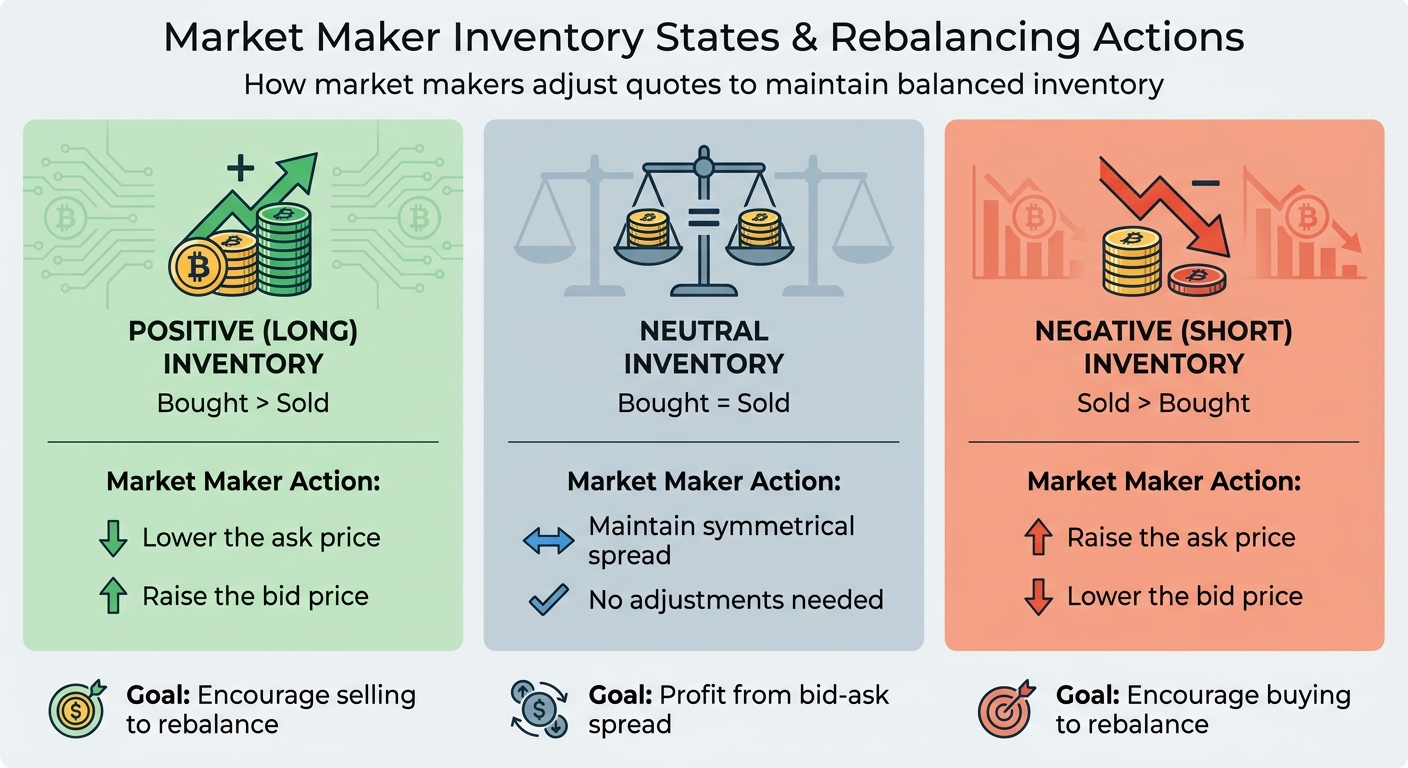
Market Maker Inventory States and Rebalancing Actions
In crypto market making, inventory refers to the tokens and quote assets (like BTC or USDT) held as part of providing liquidity [1][7]. Unlike directional traders, who focus on market trends, market makers accumulate inventory while executing buy and sell orders.
A long (positive) position means the market maker has bought more than they’ve sold, while a short (negative) position indicates the opposite. A neutral position, where buying equals selling, allows profit to come purely from the difference between the bid and ask prices (the spread).
How Inventory Works in Market Making
To provide liquidity, market makers aim to maintain balanced inventories of assets. For instance, if they quote a $49,975 bid and a $50,025 ask, they commit to buying at the lower price and selling at the higher price. When a bid is hit, the market maker accumulates the asset; when an ask is hit, they reduce their holdings. This constant back-and-forth shifts their inventory position over time.
If their inventory becomes imbalanced, market makers adjust their quotes – lowering the ask price and raising the bid price – to encourage trades that help restore balance [2][3]. These adjustments are algorithm-driven and not based on speculation.
In traditional stock markets, market makers often close their day with zero inventory. However, crypto market makers operate in a 24/7 trading environment, which adds complexity. This challenge is amplified by the crypto market’s notorious volatility and fragmented liquidity spread across multiple exchanges [4][7].
This ever-changing environment sets the stage for unique challenges, especially during periods of high volatility.
How Inventory Changes During Market Volatility
While balanced quoting strategies work under normal conditions, volatility introduces new risks. During periods of extreme price swings, inventory positions can shift rapidly. For example, in a downtrend, a market maker might end up with an inflated asset position due to filled buy orders and unexecuted sell orders. This creates inventory risk, which is the danger of being unable to offload holdings during unfavorable market conditions [1].
In the cryptocurrency market, price swings of 20% or more are not unusual [4]. Events like major news announcements, token unlocks, or large trades by whales can create one-sided order flows. When this happens, one side of the market maker’s quotes may fill quickly while the other side remains untouched.
| Inventory State | Description | Market Maker Action |
|---|---|---|
| Positive (Long) | Bought > Sold | Lower the ask price and raise the bid to encourage selling. |
| Negative (Short) | Sold > Bought | Raise the ask price and lower the bid to encourage buying. |
| Neutral | Bought = Sold | Maintain a symmetrical spread. |
The risk tied to inventory grows exponentially with both position size and market volatility. A moderate long position might be manageable in a calm market, but in a sudden downturn, it could lead to significant losses. To mitigate this, professional market makers set strict inventory limits and use automated systems to reduce exposure when those limits are breached [7][9].
These rapid inventory shifts highlight the importance of effective inventory management, which will be explored in the next sections.
Why Inventory Management Matters
Keeping inventory under control is the backbone of profitable market making. Without it, a market maker risks losing both operational stability and the profits earned from bid-ask spreads. Success in this field often hinges on how well inventory positions are managed. This management not only supports liquidity provision but also safeguards profits, as explained below.
During periods of market volatility, inventory management takes on even greater importance. Poor control over inventory introduces significant risks. For instance, if a market maker holds too much of a single asset, they become vulnerable to directional risk – the chance that price changes could quickly eat into their profits. Imagine holding a $1,000,000 position; a 20% drop in the asset’s value could result in a $200,000 loss, erasing weeks or months of hard-earned spread profits.
Proper inventory management also ensures liquidity is maintained. If a market maker’s inventory becomes "stuck" on one side – holding only the base asset with no quote asset to trade – they lose the ability to offer two-sided quotes [1][2]. At that point, they may have no choice but to halt operations or sell at a loss to rebalance, both of which are costly scenarios.
How Inventory Affects Liquidity
A market maker’s ability to provide liquidity hinges on keeping inventory balanced. To post both buy and sell orders, they need adequate holdings of both assets in the trading pair. When inventory drifts too far in one direction, it becomes impossible to quote competitively on both sides of the order book.
This imbalance often forces market makers to adjust their strategies. They might widen spreads or reduce the depth of their order book to shield themselves from further risk [2]. For traders, this translates to higher transaction costs and less reliable trade execution. What starts as an internal issue for the market maker can ripple outward, affecting the broader market’s liquidity.
To manage these challenges, professional market makers use a tactic called quote skewing. If they hold too much inventory, they adjust their quotes to become the most appealing seller – lowering the ask price and raising the bid price. This encourages trades that naturally bring their holdings back into balance [4][7]. The ultimate goal is delta neutrality, where the portfolio’s value remains steady regardless of market fluctuations [4].
Protecting Profits and Reducing Risk
Effective inventory management goes beyond maintaining liquidity; it also protects profits and minimizes risk. Market makers generate income from the bid-ask spread, not by betting on price movements. However, even small spread profits can be wiped out by losses from an unbalanced position. Without timely rebalancing or hedging, market makers expose themselves to unnecessary risks [4].
For example, earning a 0.1% spread on each trade might seem profitable, but a large unhedged position facing a 5% price drop could lead to losses that overshadow days of spread earnings. To avoid this, market makers set inventory bands – limits that automatically trigger rebalancing when exceeded [2].
High volatility amplifies these risks. Market makers face adverse selection risk when trading with better-informed counterparties [3]. They also encounter trending market risk, where repeatedly filling buy orders without matching sell orders leads to accumulating assets that are losing value [1]. Tools like filled order delays – pausing before placing new orders after one is filled – help curb rapid, one-sided accumulation during downturns [1].
"Inventory risk is the probability a market maker can’t find buyers for his inventory, resulting in the risk of holding more of an asset at exactly the wrong time, e.g. accumulating assets when prices are falling." – Hummingbot [1]
Strategies for Managing Inventory
Market makers rely on a variety of strategies to keep their inventory in check. These range from setting clear boundaries on asset holdings to using advanced models that dynamically adjust quotes. The aim is to maintain balance, minimize directional risk, and ensure smooth operations. These methods build on earlier ideas about inventory risk and offer practical steps to achieve stability.
Setting Inventory Limits
One of the most basic yet effective methods is setting strict limits on how much of each asset to hold. Market makers usually aim for a balanced portfolio – often a 50/50 split – to support consistent two-sided quoting. A predefined inventory range multiplier determines how far holdings can deviate before triggering rebalancing actions [1][6]. For instance, if the target is 50% with a 10% tolerance, rebalancing might occur when holdings hit 60% or drop to 40% of the total portfolio value.
More sophisticated systems use a risk aversion parameter (commonly labeled as γ) to decide how aggressively they respond to inventory imbalances. In the Avellaneda-Stoikov model, a low γ value leads to a balanced, symmetrical approach, while higher values result in more aggressive adjustments [6][5]. This parameter also affects the reservation price – the price at which the market maker is indifferent between holding or trading an asset [6][3]. As inventory drifts from the target, the reservation price shifts away from the market mid-price, automatically making one side of the quote less attractive and the other more appealing.
Adjusting Quotes to Rebalance Inventory
When inventory leans too heavily in one direction, adjusting bid and ask quotes can help restore balance. For example, if a market maker holds too much of an asset (net long), they might lower both quotes – making the ask price more attractive to buyers while discouraging additional sellers [3]. This adjustment leverages the market’s trading volume to offload excess inventory.
"By encouraging traders to buy from them, they use the market’s own volume to offload excess inventory and rebalance their holdings back to a neutral state." – Orcabay [4]
A real-world example from January 2026 highlights this approach. During a volatility spike, a market maker with a mid-price of $50.00 and a net long position of 25,000 shares adjusted their reservation price to $49.97. They then shifted quotes from $49.99/$50.01 to $49.975/$49.995. This small adjustment – pricing half a cent below the mid-price – encouraged buyers and allowed the firm to sell 15,000 shares in just 50 milliseconds [3].
Another technique is inventory skewing, where order sizes are adjusted based on holdings. For instance, buy orders might be reduced while sell orders are increased when inventory levels are too high [1].
Using Hedging and Diversification
Quote adjustments alone can’t eliminate all inventory risks. That’s where hedging and diversification come into play. Hedging, particularly delta-neutral hedging, is a common approach. By opening a short futures position equal to their long inventory, market makers can bring their price exposure (delta) to zero, converting inventory risk into basis risk [4].
"If a market maker operates without a hedge, they aren’t actually making a market. They are gambling." – Orcabay [4]
Another method is cross-exchange hedging, also known as liquidity mirroring. This involves offsetting positions by providing liquidity on a smaller exchange while neutralizing the exposure on a larger, more liquid one.
For high-volatility scenarios, options can act as a safety net. Buying put options, for example, caps potential losses during sudden market crashes without requiring constant adjustments. Advanced strategies might also include multi-asset diversification, where inventory is managed across several correlated assets. This reduces overall portfolio risk, but it’s crucial to monitor basis risk to ensure hedges remain effective as market conditions change [1][3].
Tools for Tracking and Managing Inventory
To put inventory management strategies into action, advanced tools are crucial. These tools allow for real-time tracking and automated adjustments, ensuring precise execution even in unpredictable markets. Market makers rely on platforms that monitor positions live and tweak orders automatically. Options range from open-source frameworks to high-end systems tailored for the fast pace of crypto trading.
Real-Time Inventory Tracking Systems
Real-time tracking tools provide market makers with immediate insights into their holdings, profits, losses, and exposure across multiple exchanges. For example, Deltix MarketMaker offers institutional-grade monitoring, enabling real-time asset tracking and volume analysis [13]. This centralized view is especially useful for firms managing liquidity across numerous exchanges, helping to avoid overexposure due to blind spots.
Another option is Raytrade Studio, which consolidates various tools into a single workspace. This platform reportedly saves traders up to 20 hours each month. Pricing starts at $99 per month per bot for the Basic plan, with a Pro tier available at $199 per month [12].
For those leaning toward open-source solutions, Hummingbot is a community-driven platform boasting over 15,600 subscribers and billions in trade volume [11]. It features real-time dashboards for tracking trade volume and includes "Condor", a Telegram-based interface for remote bot management – ideal for continuous trading. As Kollan, a Prop Trader, shared:
"Hummingbot allowed me to run profitable strategies and generate $2 billion in trade volume. I can’t recommend Hummingbot enough for any algo trader seeking a 0 to 1 platform" [11].
QuantMesh, built on a Go-based multi-threaded architecture, offers impressive performance speeds – 10 to 50 times faster than Python-based alternatives [10]. It includes advanced tools like a "Super Position Manager" for detailed order and position tracking and "Auto Reconciliation" to sync local and exchange data, minimizing risks during volatility spikes. QuantMesh is free for individual users under an AGPL-3.0 license, with commercial licensing options for larger operations [10].
While these systems provide critical visibility, the next step involves automating inventory control to maintain balance and minimize risk.
Automated Inventory Control Algorithms
Tracking inventory is just the beginning – automation is key to managing it effectively. Algorithms handle rebalancing by adjusting quotes and order sizes based on current holdings. These systems dynamically modify reservation prices in response to inventory levels, market volatility, and risk tolerance [6][9]. When imbalances occur, algorithms recalibrate quotes to restore equilibrium [3][4][1].
For instance, in March 2026, DolphinDB backtested the Avellaneda-Stoikov strategy on Binance BTC/USDT data. The system processed over 700,000 data points in one day, executing 184 BTC in buys and 201 BTC in sells [9][15].
Automated systems also incorporate safeguards to prevent overtrading or unintended risks. Features like filled order delays (pausing after a trade to avoid rapid accumulation), hanging orders (keeping one side open until a matching trade occurs), and ping pong strategies (placing orders on the opposite side of a recently filled order) help maintain a balanced inventory ratio, often targeting a 50/50 split [1].
The GRID system takes this a step further with its dual-engine design. A Rust-based LP engine and a TypeScript-based Hedge engine work together to calculate net delta in real time and manage collateral on decentralized protocols like Drift [14]. The system classifies market volatility into three categories – "Crab" (daily volatility below 3%), "Normal" (3–8%), and "Blast" (above 8%) – to optimize trading ranges. It also includes "Balance Actor Circuit Breakers", which monitor for technical issues like RPC failures and pause operations to protect funds during instability [14].
These automated controls are essential for maintaining balanced inventories, supporting liquidity, and managing risks in ever-changing market conditions.
Best Practices for Inventory Management
Matching Inventory to Market Demand
It’s essential to align your inventory with market demand. Instead of striving for constant neutrality, experienced market makers operate within specific inventory bands. These bands help absorb normal trading flows while ensuring steady liquidity [2]. This method prevents the disruptive effects of overly aggressive rebalancing.
When your inventory drifts from target levels, use strategies like adjusting quotes and order sizes to encourage rebalancing trades. The reservation price plays a pivotal role here: it moves below the mid-price when your inventory is long (to promote selling) and above the mid-price when short (to stimulate buying) [5][6]. During periods of extreme volatility – like when crypto prices swing by 20% or more – consider widening spreads, resizing orders, or tightening inventory thresholds to reduce exposure to "toxic flow" [4].
| Strategy Component | Action for Long Inventory | Action for Short Inventory |
|---|---|---|
| Quote Skewing | Lower ask / aggressive offers | Higher bid / aggressive bids |
| Reservation Price | Lowered below mid-price | Raised above mid-price |
| Order Sizes | Larger sells / smaller buys | Larger buys / smaller sells |
| Inventory Goal | Encourage selling to rebalance | Encourage buying to rebalance |
To avoid overtrading, implement safeguards like a "Filled Order Delay", which pauses new orders after a fill to prevent accumulating losing positions too quickly. Another useful tool is "ping-pong logic", which places orders on the opposite side after a fill to maintain balance. Additionally, setting clear depth targets ensures that the liquidity you provide is accessible to other traders [1][2].
By making these demand-driven adjustments, you create a solid foundation for ongoing strategy refinement.
Reviewing and Adjusting Your Approach
Once you’ve implemented demand-based tweaks, it’s vital to periodically review and fine-tune your inventory strategy. Regular recalibration – updating parameters like order arrival rates, volatility estimates, and risk aversion settings – keeps your strategy aligned with current market dynamics [5][6]. Analyzing historical trade data and performance metrics can help identify recurring issues, such as excessive accumulation during certain sessions or spreads that are too narrow during news events [1][2].
Backtesting is another crucial step. It offers a risk-free way to evaluate how your inventory strategies perform under different market conditions, ensuring they’re effective before going live.
Pay close attention to the micro-price, which provides a more accurate measure of price pressure and supply-demand imbalances than the simple mid-price. This metric, a weighted average of the best bid and ask adjusted for volume depth, is particularly useful during uncertain times. In such scenarios, increasing risk aversion can help shift the reservation price more aggressively toward your target levels [6][8].
To further manage risk, set position limits, loss limits, and inventory thresholds that trigger predefined responses when your exposure exceeds acceptable levels [2][9]. As Warren Buffett wisely said:
"Risk comes from not knowing what you’re doing." [1]
Consider tailoring your approach to the trading day’s natural rhythms. For instance, markets often see heightened activity at the open and might require aggressive inventory adjustments near the close. Adapting your strategy to these patterns can improve both profitability and risk management [7].
Conclusion
Managing inventory effectively is the cornerstone of successful crypto market making. It transforms directional risk into a structured, numbers-driven strategy that thrives on spreads. Jakob Brezigar, a cryptocurrency market-making expert at Orcabay, sums it up perfectly:
"The best market makers aren’t the best at predicting price; they are the best at managing math."
This approach revolves around maintaining balance over time by staying within defined inventory ranges, using quote skewing to drive rebalancing trades, and applying hedging techniques to offset directional risk. These methods are crucial in a market where 20% price swings are the norm, helping to avoid large, unbalanced positions [4].
The challenge lies in how quickly inventory risk grows with larger positions and increased volatility [3]. By leveraging tools like filled order delays, dynamic hedging, and real-time micro-price tracking – discussed earlier – you can minimize the likelihood of holding assets at the wrong time.
Professional market making is a dynamic process. It requires constant recalibration, rigorous backtesting, and setting clear boundaries to maintain control and avoid market turbulence.
Armed with the strategies, tools, and insights shared in this guide, you’re equipped to manage inventory with precision and build a stable, profitable market-making operation.
FAQs
How do market makers choose their inventory limits?
Market makers use risk management strategies to set inventory limits, aiming to strike a balance between profitability and controlling exposure. To manage their positions, they tweak their quotes to encourage trades that offset any imbalances – a technique known as inventory skewing. Tools like the Avellaneda-Stoikov framework play a big role in this process. These dynamic models help fine-tune adjustments by factoring in market volatility and the firm’s risk tolerance. The result? Inventory limits that stay adaptable, aligned with market conditions, and designed to maintain liquidity while keeping risks in check.
When should a market maker hedge instead of just skewing quotes?
Market makers facing significant inventory risk – like during sharp price changes or heightened volatility – should prioritize hedging over adjusting their quotes. Hedging provides a safeguard against unfavorable exposure and potential losses, particularly when inventory levels become uneven or surpass manageable thresholds.
What signals indicate inventory risk is becoming dangerous?
Inventory risk becomes a serious concern when there’s heavy directional exposure – like being significantly long or short on an asset. This kind of positioning makes you more vulnerable to sudden, unfavorable price swings. Another red flag is when inventory levels stray far from neutral, creating imbalances that demand active management to minimize potential losses.