


Staking rewards are critical for maintaining a token’s value and supporting its ecosystem over time. If you’re designing staking incentives, you need to balance attractive yields, network security, and long-term viability. Without proper planning, you risk short-lived hype, token inflation, and user disengagement.
Here’s how to approach it:
- Set clear objectives: Define what your token aims to achieve – security, governance, or utility.
- Incentivize long-term staking: Use time-lock mechanisms like perpetual contracts or fixed expiration dates to reward participants who commit for longer periods.
- Design smart reward formulas: Consider time-weighted rewards, staking participation rates, and performance requirements to align incentives with user behavior.
- Balance security and liquidity: Offer competitive yields (4–8%) while avoiding excessive inflation. Use mechanisms like liquid staking tokens (LSTs) to address liquidity challenges.
- Monitor and adjust: Regularly track metrics like staking rate, token velocity, and protocol revenue per token. Use simulations to stress-test your model and ensure stability.
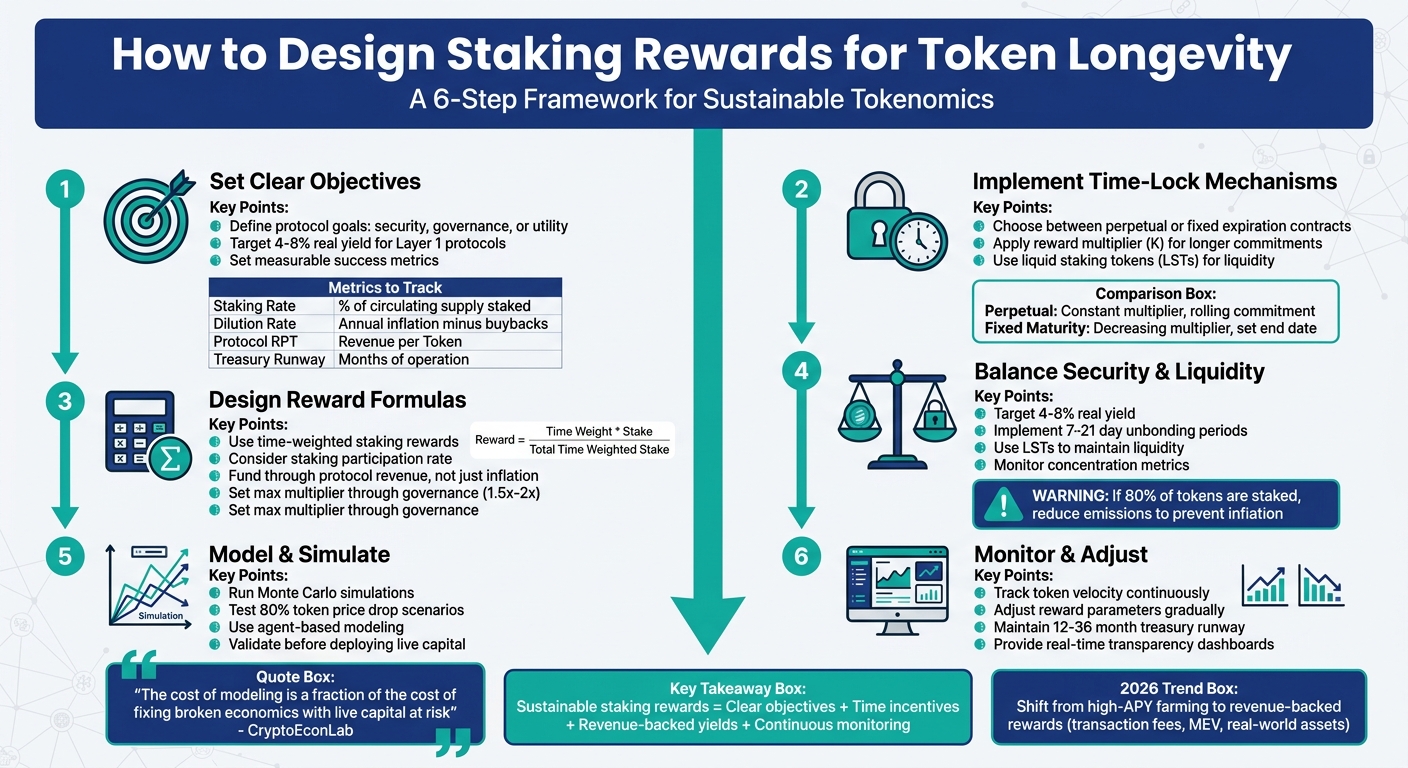
6-Step Framework for Designing Sustainable Token Staking Rewards
INKRYPTUS DEEP DIVE: Staking Rewards, Tokenomics & How Stable the Income Really Is?
sbb-itb-c5fef17
Step 1: Set Clear Objectives for Long-Term Token Alignment
First, ask yourself: what problem is your protocol solving? As CryptoEconLab explains, "Tokenomics design starts with the economic problem your protocol solves, not with a token supply number" [1]. Tokens are tools for coordination, and their purpose is justified only when they align the actions of independent, untrusting participants [1].
Failing to set clear objectives can lead to serious issues. For instance, if emission rates outpace consumption, the token’s value can spiral downward. Look at Filecoin‘s case: between 2024 and 2026, inflation ran at 15-19% annually – 8-9 times higher than a sustainable level. The network emitted 300,000 FIL daily, but consumption capped at 180,000. This mismatch stemmed from objectives that didn’t align with the network’s growth patterns [1].
Think of tokenomics as economic architecture. Start by defining your goals – whether it’s ensuring security, encouraging active governance, or bootstrapping service delivery. These goals will guide you in structuring rewards and setting success metrics [1].
Identify Target User Behavior
Pinpointing your early, high-value users is critical. Are you targeting validators for security? Developers to build applications? Enterprises seeking efficiency? Or individuals motivated by rewards? [8]
For security, focus on attracting validators who can stake enough capital to deter dishonesty or downtime through slashing penalties. Ethereum’s model is a great example. By January 2026, about 28.9% of the total ETH supply (35.86 million ETH) was staked. Out of 1.2 million validators, only 472 (0.04%) were slashed, showing that the incentives successfully attracted reliable participants [7].
If governance is your priority, consider vote-escrowed models or reward multipliers. These systems reward users who lock up their tokens for longer periods, granting them greater voting power. This discourages "mercenary capital" that chases high APYs and exits quickly. Instead, it draws participants who actively engage in decisions like protocol upgrades, fee structures, and treasury management [2].
Set Measurable Success Metrics
Vague goals like "boost staking participation" won’t cut it. You need specific metrics that reveal whether your rewards are fostering sustainable alignment. Here are some key metrics to track [5]:
| Metric | What It Measures | Why It Matters |
|---|---|---|
| Staking Rate | Percentage of circulating supply currently staked | Reflects network security and token holder commitment |
| Dilution Rate | Annualized inflation minus buybacks and burns | Shows how emissions impact token value |
| Protocol Revenue per Token (RPT) | Annual revenue attributed to each token | Links the protocol’s success to token utility |
| Treasury Runway | Months of operation at the current spending rate | Assesses financial sustainability over time |
Most Layer 1 protocols now aim for a 4-8% real yield – a balance that attracts capital without causing excessive dilution [1]. This marks a shift from the high-APY farming schemes of earlier cycles. Additionally, when teams and investors control over 40% of the total supply, community governance often becomes performative, as insiders maintain full control [1].
Another critical metric is token velocity, which measures how often tokens change hands. High velocity indicates short-term speculation or use as a medium of exchange, while lower velocity paired with higher staking rates suggests long-term alignment [2][4].
Lastly, test your metrics under stress. Simulate scenarios where token value drops by 80% [1]. Many systems fail this test because collateral requirements become unsustainable, leading to liquidations and mass unstaking.
Once your objectives and metrics are clearly defined, you’re ready to model reward scenarios that ensure lasting token alignment.
Step 2: Implement Time-Lock Mechanisms
Once you’ve set clear objectives and metrics in Step 1, the next step is to ensure long-term commitment using time-lock mechanisms. These systems reward participants who stake their tokens for longer periods, which not only boosts network security but also helps maintain token value over time.
Time-lock mechanisms work by applying a reward multiplier, often called "K", to incentivize extended staking durations. The longer someone commits, the greater their share of rewards – without penalizing those who prefer shorter commitments. This approach strikes a balance, encouraging both broad participation and rewarding those who stick around for the long haul.
The choice comes down to two main types of contracts: perpetual time-locks and fixed expiration date contracts, each offering distinct benefits and trade-offs.
Perpetual Time-Lock Contracts
Perpetual time-locks operate like rolling commitments. For example, if you stake with a one-year lock, that duration resets with every block or epoch. To exit, you submit a notice and wait the full lock period – say, 365 days – before you can reclaim your assets. This setup is somewhat similar to a puttable bond in traditional finance [6].
One big advantage of perpetual time-locks is that the reward multiplier stays consistent throughout the staking period. This ensures the network maintains strong security at every block.
"Perpetuals are a better construct than the fixed-maturity alternative because… the perpetual, 1-year time-lock construction allows networks to operate at the maximum possible time-lock every epoch/block, which best incentivizes long-term staking."
– Vishal Kankani and Tushar Jain, Multicoin Capital [6]
To address potential liquidity challenges, protocols can introduce liquid staking token (LST) pools based on terms. For instance, a "stToken-12month" pool lets long-term stakers exit early by trading their locked tokens on secondary markets, transferring the duration risk to others.
Fixed Expiration Date Contracts
Fixed-maturity contracts work more like traditional bonds. You lock your tokens until a specific date, at which point they are released. As the maturity date approaches, the reward multiplier decreases. For instance, if you lock tokens for a year and nine months pass, only three months remain until unlocking – reducing the incentive advantage for the remaining period.
A noteworthy example comes from Aave’s governance in early 2025. With the "Umbrella" update, they reduced potential slashing from 20% to 10% and shortened the cooldown period from 20 days to 7 days. These changes were aimed at increasing participation by making staking more flexible while maintaining security [9].
For most proof-of-stake protocols, perpetual time-locks tend to be the preferred choice. They provide stable incentives, strengthen network security, and avoid the diminishing commitment issues seen with fixed-maturity contracts. The value of the reward multiplier (K) should be determined through community discussions – high enough to incentivize participation but not so steep that it discourages users [6]. With these mechanisms in place, protocols can then focus on refining reward formulas to align incentives with their security goals.
Step 3: Design Reward Formulas and Multipliers
Once time-locks are defined (as outlined in Step 2), the next step is to create a clear formula for calculating and distributing rewards. This formula plays a crucial role in determining whether users stick around for the long haul or chase short-term profits. The goal here is to align rewards with long-term participation, making the system more stable and appealing.
Time-Weighted Staking Rewards
Time-weighted reward systems prioritize how long tokens are staked rather than just the amount deposited. This approach discourages quick trades and encourages sustained engagement. Multicoin Capital describes this as creating a "yield curve" for crypto protocols, a concept borrowed from traditional financial markets:
"Yield curves are the backbone of well-functioning financial markets. Long-Term Staking is a crypto-native way to bring that vision to life." – Vishal Kankani and Tushar Jain, Multicoin Capital [6]
Take Resolv‘s Season 2 campaign (2025–2026) as an example. They used a Weighted Average Holding Period (WAHP) model where rewards were capped at 2x. A boost factor was calculated as min(1 + WAHP in years, 2). For instance, a user staking 2,000 tokens for 7 days earned a boost factor of about 1.0192x. Adding 500 tokens dropped the average stake age to 5.6 days, reducing the boost to roughly 1.01535x [11].
You can implement time-weighting through tiered multipliers (e.g., 1x for 30 days, 1.5x for 90 days, 2x for 180 days). However, be mindful of potential "cliff effects", where participants may unstake and restake to reach the next reward tier, as seen in systems like Synthetix [10].
Another option is to track token-seconds. For example, staking 50 tokens for one day (86,400 seconds) generates 4,320,000 token-seconds of age. New deposits lower the average stake age, while withdrawals preserve the age of remaining tokens. This method prevents gaming the system and aligns well with the goal of promoting token longevity [11].
Factors Influencing Rewards
Beyond staking duration, other factors should be considered to maintain balance and sustainability in the reward formula. One key factor is the staking participation rate. If only 10% of tokens are staked, rewards can be generous. However, if 80% are locked up, adjustments might be needed to avoid excessive inflation [5].
Another factor is funding rewards through protocol revenue rather than relying solely on token inflation. By 2026, many protocols have shifted to tying staking yields to transaction fees, MEV capture, or treasury earnings from tokenized real-world assets.
Performance requirements are also critical. For instance, Avalanche’s Primary Network now requires validators to maintain at least 90% uptime to qualify for rewards, up from the previous 80% threshold. Their formula uses an "Effective Consumption Rate" that scales between 10% and 12% based on staking duration, with a maximum cap of 365 days [12].
From a technical perspective, Solidity developers should multiply rates by 1e18 for calculations and only divide at the final step [10]. To optimize performance, consider using lazy updates – recalculating user rewards only during interactions like staking, unstaking, or claiming. This reduces computational overhead and ensures efficient reward calculations over time [10][11].
Finally, set the maximum multiplier (K) through community governance to encourage long-term staking without disproportionately benefiting large holders [6]. Starting with a conservative cap (e.g., 1.5x to 2x) and adjusting based on observed behaviors is often more effective than launching with aggressive multipliers that could lead to unintended outcomes. These strategies help create a balanced, sustainable reward system that supports long-term network health and security.
Step 4: Balance Incentives with Network Security and Liquidity
Once your reward formulas are set, it’s time to tackle a critical challenge: staking rewards need to be appealing enough to secure the network, but not so high that they drain market liquidity. CryptoEconLab sums it up well: "Staking yield: High enough to attract capital, low enough to not be purely mercenary" [1]. For Layer 1 protocols, this often means targeting a real yield of 4–8% to maintain this balance [1]. From here, liquidity issues take center stage.
Unbonding periods, typically ranging from 7 to 21 days, add another layer of complexity [1]. While these periods enhance security by preventing quick exits during potential network attacks, they also tie up users’ funds, creating liquidity challenges. This is where Liquid Staking Tokens (LSTs) step in. By offering tradable derivatives of staked assets, LSTs allow users to keep their capital active in DeFi while still supporting network security [2][5].
To fund staking rewards sustainably, protocols now rely on transaction fees, MEV (Maximum Extractable Value) capture, and treasury earnings from tokenized assets [2][5]. This strategy helps attract participants who are committed for the long haul, rather than those chasing the highest short-term returns.
Once security and liquidity are in check, the next step is refining incentives to avoid centralization. One approach is implementing non-whaling policies, which reduce rewards for stakes beyond a certain threshold. For example, square-root reward formulas can limit the advantage of large stakers, capping their yields with only a 23% stake advantage [1]. However, this method can destabilize the network and discourage smaller validators. A better alternative is using diminishing reward curves, which encourage participation while safeguarding decentralization.
Constant monitoring is essential. If staking participation is low – say, only 10% of tokens are staked – you can afford to offer higher rewards. On the flip side, if 80% of tokens are locked up, you may need to scale back emissions to prevent inflation and ensure liquidity [5]. Keep an eye on concentration metrics, like the percentage of tokens held by the top 10 or 100 addresses, to spot centralization risks early [5]. For protocols that use restaking, limit the amount of restaked tokens to a specific percentage of the total staked supply to mitigate systemic risks [5].
Step 5: Model and Simulate Reward Scenarios
After establishing reward structures and liquidity balances, it’s time to put your staking program through rigorous testing. Modeling and simulation are crucial steps to ensure the system can withstand various market conditions. By running simulations, you can stress-test your reward structure and observe user behavior under scenarios like fluctuating APY rates or an 80% drop in token prices [10]. These tests help confirm that your reward system supports long-term token sustainability.
One effective method is Monte Carlo simulations, which run thousands of iterations to uncover risks in extreme scenarios. For instance, in the volatile world of crypto, a 95% Value-at-Risk (VaR) could show a potential annual return loss of 56%, meaning there’s a 5% chance of returns falling below this threshold [13]. These insights allow you to fine-tune the reward multiplier (K) to strike a balance – locking in capital without discouraging short-term participation or concentrating power in the network [6].
Another approach is agent-based modeling, which simulates how rational participants might behave under different conditions. This method helps identify potential weaknesses before real funds are at stake. As CryptoEconLab aptly puts it:
"The cost of modeling is a fraction of the cost of fixing broken economics with live capital at risk" – CryptoEconLab [1]
Simulations can also guide decisions on whether to use perpetual or fixed-maturity contracts by showcasing how each structure impacts liquidity, security, and user experience over time.
Comparison of Perpetual vs. Fixed Maturity Contracts
To better understand the trade-offs, here’s a side-by-side comparison of the two contract types:
| Feature | Perpetual Time-Lock Contracts | Fixed Maturity Contracts |
|---|---|---|
| Reward Multiplier (K) | Remains constant as the time-lock resets to the maximum each epoch. | Gradually decreases as the maturity date nears, reducing the reward spread. |
| Liquidity Impact | Predictable exit window (e.g., always 1 year away after providing notice). | Locked liquidity until a specific date set in the contract. |
| Security Benefits | Maintains high network security by keeping the maximum time-lock active. | Security contribution declines as the maturity date approaches. |
| Implementation Complexity | More complex; requires automated rolling mechanisms and tracking. | Simpler; follows a traditional bond-like structure. |
| Staker Experience | Functions like a "puttable bond" with automatic renewal. | Similar to a standard bond with a fixed return date. |
This comparison is based on data from [6].
Vishal Kankani and Tushar Jain from Multicoin Capital emphasize the advantages of perpetual contracts:
"Perpetuals are a better construct than the fixed-maturity alternative because… the perpetual, 1-year time-lock construction allows networks to operate at the maximum possible time-lock every epoch/block" – Vishal Kankani and Tushar Jain, Multicoin Capital [6]
Step 6: Monitor and Adjust for Token Velocity
Once you’ve established a solid staking rewards framework, the next priority is keeping a close eye on token velocity. Why? Because token velocity – the rate at which tokens circulate within your ecosystem – has a direct impact on price stability and the overall health of your tokenomics. High velocity often signals rapid token selling, while low velocity might indicate limited activity or liquidity.
To ensure your tokenomics stay on track, you’ll need to monitor metrics like staking ratios and protocol performance. These KPIs act as vital signs for your system’s health. For example, a drop in the staking ratio or a low Protocol Revenue per Token could mean it’s time to revisit and adjust your reward rates. The goal is to keep yields within sustainable levels to maintain network balance.
When making adjustments, rely on data and proceed gradually. Dynamic reward parameters, such as the reward rate coefficient (ρ) and the price sensitivity parameter (γ), can be fine-tuned through governance or automated feedback systems. Filecoin offers a great example of this approach with its baseline minting model, where token issuance is tied to network storage growth targets. However, analysis has shown its inflation rate – ranging from 15% to 19% – to be significantly higher than the sustainable range, highlighting why regular monitoring and adjustments are critical [1].
"If your protocol needs users to do X, and doing X is only rational when token price goes up, your incentive structure depends on speculation rather than utility." – CryptoEconLab [1]
To maintain trust and stability, implement changes thoughtfully and transparently. Consider providing real-time dashboards that allow stakeholders to track parameter updates as they happen [2][3]. Protocols that stand the test of time often incorporate governance mechanisms that allow for parameter adjustments within defined limits, enabling them to respond to market changes without destabilizing the network [1].
Conclusion
Creating staking rewards that support long-term token viability is a careful balancing act between offering incentives and ensuring utility. The most enduring protocols start by addressing a clear coordination issue, design rewards tied to the token’s core purpose, and stay flexible as market conditions evolve. As CryptoEconLab wisely notes:
"Complexity isn’t sophistication – each additional mechanism is a new surface for exploits and a new thing users have to understand" [1].
To succeed, your framework should incorporate sustainable token supply management, strategic distribution, and well-aligned incentives. By 2026, the trend has shifted away from hyper-inflationary yield farming toward rewards backed by tangible revenue sources like transaction fees, MEV capture, and yields from real-world assets [5]. This evolution ensures protocols remain stable even during periods when token prices aren’t on the rise.
Ongoing evaluation is critical. Monitor metrics such as staking rate, dilution rate, Protocol Revenue per Token (RPT), and treasury runway consistently. Implement governance tools to adjust emission rates and staking yields carefully, avoiding network instability. The strongest protocols in 2026 maintain a treasury runway of 12–36 months and provide transparent, real-time dashboards for stakeholders to track progress [5]. If your protocol’s success hinges solely on rising token prices, you’re building a fragile system – not a durable economic model [1].
FAQs
How do I pick staking rewards without causing token inflation?
To prevent token inflation, it’s crucial to focus on rewards that promote sustainability and long-term growth instead of simply chasing high APYs. Here’s how you can achieve that:
- Create intrinsic utility for your token: This could include offering governance rights or other meaningful uses within your ecosystem.
- Align rewards with real value creation: Ensure that incentives directly contribute to the growth and health of your project, rather than encouraging short-term gains.
- Stress-test your incentive structures: This helps identify and address potential vulnerabilities that could lead to exploitation or unsustainable practices.
- Balance token emissions with ecosystem growth: Carefully manage the release of tokens to support steady development without overwhelming the system.
By taking these steps, you can build a tokenomics model that supports long-term engagement and value for participants.
Should my protocol use perpetual time-locks or fixed-maturity locks?
Fixed-maturity locks offer a clear advantage when it comes to encouraging long-term participation and stability. By setting specific timelines for token release, they provide a structured framework that aligns well with the goals of token longevity. On the other hand, perpetual time-locks, which keep tokens locked indefinitely, are less common. While they might enhance security, they can limit liquidity and reduce flexibility for stakeholders. Fixed-maturity locks strike a balance by fostering commitment over defined periods while still offering a clear path for token distribution.
Which metrics best signal whether staking incentives are sustainable?
Creating sustainable staking incentives hinges on several key factors: intrinsic utility, demand stability, and long-term engagement.
To start, staking rewards should tie directly to the token’s real-world use within its ecosystem. This could mean enabling governance participation, sharing platform fees, or other practical applications that give the token inherent value.
Next, consistent demand and usage are critical. If demand fluctuates too much or relies heavily on speculation, the staking model may struggle to maintain stability. Balanced emission and supply dynamics also play a role in avoiding inflationary pressures that could undermine the token’s value over time.
Finally, stress-testing the system against potential vulnerabilities ensures that the staking mechanism can withstand external pressures or market downturns. When combined, these metrics help create staking rewards that promote lasting value rather than short-term gains driven by speculation.