


Investing in pre-IPO companies can be done through forward contracts or direct equity, each offering distinct benefits and risks. Forward contracts provide rights to future shares or tokens without immediate ownership, while direct equity gives you immediate legal ownership and voting rights. Here’s a quick breakdown:
- Forward Contracts: Pay upfront or later for future shares/tokens. They offer flexibility and don’t affect the company’s cap table immediately but come with risks like non-delivery and counterparty credit exposure.
- Direct Equity: Buy shares directly with immediate ownership. This method includes voting rights and access to company information but involves higher costs, liquidity restrictions, and potential delays due to company approval processes.
Quick Comparison
| Feature | Forward Contracts | Direct Equity |
|---|---|---|
| Payment Timing | Upfront or at a set future price | Upfront at transaction close |
| Ownership Transfer | Delayed (at a future event) | Immediate (post-settlement) |
| Liquidity Risk | No liquidity until issuance | Restricted until IPO or sale |
| Governance | No voting rights | Includes voting rights |
| Risks | Delivery and counterparty risks | ROFR delays, lower liquidation rank |
Choosing the right approach depends on your goals and the company’s stage. Forward contracts suit investors seeking exposure without immediate cap-table impact, while direct equity is ideal for those wanting ownership and involvement. Always review company bylaws and perform due diligence before investing.
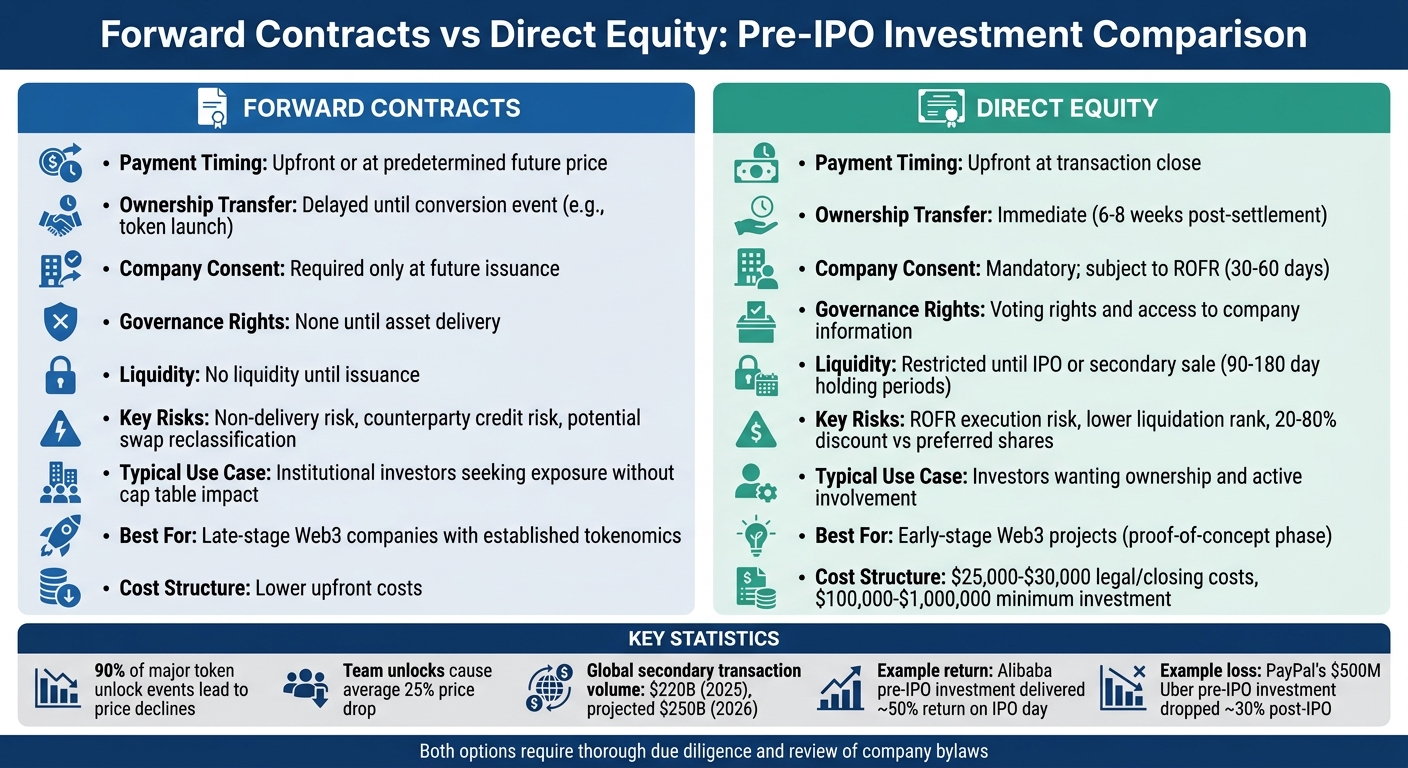
Forward Contracts vs Direct Equity in Pre-IPO Investments Comparison
Forward Contracts in Pre-IPO Transactions
How Forward Contracts Work
A deliverable forward contract is an agreement to deliver a set quantity of pre-IPO shares or tokens at a fixed price on a future date. This arrangement provides economic exposure to the asset without granting immediate legal ownership [4]. In Web3 transactions, delivery is often deferred until a specific milestone is achieved – such as the end of a lock-up period or the launch of a token. For projects that don’t yet have circulating tokens, forward contracts allow interests to change hands before the asset becomes traditionally transferable.
Attorney Mike Frisch explains the essence of forward contracts:
"The primary purpose of a forward contract is to transfer ownership of the commodity and not to transfer solely its price risk." [4]
To avoid being classified as a swap – which comes with strict regulations – a crypto forward must be structured for physical settlement and involve a nonfinancial commodity, with delivery delayed due to commercial reasons. This distinction matters because swaps require real-time reporting and could trigger dealer registration requirements. These structural elements are key to why forward contracts appeal to early-stage investors.
Benefits of Forward Contracts
Forward contracts offer early-stage investors a way to manage positions in illiquid assets with greater flexibility. In the Web3 space, they are often used to liquidate positions or hedge against potential losses when tokens are tied to multi-year vesting schedules. This is especially relevant since 90% of major token unlock events tend to lead to price declines, with team unlocks causing an average drop of 25% [1].
These agreements allow investors to lock in profits and manage risks without waiting years for a traditional exit. They also provide economic exposure without immediately impacting a company’s cap table. When structured as commercial transactions with a clear intent for physical delivery, forward contracts can avoid the regulatory burdens associated with swaps.
Risks and Limitations
Despite their advantages, forward contracts come with notable risks. The most significant is non-delivery. If the underlying project fails to launch or if the seller defaults once the asset becomes liquid, the investor could face an unmet obligation. Additionally, the bilateral nature of these agreements exposes investors to counterparty credit risk throughout the holding period.
Another concern is the potential reclassification of a forward contract as a swap. If this happens, both parties must qualify as Eligible Contract Participants (ECPs), which typically requires companies to have at least $10 million in assets [4]. To reduce this risk, it’s wise to secure ECP representations from counterparties and document the commercial intent of the tokens, such as their use for governance or network participation.
Finally, transaction documents should address technical events – like blockchain hard forks – to avoid disputes over which version of the asset will be delivered. Locked capital is also vulnerable to market volatility, making it essential to weigh these risks carefully. Understanding these mechanisms and potential pitfalls is crucial before comparing forward contracts to direct equity investments in pre-IPO scenarios.
sbb-itb-c5fef17
Direct Equity in Pre-IPO Transactions
How Direct Equity Works
Unlike forward contracts, direct equity offers immediate ownership, making it a compelling option for pre-IPO investments, particularly in Web3 ventures. This involves buying shares directly from current shareholders, with the transaction recorded on the company’s cap table. The process begins with submitting a Stock Transfer Notice, which triggers a 30–60 day Right of First Refusal (ROFR) period. During this time, the company or existing investors can match the offer. After the ROFR period, the transaction requires board approval and final settlement, typically completed within 6–8 weeks.
As AltStreet explains:
"The Right of First Refusal represents the single most significant operational difference between public and private market transactions." – AltStreet [2]
This structured process ensures legal ownership is transferred and establishes a direct connection with the company’s transfer agent.
Benefits of Direct Equity
The standout advantage of direct equity is immediate legal ownership along with full shareholder rights. Investors gain direct voting rights, access to company information, and other privileges tied to their share class, often common stock. This fosters a closer, more engaged relationship with the company.
Another benefit is simplified tax reporting. Direct equity transactions are reported via 1099-B forms, which are generally easier to manage compared to K-1 forms. In the Web3 space, direct equity can also serve as a "regulatory compliance certification mark", signaling credibility to institutional investors. These investors, managing around $13 trillion in assets, often avoid volatile tokens due to regulatory restrictions [1].
For instance, a $35 million pre-IPO investment in Alibaba delivered nearly a 50% return on the first day of public trading [7][8]. This highlights the potential for direct equity to generate substantial profits during market transitions. However, alongside these advantages, there are notable risks and limitations to consider.
Risks and Limitations
While direct equity offers immediate ownership, it comes with significant challenges. Shares often remain illiquid due to mandatory 90–180 day holding periods post-IPO and ROFR provisions that can delay or block transfers. As Rainmaker Securities warns:
"Pre-IPO shares are inherently riskier and less liquid than publicly traded stocks. The lack of a public market can make it challenging to sell the shares or determine their market value." – Rainmaker Securities [6]
Additionally, common stockholders rank below preferred shareholders in the liquidation hierarchy, which often results in a 20–80% discount compared to the most recent preferred share pricing.
Direct equity transactions also involve high costs. Minimum investments usually range from $100,000 to $1,000,000, with closing costs between $25,000 and $30,000 to cover legal fees, brokerage commissions, and administrative expenses [6]. A notable example is PayPal’s pre-IPO direct equity purchase of $500 million in Uber’s common stock. Following Uber’s IPO, the stock price dropped by roughly 30%, leading to a significant unrealized loss on PayPal’s investment [8].
Forward Contracts vs. Direct Equity: Side-by-Side Comparison
Structure and Mechanics
The main difference between forward contracts and direct equity lies in when ownership is established. With direct equity, your name appears on the company’s cap table shortly after settlement – usually within 6–8 weeks [2]. This makes you a legal shareholder, alongside institutional investors and employees. Forward contracts, on the other hand, offer a contractual right to receive tokens or shares at a later date, often linked to a "conversion event" like a network launch [3].
Another key distinction is in company consent. Direct equity requires approval upfront, and the process is subject to the company’s right of first refusal (ROFR). Forward contracts simplify the initial execution because company consent is only needed when the future issuance occurs. However, this means delivery isn’t guaranteed [3].
| Feature | Direct Equity | Forward Contracts / Warrants |
|---|---|---|
| Payment Timing | Upfront at transaction close [2] | Upfront or at a predetermined price [3] |
| Ownership Transfer | Immediate (post-settlement) to cap table [2] | Delayed until a "conversion event" [3] |
| Company Consent | Mandatory; subject to ROFR [2] | Required at future issuance/exercise [3] |
| Governance | May include voting rights [2] | No rights until the asset is delivered [3] |
These differences in structure influence the risks and benefits of each option.
Risk Comparison
Both investment types come with their own risks, and understanding these is crucial for investors.
With direct equity, execution risk is significant. The company can exercise its ROFR, potentially blocking the purchase entirely [2]. Even if you successfully acquire shares, they remain restricted until an IPO or a secondary market sale, which creates liquidity risk. Additionally, common stockholders are lower in the liquidation hierarchy, which can limit returns in modest exit scenarios [2].
Forward contracts carry delivery risk, as there’s always the chance the project won’t launch its tokens or complete the conversion event [3]. In Web3 investments, regulatory changes can also affect the legal status of the asset, adding another layer of uncertainty. Until the asset is issued, there’s no liquidity at all [3].
| Risk Factor | Direct Equity | Forward Contracts / Warrants |
|---|---|---|
| Execution Risk | High; company can exercise ROFR [2] | Project may fail to launch or convert [3] |
| Liquidity Risk | High; shares restricted until IPO [2] | Absolute; no liquidity until issuance [3] |
| Valuation Risk | Impacted by 409A delta and liquidation preferences [2] | Regulatory shifts may alter asset status [3] |
These risks highlight the trade-offs investors face when choosing between the two.
Returns and Liquidity
The potential returns and liquidity of these investments also differ sharply.
Direct equity provides returns through capital appreciation of common shares. Investors typically see returns during an IPO, acquisition, or secondary market sale [2][9]. The final return depends on the difference between the purchase price and the exit valuation, minus the impact of liquidation preferences. However, buybacks are uncommon in the pre-IPO phase [9].
Forward contracts, in contrast, base their returns on a predetermined price or a discount to the future market price [3]. Settlement happens when the asset is issued, usually tied to a "Network & Token Launch" event. As Nestor Dubnevych, Co-founder & Head of Web3 Legal at Legal Nodes, explains:
"The token warrant provides investors with a right to purchase tokens in the future at a predetermined price or with a predetermined discount, while also specifying when the Token SPV will be formed." – Nestor Dubnevych, Legal Nodes [3]
For Web3 investors, this structure means balancing short-term liquidity constraints against the potential for long-term growth.
| Feature | Direct Equity | Forward Contracts / Warrants |
|---|---|---|
| Return Basis | Capital appreciation of common shares [2] | Predetermined price or discount [3] |
| Exit Options | IPO, acquisition, or secondary sales [2][9] | Settlement upon issuance; linked to "Network & Token Launch" [3] |
| Cash Flow | Rare buybacks pre-IPO [9] | None until settlement [3] |
Pre-IPO Investing: Risks, Rewards, and Strategy
Which Option Works Best for Web3 Investors
Deciding between forward contracts and direct equity depends largely on your investment goals and the stage of the Web3 project you’re targeting. Here’s how these two approaches cater to different investor needs in the Web3 landscape.
Forward Contracts for Institutional Investors
Forward contracts are often the go-to choice for institutional investors looking to gain economic exposure without affecting the cap table. This method is particularly effective for late-stage Web3 companies that have already established their tokenomics and set up a Token SPV with a confirmed Network & Token Launch date [5]. Through forward purchase agreements, institutions can secure a price – usually discounted from the last funding round – without triggering the legal processes that come with immediate ownership, like board approval or ROFR waivers [10].
The rising global volume of secondary transactions highlights the increasing popularity of forward contracts in pre-IPO scenarios. Firms like Bestla VC specialize in OTC solutions, offering liquidity and mitigating counterparty risks, which are particularly beneficial for institutional investors tackling the complexities of pre-IPO Web3 deals.
That said, forward contracts are not without risks. For example, in December 2025, Matt Grimm, co-founder of Anduril Industries (valued at around $60 billion at the time), publicly noted that the company’s stock plan and bylaws prohibited forward contracts. This meant Anduril would never consent to an SPV taking possession of shares while the company remained private [10]. This example highlights the critical need for investors to thoroughly review a company’s bylaws before entering forward agreements. On the other hand, early-stage ventures often find direct equity structures more suitable for their needs.
Direct Equity for Early-Stage Web3 Projects
For early-stage Web3 ventures, direct equity tends to be a better fit. This approach – commonly structured as a SAFE with a token warrant – caters to projects still in the proof-of-concept phase, where tokenomics and the Token SPV have yet to be finalized [5]. In such cases, founders often lack the legal framework to issue tokens. Instead, investors secure a convertible stake in the development company (DevLab), along with warrants to ensure future token rights.
This structure is particularly useful for U.S.-based Web3 projects navigating regulatory uncertainty. By using a token warrant rather than a side letter, the risk of tokens being classified as securities is reduced, and the U.S.-based DevLab’s role in token distribution is minimized [5]. Bestla VC provides legal guidance and strategic support to help early-stage projects manage these intricate structuring decisions, ensuring compliance while protecting investors’ token rights.
However, direct equity comes with its own challenges. These deals often involve legal and due diligence costs ranging from $25,000 to $30,000, making them practical only for investments exceeding $100,000 [2]. Additionally, ROFR clauses can delay or even block transactions [2]. Despite these hurdles, direct equity offers tangible ownership benefits, such as voting rights and access to company information – advantages that forward contracts typically lack [2].
Conclusion
The best investment route ultimately hinges on your goals and the maturity of the project. Forward contracts offer economic exposure without immediately impacting the cap table, but they come with substantial counterparty risk and potential delivery issues, which may limit recovery to the initial investment amount [10]. On the other hand, direct equity provides actual ownership, voting rights, and access to company information, though it requires the company’s consent and involves legal fees ranging from $25,000 to $30,000 [2].
The regulatory environment adds another layer of complexity. With global secondary transaction volume reaching $220 billion in 2025 and projected to grow to $250 billion in 2026 [10], the SEC is intensifying its focus on unregistered brokers and unclear fee structures. This makes working with seasoned advisors crucial to avoid compliance risks.
For Web3 investors, the choice often depends on the stage of the venture. Early-stage companies tend to favor direct equity for those seeking active involvement, while forward contracts are better suited for mature firms, offering economic exposure without immediate cap table changes. Regardless of the approach, thorough due diligence is non-negotiable – this includes reviewing bylaws and modeling liquidation preferences to understand potential outcomes.
Bestla VC is uniquely equipped to assist investors in both scenarios. They provide OTC solutions to reduce counterparty risks tied to forward contracts and offer legal expertise for structuring direct equity investments in Web3 ventures. Choosing the right investment vehicle is critical: forward contracts deliver flexibility and lower upfront costs, while direct equity gives you true ownership and a tangible stake in the company’s future. By carefully aligning your strategy with these considerations, you can confidently navigate pre-IPO opportunities in the evolving Web3 space.
FAQs
How do I verify a forward contract won’t be reclassified as a swap?
To keep a forward contract from being reclassified as a swap, it’s crucial to ensure it aligns with regulatory standards that distinguish forwards from swaps. This means having proper documentation, clearly defined terms, and following the rules set by the SEC or CFTC. It’s a smart move to consult legal and compliance professionals who specialize in derivatives regulations. Their expertise can help confirm the contract’s structure and reduce the risk of reclassification.
What should I check in a company’s bylaws before buying pre-IPO shares?
Review the company’s bylaws carefully to get a clear picture of shareholder rights, voting processes, transfer restrictions, and any specific rules tied to pre-IPO share issuance. Focus on sections detailing investor protections and governance policies, as these can directly influence your rights and the level of flexibility you’ll have as a shareholder.
How can I reduce non-delivery and counterparty risk in a forward contract?
To minimize the risks of non-delivery and counterparty default in a forward contract, start by carefully assessing the counterparty’s financial health and reputation. This step helps ensure you’re entering into an agreement with a reliable party.
Next, design the contract with clear delivery terms and consider including collateral arrangements or escrow provisions to provide added security. Since forward contracts lack regulation and standardization, incorporating legal protections like guarantees or collateral agreements can further reduce the potential for default or non-delivery. These measures help safeguard your interests in an otherwise flexible but riskier financial arrangement.