

Investing in pre-IPO shares or IPO allocations can significantly impact your returns. Here’s the key takeaway: pre-IPO investments offer higher potential returns but come with higher risks and less liquidity. IPO allocations are more accessible, transparent, and liquid but often deliver more modest gains.
Key Points:
- Pre-IPO Investments:
- High risk, high reward.
- Limited access (accredited investors only).
- Capital locked for years; illiquidity is a major issue.
- Returns can range from -50% to +500%, depending on timing and valuation.
- IPO Allocations:
- Moderate risk, moderate reward.
- Open to all investors; easier to access.
- Immediate liquidity after the lock-up period (90–180 days).
- Roughly 50% of IPOs trade below their offering price within a year.
Quick Comparison:
| Feature | Pre-IPO Allocation | IPO Allocation |
|---|---|---|
| Risk Level | High | Moderate |
| Potential Returns | Very high (+500% possible) | Modest (often underperforms market) |
| Liquidity | Very low (multi-year lockup) | High (tradable after lock-up) |
| Access | Restricted to accredited investors | Open to all investors |
| Information | Limited disclosures | Full transparency |
Bottom Line: If you’re an accredited investor with a high-risk appetite and long-term patience, pre-IPO investments might be worth considering. Otherwise, IPO allocations provide a safer, more liquid option with lower return potential.
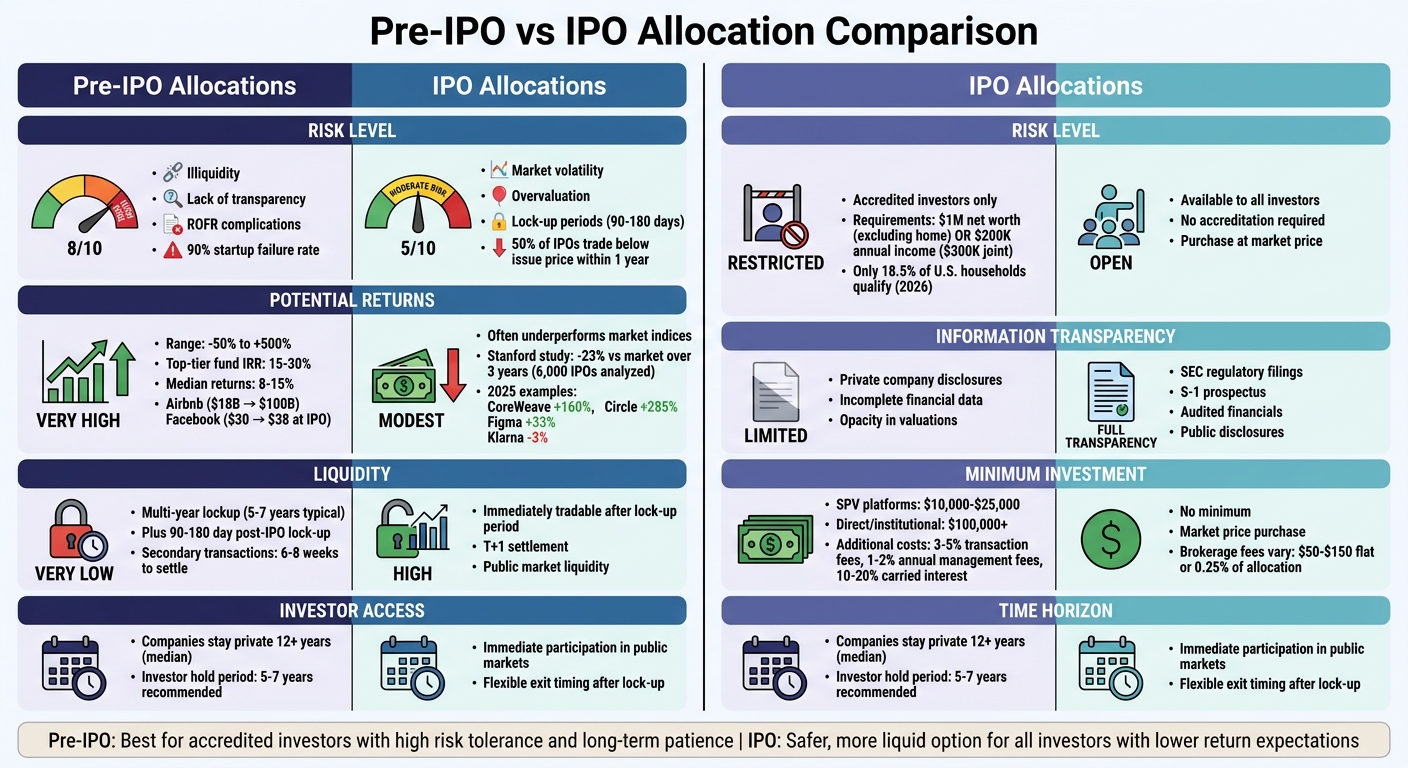
Pre-IPO vs IPO Allocation: Complete Risk-Return Comparison
1. Pre-IPO Allocations
Risk Factors
Pre-IPO investments come with their own set of challenges. One of the biggest concerns is illiquidity – your funds are often tied up for years until the company goes public or is acquired. Even after an IPO, there’s typically a lock-up period of 90 to 180 days when you can’t sell your shares [7][2].
Another hurdle is the lack of financial transparency. Private companies aren’t required to disclose as much information as public companies, leaving investors to make decisions with incomplete data. Take WeWork, for example: its valuation plummeted from $47 billion in early 2019 to just $9 billion by 2021, causing significant losses for investors [7][6].
Investors should also watch out for the Right of First Refusal (ROFR). This clause allows the company or existing shareholders to buy your shares at the agreed price, adding an extra layer of risk to executing sales. Plus, pre-IPO investments are often in common stock, which ranks lowest in the liquidation hierarchy. This means preferred shareholders usually get the lion’s share of proceeds during an exit [3].
Return Potential
While the risks are high, the potential rewards can be massive. Top-tier pre-IPO funds often aim for an Internal Rate of Return (IRR) between 15% and 30%, while median returns hover around 8% to 15%. Secondary shares, depending on timing and valuation, have seen returns ranging from a staggering +500% to losses of –50% [1].
Some standout examples include Airbnb and Facebook. Airbnb’s late-stage investors backed the company at an $18 billion valuation, and by the time it went public in December 2020, its market cap exceeded $100 billion. Similarly, Facebook’s pre-IPO shares were purchased at around $30, debuting at $38 during its 2012 IPO [6].
"The IPO was not the beginning of the Airbnb story – it was the end game, a carefully orchestrated liquidity event designed to allow private investors to monetize positions built over a decade." – AltStreet [5]
The trend is clear: much of a company’s rapid value growth now happens while it’s still private. With companies staying private for an average of over 12 years as of 2025, public investors often miss out on this key growth phase. The secondary market, now exceeding $50 billion annually, reflects this shift, as more investors seek to capture gains during the private stage [5][1].
Liquidity and Accessibility
Accessing pre-IPO deals isn’t for everyone. You typically need to qualify as an Accredited Investor, which means having a net worth of at least $1 million (excluding your primary home) or an annual income of $200,000 ($300,000 if filing jointly). By 2026, about 18.5% of U.S. households meet these criteria, a significant rise from just 2% in the 1980s [3].
Even for those who qualify, hurdles remain. Companies like SpaceX and Stripe impose strict controls on secondary transactions, often requiring approvals and invoking ROFR to adhere to the 2,000-shareholder limit set by the JOBS Act [2].
Special Purpose Vehicles (SPVs) have become a popular way to enter pre-IPO deals. These pooled investment vehicles lower the minimum investment to $10,000–$25,000, compared to $100,000 or more for direct purchases. However, SPVs come with additional costs, such as 3–5% transaction fees, $10,000–$20,000 in setup costs (shared among participants), 1–2% annual management fees, and 10–20% carried interest on profits [3].
Portfolio Strategies
Pre-IPO investments are best viewed as high-risk, satellite holdings rather than core portfolio components. Only invest what you can afford to lose, and expect to hold these investments for 5–7 years [4].
Diversification is crucial. Building a portfolio of 3–5 pre-IPO investments across different sectors can help balance the risk of individual failures – especially considering that around 90% of startups don’t succeed [7].
Before committing, it’s wise to examine the liquidation waterfall to understand how proceeds will be distributed. Comparing private valuations to public benchmarks can also highlight potential overvaluations. Focusing on late-stage companies with solid revenue and backing from reputable institutions can further reduce the likelihood of losses from early-stage failures [3][4].
These strategies highlight the delicate balance between risk and reward in pre-IPO investing. By carefully evaluating opportunities, investors can better navigate this challenging yet potentially rewarding space.
2. IPO Allocations
Risk Factors
Investing in IPO allocations comes with its own set of challenges, distinct from pre-IPO risks. One major issue is overvaluation risk. Companies often go public during favorable market conditions, pricing their shares based on optimistic projections. If market sentiment shifts or the company underperforms in its early quarters, the stock price can quickly dip below the offering price [6].
Another factor to consider is the lock-up period, which typically lasts 90 to 180 days after the IPO. During this time, investors are restricted from selling their shares, leaving them vulnerable to market fluctuations without a way to exit [6,8]. Historical trends show that when these lock-ups expire, share prices often decline by 20–30% as insiders and early investors sell off shares, increasing supply [5].
Statistics underscore the risks: about 50% of IPOs trade below their issue price within a year of listing. A Stanford study analyzing 6,000 IPOs revealed that investors who bought at the open and held for three years lost an average of 23% compared to the broader market [10]. While some IPOs, like Snowflake, saw a 112% jump on their first day, others, such as Rivian, plummeted 50% within three months [10].
"Average long-term IPO returns are often modest and frequently underperform broader market indices on a risk-adjusted basis." – Global Banking & Markets [4]
Return Potential
The performance of IPO allocations varies significantly, as shown by the IPO class of 2025. For example:
- CoreWeave, an AI infrastructure company, went public in March 2025 with a $23 billion valuation. By September 2025, its market cap soared to $59.8 billion. Pre-IPO investors saw returns of +214%, while IPO allocation investors gained +160% [9].
- Circle, a stablecoin provider, listed in June 2025 at an $8 billion valuation. Pre-IPO Series E investors from 2021 enjoyed a +780% return, while IPO allocation investors achieved a +285% gain [9].
- Figma, after an Adobe acquisition fell through, went public in July 2025 at a $19.3 billion valuation. Pre-IPO investors gained +158%, but IPO allocation investors saw a more modest +33% return [9].
Not all IPOs delivered positive outcomes. Take Klarna, which listed in September 2025 at a $15 billion valuation. By the end of that month, its market cap dropped to $14.5 billion. Pre-IPO investors from 2015 recorded a +544% return, but IPO allocation investors faced a -3% loss [9].
These examples illustrate a key point: much of a company’s explosive growth often occurs before it goes public. Companies now stay private for a median of over 12 years, compared to just 5 years in the past, meaning public investors frequently miss out on the early, high-growth phase [5].
Liquidity and Accessibility
One advantage of IPO allocations is immediate liquidity. After the lock-up period ends, shares can be sold in public markets with settlement typically occurring on a T+1 basis. In contrast, pre-IPO secondary transactions can take 6–8 weeks to settle [3].
However, access to IPO allocations is not evenly distributed. Institutional investors are prioritized and often receive discounts of 15–20%. Next in line are brokerage VIP clients, who usually need accounts with at least $250,000. Retail investors, on the other hand, typically buy shares at market price once trading begins [10].
Investors should also account for fees that can eat into returns. For instance, Fidelity charges a $50 flat fee for accounts exceeding $100,000, Vanguard takes 0.25% of the allocation, and Morgan Stanley imposes a $0.005 per share fee along with a $150 flat fee [10].
Portfolio Strategies
IPO allocations are best viewed as high-risk satellite holdings, not core positions in a portfolio. Before investing, it’s essential to examine the company’s S-1 filing, paying close attention to the "Risk Factors" section. Red flags include changes in revenue recognition policies, reliance on a small number of customers, or excessive executive compensation [10]. Tools like EDGAR can help verify whether management has faced SEC investigations or other setbacks.
Timing is another critical aspect. Many seasoned investors wait for "Day 2" opportunities, after the initial hype subsides. Trading volume often drops by about 50% from Day 1, and technical indicators like an RSI below 40 can signal oversold conditions [10].
Setting reminders for lock-up expirations (90–180 days post-IPO) is also a smart move. Share prices often dip 2–4 weeks before insiders are allowed to sell, creating potential buying opportunities. Comparing a company’s customer acquisition costs and burn rate to those of established public competitors can further help assess whether the IPO valuation is reasonable [10].
Pre-IPO investments look exciting, but valuation, liquidity and regulatory risks are often ignored.!
sbb-itb-c5fef17
Pros and Cons
Deciding between pre-IPO and IPO allocations requires a solid grasp of the tradeoffs involved. Each option has its own perks and challenges, which can align differently based on an investor’s risk appetite and financial objectives. Here’s a breakdown to help clarify these distinctions.
Pre-IPO allocations can deliver massive returns by investing in a company during its early, fast-growth phase. However, this comes with strings attached: your capital is tied up until a liquidity event, there’s no guarantee the company will go public, and limited disclosures can make valuation tricky[2][3].
On the other hand, IPO allocations offer greater transparency, and shares can be traded immediately after the lock-up period, providing better liquidity[2][4]. But the returns are often more modest. In fact, roughly 50% of IPOs end up trading below their issue price within the first year[5]. Plus, by the time a company goes public – often after a decade or more of private growth – most of its early explosive gains are already baked into its valuation[5].
Here’s a quick comparison of the two strategies:
| Feature | Pre-IPO Allocation | IPO Allocation |
|---|---|---|
| Risk Level | High; includes potential for total loss and complications from the Right of First Refusal[3] | Moderate; subject to market volatility[4] |
| Potential Returns | Very high; "multi-bagger" potential during a high-growth phase[4] | Modest; often underperforms market indices long-term[5] |
| Liquidity | Very low; involves a multi-year hold plus a 90–180 day lock-up period post-IPO[2] | High; shares become immediately tradable on public exchanges[4] |
| Information Access | Limited; private companies provide fewer disclosures, leading to opacity in financial details[4] | High; regulatory filings and prospectuses ensure transparency[2] |
| Investor Access | Restricted; typically available only to accredited investors (approximately 18.5% of U.S. households)[3] | Open; available to all investors |
| Minimum Investment | $10,000–$25,000 on platforms like EquityZen; $100,000+ on institutional platforms[3] | No minimum requirement; shares are purchased at market price |
"For most portfolios, pre-IPO exposure works best as a satellite, high-risk allocation, not a core holding."
– Global Banking & Markets[4]
Conclusion
Choosing between pre-IPO and IPO investments ultimately comes down to how much risk you’re comfortable taking on and your long-term financial goals. For accredited investors willing to embrace higher risks and extended time horizons, pre-IPO shares can offer a chance to tap into private market growth, potentially delivering higher returns than IPO investments.
That said, pre-IPO investments come with challenges. They often involve long periods of illiquidity, less transparency in financial disclosures, and the reality that about 90% of startups don’t succeed [7]. These investments are best kept as small, high-risk portions of your portfolio rather than central components [4]. If liquidity is a priority, pre-IPO investments might not be the right fit.
On the other hand, IPO allocations are more accessible to a wider range of investors. They offer greater transparency, immediate liquidity, and regulated financial disclosures. With IPO shares, you can trade right away, analyze audited financials, and exit your positions without waiting years for a liquidity event. However, returns tend to be more modest, and nearly half of IPOs trade below their offering price within the first year [5]. By the time a company goes public, much of its rapid growth has already happened in the private market.
For a balanced approach, consider blending a small allocation of late-stage pre-IPO opportunities with IPO investments. This strategy can combine the growth potential of private markets with the stability and liquidity of public markets. Focus on companies backed by reputable institutions, showing improving financial performance, and aiming for an exit within 18 months [8].
The bottom line is to assess your situation honestly. Ensure you meet accreditation requirements [4,18], understand the impact of fees on your returns, and never risk money you might need soon. Whether you lean toward pre-IPO, IPO, or a mix of the two, your investment decisions should reflect your risk tolerance and financial goals to help you build a portfolio that works for you.
FAQs
How do I know if a pre-IPO deal is overpriced?
To determine if a pre-IPO deal might be overpriced, start by comparing the company’s valuation to its most recent funding rounds and the current market environment. Look closely to see if the price being offered is higher than the last preferred funding valuation, which is usually adjusted with a 25%-45% discount to account for illiquidity and risk factors.
Beyond that, thorough due diligence is essential. Dive into the company’s financial health, growth prospects, and valuation metrics. Be on the lookout for red flags like overly optimistic revenue projections or fundamentals that don’t align with the valuation. These can be clear indicators of potential overvaluation.
What’s the best way to manage lock-up and exit timing after an IPO?
Navigating the lock-up period and planning your exit strategy post-IPO takes careful thought to maximize returns and limit market impact. The lock-up period – usually about 180 days – restricts insiders from selling their shares. Once this period ends, selling shares all at once can create unnecessary market volatility.
Instead, consider a gradual approach. Spreading out sales over time can help maintain price stability. Timing your exits around key events like company milestones, earnings announcements, or favorable market trends can also enhance your returns. A steady, disciplined approach to selling is often the most effective way to balance profit and market dynamics.
How much of my portfolio should go to pre-IPO vs IPO?
When deciding how much to allocate to pre-IPO versus IPO investments, it’s crucial to consider your risk tolerance, financial goals, and overall strategy. Pre-IPO investments often come with higher risk but also the potential for greater rewards. Because of this, they’re typically better suited as a smaller, complementary part of a well-diversified portfolio. Many financial experts recommend keeping pre-IPO exposure to about 5–10% of your portfolio, while focusing the majority on more stable, liquid assets like public stocks and bonds.